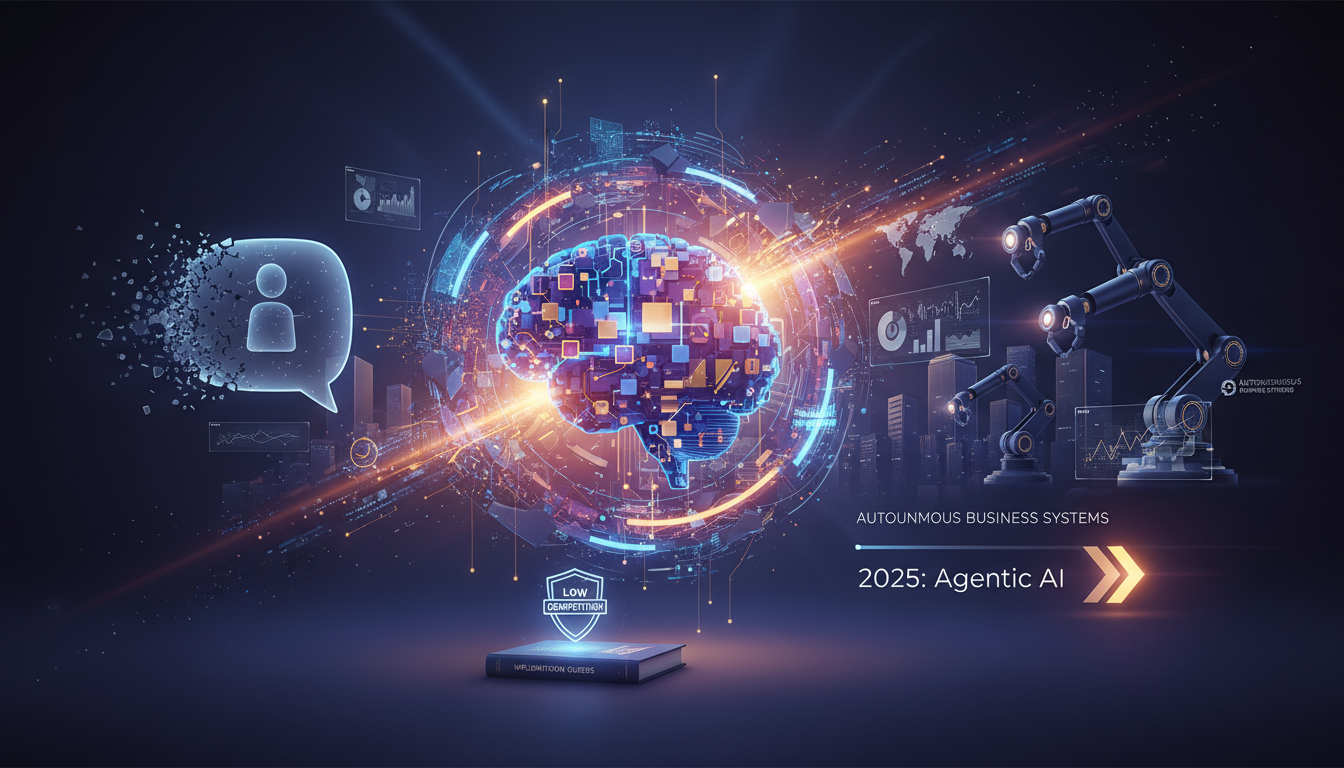

The era of “Chat AI” is rapidly sunsetting. While Generative AI tools like ChatGPT brought the power of Large Language Models (LLMs) to the masses, they came with a significant bottleneck: the human user. They wait for prompts. They require constant guidance. They are reactive, not proactive.
Enter Agentic AI. As we move deeper into 2026, the technology landscape is shifting toward autonomous systems capable of reasoning, planning, and executing complex workflows with minimal human intervention. For businesses, this is not just an upgrade; it is a fundamental operational shift.
This guide utilizes the Semantic SEO framework to explore the top Agentic AI frameworks for business, dissecting the tools that allow enterprises to build autonomous workforces rather than just smarter chatbots.
The Paradigm Shift: From Generative to Agentic AI
To understand the value of Agentic AI frameworks, we must first define the “Agency” in Artificial Intelligence. Traditional Generative AI is a prediction engine—it predicts the next word in a sequence. Agentic AI, however, is a decision engine.
Agentic workflows utilize LLMs as a “brain” to:
- Perceive: Read emails, query databases, or scrape web data.
- Reason: Break down a high-level goal (e.g., “Increase Q3 leads”) into actionable steps.
- Act: Execute code, call APIs, or update CRMs.
- Reflect: Evaluate the output and correct errors autonomously.
For business leaders, this means moving from tools that help you work, to tools that do the work.
Core Components of an Enterprise Agentic Architecture
Before selecting a framework, it is crucial to understand the semantic entities that make up these systems. A robust business agent architecture consists of:
- The Orchestrator: The central logic that manages state and delegates tasks (often built on LangGraph or AutoGen).
- Tools (Function Calling): The capabilities given to the agent, such as access to Salesforce, Google Sheets, or Python code execution environments.
- Memory (Vector Stores): Long-term storage (RAG) that allows agents to recall past interactions and company policies using databases like Pinecone or Weaviate.
- Guardrails: Semantic filters ensuring the agents adhere to brand voice, compliance, and security protocols.
Top Agentic AI Frameworks for Business in 2026
Choosing the right framework depends on your specific business logic, technical maturity, and required scalability. Below are the leading open-source and proprietary frameworks driving enterprise automation today.
1. Microsoft AutoGen: The Multi-Agent Conversation Standard
Best For: Complex problem-solving requiring collaboration between multiple specialized agents.
AutoGen operates on the premise that agents perform better when they collaborate. It enables the creation of multiple agents—for example, a “Coder,” a “Reviewer,” and a “Product Manager”—that converse with each other to solve a task. In a business context, this simulates a digital department.
Key Business Benefit: It excels at code generation and data analysis workflows where error checking is vital. If the “Coder” agent writes a script that fails, the “Executor” agent feeds the error back, and the “Coder” fixes it automatically.
2. LangChain & LangGraph: The Granular Control Engine
Best For: Production-grade applications requiring strict state management and cyclic workflows.
While LangChain popularized the “Chain” (linear steps), LangGraph introduces the concept of a graph (nodes and edges) to agent development. This allows for loops and conditional paths, which are essential for business logic. If an agent tries to book a meeting but finds a conflict, LangGraph allows it to loop back and propose a new time without human input.
Key Business Benefit: It offers the highest level of control over the agent’s cognition, making it ideal for customer support bots that must adhere to strict company policies.
3. CrewAI: Role-Playing Orchestration
Best For: Rapid deployment of process-oriented teams (Marketing, HR, Research).
CrewAI is built on top of LangChain but abstracts the complexity into a focus on “Roles.” You define an agent by its role, goal, and backstory. For example, you can create a “Senior Copywriter” agent and a “Social Media Manager” agent, then assign them a sequential task.
Key Business Benefit: It is highly intuitive for non-technical product managers. Businesses can model their org charts digitally, assigning tasks to specific “crews” of agents.
4. Semantic Kernel (Microsoft): The Enterprise Integrator
Best For: .NET shops and deep integration with the Microsoft 365 ecosystem.
Semantic Kernel is designed to integrate LLMs with existing code (C#, Python, Java) easily. It treats prompts as function calls, making it highly compatible with legacy enterprise systems.
Key Business Benefit: For enterprises already heavily invested in Azure and C#, Semantic Kernel provides the path of least resistance to building agentic capabilities.
Strategic Implementation: How to Deploy Agentic AI
Adopting these frameworks requires a strategic roadmap. Do not start by trying to replace your entire workforce. Follow this semantic clustering of implementation phases:
Phase 1: The Co-Pilot (Human-in-the-Loop)
Deploy agents that draft emails, generate reports, or aggregate data, but require human approval before final execution. Use frameworks like CrewAI for quick wins in content generation.
Phase 2: The Semi-Autonomous (Human-on-the-Loop)
Allow agents to execute low-risk tasks (e.g., scheduling, tier-1 support ticket resolution) autonomously. Use LangGraph to ensure strict adherence to standard operating procedures (SOPs).
Phase 3: The Fully Autonomous (Human-out-of-the-Loop)
Reserve this for high-maturity implementations. Agents manage complex supply chain logistics or dynamic pricing adjustments. Microsoft AutoGen is often used here to create checks and balances between agents to prevent hallucinations.
Challenges and Ethical Considerations
As you integrate these frameworks, you must address the “Black Box” problem. Agentic AI can make decisions that are difficult to trace. Implementation must include:
- Observability: Tools like LangSmith or Arize AI to track agent thought processes.
- Cost Management: Autonomous loops can rack up token costs quickly. Implement strict budget caps on API calls.
- Data Privacy: Ensure your Vector Databases are isolated and compliant with GDPR/CCPA.
Frequently Asked Questions (FAQ)
What is the difference between a Chatbot and an AI Agent?
A chatbot is reactive; it responds to a user’s query with text. An AI Agent is proactive; it uses tools (web search, calculators, APIs) to perform actions and achieve a goal, often without continuous user input.
Which Agentic AI framework is best for small businesses?
CrewAI is generally considered the best starting point for small businesses due to its ease of use, readability, and focus on defining roles rather than writing complex code.
Are Agentic AI frameworks secure for enterprise data?
Security depends on implementation. Frameworks like Semantic Kernel and LangGraph offer robust integration with enterprise security protocols. However, businesses must ensure they use private instances of LLMs (e.g., via Azure OpenAI or Bedrock) rather than public APIs to protect proprietary data.
How much does it cost to build a business agent?
Costs vary based on complexity. A simple CrewAI automation might cost $50/month in API credits. A complex, enterprise-grade AutoGen system integrated with internal databases could run into thousands per month in inference and infrastructure costs.
Conclusion
The transition to Agentic AI represents the maturation of artificial intelligence in the business sector. By leveraging frameworks like AutoGen, LangGraph, and CrewAI, companies can unlock a level of productivity previously thought impossible. The winners of 2026 will not be the companies that just use AI, but those that successfully delegate to it.
Start small, choose the framework that aligns with your technical stack, and focus on automating workflows, not just conversations.