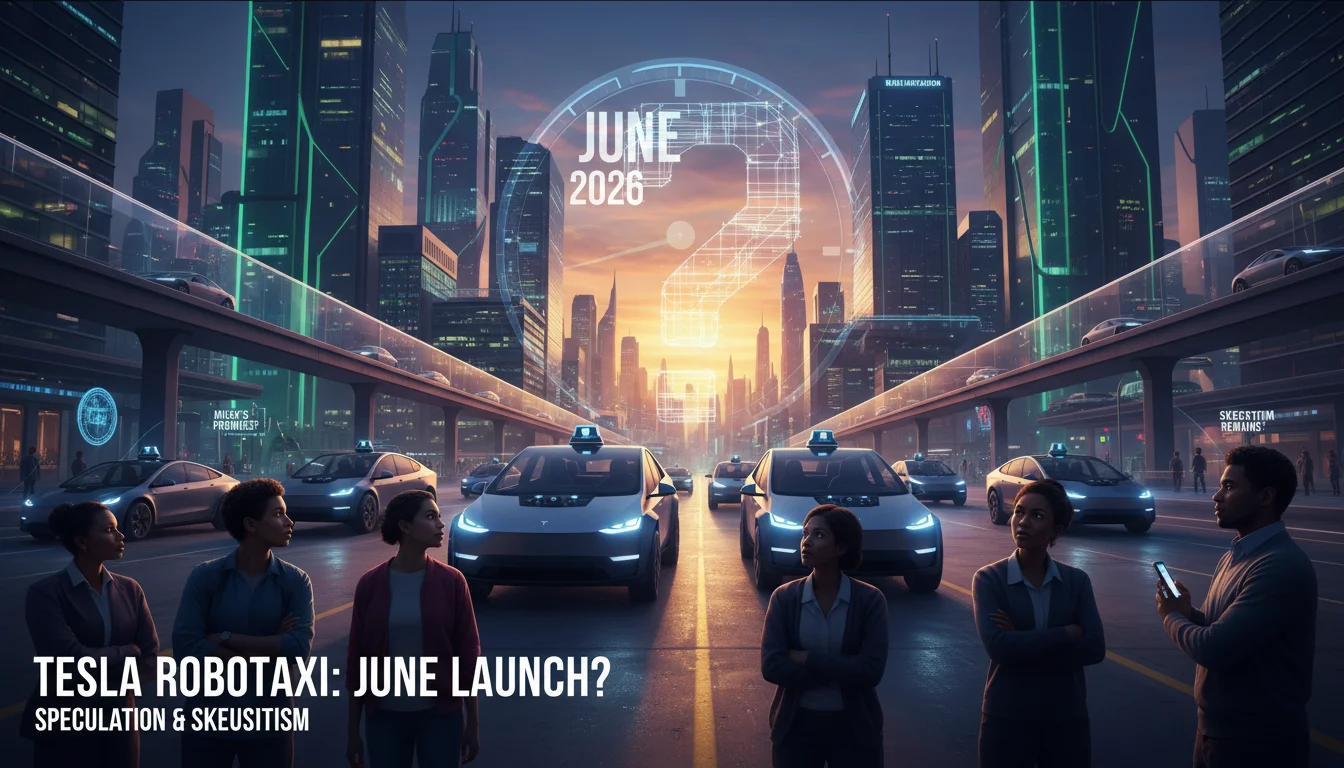

The automotive world is once again buzzing with high-voltage anticipation. Following a turbulent few years of delays and hardware revisions, Elon Musk has reignited the conversation around autonomous transport—much like the anticipation surrounding Neuralink phase 3 human trial updates—with a specific, aggressive timeline. The latest projection? A Tesla Robotaxi service launch in mid-2026, with insiders and analysts pinpointing June 2026 as the critical go-live window for the first public rides.
As we stand in early 2026, the clock is ticking. This isn’t just another product announcement; it is the pivot point for Tesla’s transition from an EV manufacturer to an AI robotics company. This evolution requires the integration of agentic AI frameworks to allow vehicles to make autonomous, real-time decisions without human intervention. But with the ghost of previous missed deadlines lingering, investors and enthusiasts alike are asking: Is the technology actually ready? Will regulators sign off? And can Tesla scale a vehicle with no steering wheel in just a few months?
In this deep dive, we explore the feasibility of the Tesla Robotaxi June launch date, the state of the “Cybercab,” and the regulatory labyrinth standing between Musk and his autonomous dream.
The Significance of the Mid-2026 Timeline
For years, the promise of a “Tesla Network”—where your car earns money for you while you sleep—has been the holy grail of Musk’s master plan. The shift to a hard target of mid-2026 marks a departure from vague “next year” promises. Why is June 2026 the specific focus?
- Production Ramps: The dedicated Cybercab production lines at Giga Texas have reportedly moved from pilot phases to volume testing as of late 2025.
- Software Maturity: FSD (Full Self-Driving) v13 and the emerging v14 neural networks are finally showing the “intervention-free” miles required for Level 4 autonomy in geofenced areas.
- Market Pressure: With Waymo expanding aggressively in Los Angeles, San Francisco, and Phoenix, Tesla risks losing the first-mover advantage in the eyes of the general public if they do not deploy a dedicated robotaxi this year.
The Hardware: Cybercab Reality Check
The vehicle intended to meet this June launch date is the Cybercab, a purpose-built two-seater unveiled in late 2024. Unlike the Model 3 or Model Y, this vehicle lacks a steering wheel and pedals. This design choice is the single biggest gamble in Tesla’s history.
Cost Engineering
To make the economics work, Tesla targets a production cost below $30,000. By removing manual controls, mirrors, and unnecessary structural components required for human drivers, Tesla aims to drive the cost per mile down to roughly $0.20—significantly lower than a bus ticket or a Waymo ride.
The Sensor Suite Debate
Tesla remains committed to a “Vision Only” approach, eschewing LiDAR which competitors argue is essential for safety. The 2026 Cybercab relies on high-definition cameras and the AI inference power of the HW5 (Hardware 5) computer. To protect the integrity of the data processed on-board, Tesla must implement a sophisticated edge computing security architecture to prevent unauthorized access. The success of the June launch depends entirely on whether this camera-based system can handle edge cases—like heavy rain, blinding sun, or erratic human behavior—without the redundancy of laser sensors.
The Software: Is Unsupervised FSD Ready?
The gap between “Supervised FSD” (where you must watch the road) and “Unsupervised FSD” (Robotaxi) is massive. For a June 2026 launch to happen, Tesla must demonstrate to regulators that their system is statistically safer than a human driver by a wide margin.
Recent reports suggest that Tesla’s internal “Miles Per Disengagement” metrics have seen exponential growth since the introduction of end-to-end neural nets. However, the “march of 9s” (getting reliability from 99% to 99.9999%) is notoriously difficult. The mid-2026 target implies that Tesla believes they have solved the final 1% of edge cases, a claim that draws skepticism from safety experts.
Regulatory Roadblocks: The True Launch Date Decider
Even if the cars are built and the software works, the government holds the keys. A vehicle without a steering wheel requires an exemption from the Federal Motor Vehicle Safety Standards (FMVSS). While the NHTSA (National Highway Traffic Safety Administration) has been hesitant, the political landscape in 2026 may favor innovation.
State-by-State Rollout
It is highly probable that the “June Launch” will not be nationwide. Instead, expect a geofenced rollout in friendly jurisdictions:
- Texas: With less restrictive autonomous vehicle laws and Tesla’s HQ in Austin, Texas is the most likely candidate for the inaugural rides.
- California: Despite being Tesla’s engineering home, the CPUC and DMV have strict permitting processes that could delay a California launch beyond June.
- Florida & Nevada: Both states have legal frameworks conducive to autonomous deployment and are likely secondary markets.
The Economics of the Tesla Network
Why is the financial world watching this date so closely? Because it changes Tesla’s valuation model. If the June launch succeeds, Tesla begins to unlock high-margin software revenue.
The Airbnb Model for Cars: Musk’s vision allows private owners to add their Cybercabs to the fleet. Tesla would take a percentage of the revenue (estimated at 25-30%), creating a recurring revenue stream with infinite scalability. This shifts the focus from “how many cars did you sell this quarter?” to “how many miles did your fleet monetize?”
Skepticism vs. Optimism: Weighing the Odds
The Bear Case: Critics argue that June 2026 is just another “aspirational” target. They point to the unresolved issues with FSD in complex urban environments and the lack of a federally approved exemption for steering-wheel-less cars. If the NHTSA denies the petition, the Cybercab cannot legally operate on public roads.
The Bull Case: Supporters argue that the convergence of AI compute power (Dojo supercomputer) and massive real-world data (millions of FSD users) has created a flywheel effect. They believe the technology is ready and that the June date is based on internal confidence, not just hype.
Frequently Asked Questions (FAQ)
Will the Tesla Robotaxi really launch in June 2026?
While June is the targeted timeframe for initial deployment, it will likely start as a limited pilot program in specific cities like Austin, Texas. A widespread national rollout will take much longer.
How much will a ride in a Tesla Robotaxi cost?
Elon Musk has projected costs potentially lower than public transport, aiming for approximately $0.30 to $0.40 per mile for the consumer. This would make it significantly cheaper than Uber or Lyft.
Can I buy a Cybercab for personal use?
Yes, Tesla intends to sell the Cybercab to individuals. However, the initial production batch in 2026 may be reserved for Tesla’s own operated fleet to ensure quality control and safety validation.
Is the Tesla Robotaxi safe without LiDAR?
Tesla argues that its camera-based system, processed by advanced AI, offers superhuman safety by reacting faster than humans and seeing in 360 degrees simultaneously. However, this remains a point of contention among safety advocates.
What happens if the Robotaxi gets into an accident?
In a fully autonomous future, liability shifts from the driver (since there isn’t one) to the operator or manufacturer. Tesla has indicated it would assume liability for accidents caused by system failures in Unsupervised FSD mode.
Conclusion
The Tesla Robotaxi June launch date represents more than just a deadline; it is a litmus test for the future of artificial intelligence in the physical world. If Tesla hits this mid-2026 target, it will disrupt the trillion-dollar transportation industry and validate Elon Musk’s most ambitious gamble yet.
However, the path to June is paved with regulatory red tape and technical hurdles. For investors and tech enthusiasts, the next few months will be critical. Watch for news on NHTSA exemptions and FSD v14 release notes—these will be the true indicators of whether the Cybercab is ready to pick you up this summer.