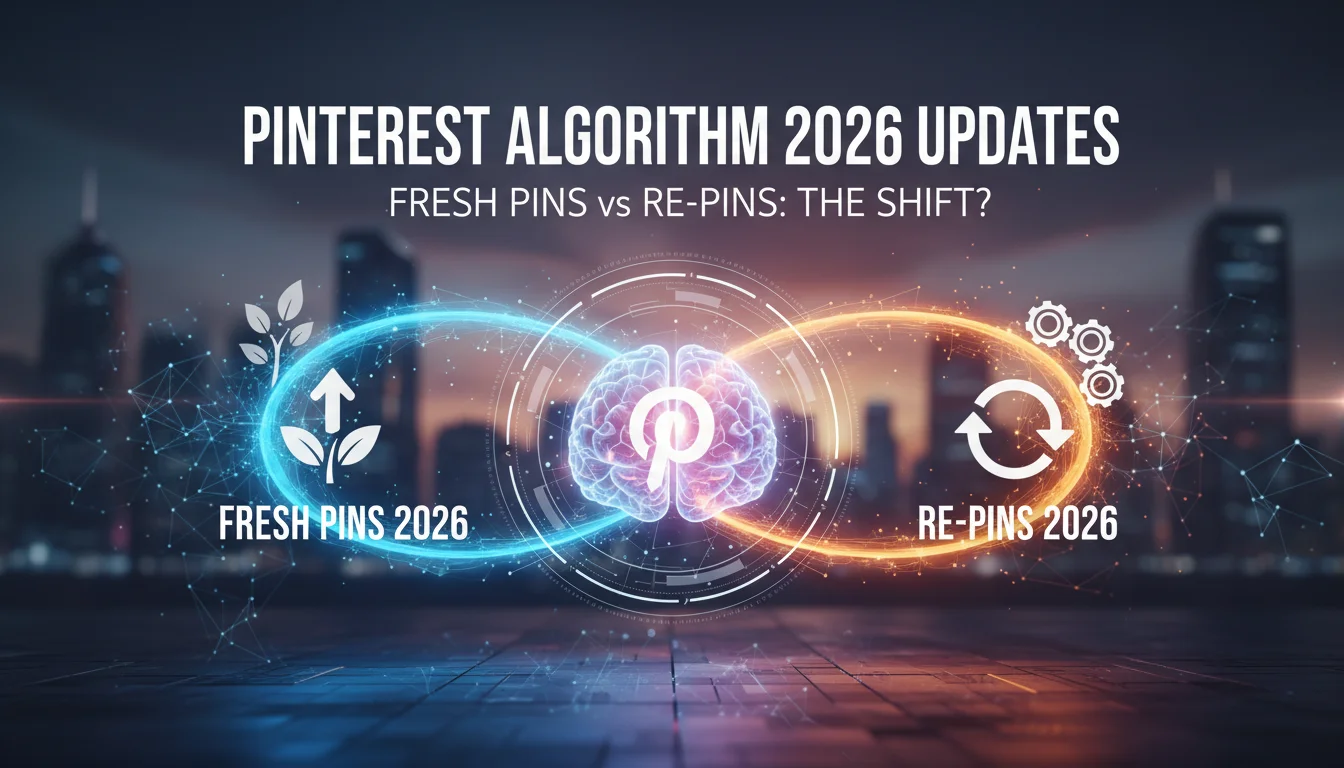

In the rapidly evolving landscape of visual search, the Pinterest Algorithm 2026 updates represent a watershed moment for content creators and marketers. Gone are the days when simple keyword stuffing or mass-producing slightly altered images guaranteed vitality. As we navigate 2026, Pinterest has solidified its identity not just as a social media platform, but as a sophisticated Semantic Visual Discovery Engine. To stay ahead, many creators now align their aesthetic choices with the latest Pinterest predicts trends to ensure their content resonates with projected user interests.
For years, the industry has debated the efficiency of “Fresh Pins” versus the viral potential of “Repins.” This year, the algorithm has finally provided a clear answer, though it is not the one most marketers expected. This guide uses the Koray Framework of Semantic SEO to deconstruct these changes, offering a high-authority roadmap to aligning your content strategy with Pinterest’s new ranking factors.
The Core Shift: From Volume to Contextual Originality
To understand the 2026 update, we must first look at the trajectory of the platform. Previously, Pinterest prioritized “Fresh Pins”—images that the system had not seen before—to keep the user experience novel. However, by late 2025, this led to a saturation of low-quality, template-generated content that offered little value.
The 2026 Algorithm Update introduces a metric we call Contextual Originality. It is no longer enough for an image to have a unique file hash or a different background color. The AI now analyzes the semantic value of the image contents.
- Visual Semantics: Does the image add new visual information to the topic?
- Entity Recognition: Can the algorithm identify distinct products, styles, or solutions within the pin?
- Text Overlay Consistency: Does the text on the image semantically match the description and the destination URL?
Fresh Pins vs. Repins: The 2026 Verdict
The specific informational gap plaguing the industry is the weight of Fresh Pins versus Repins. Here is the technical breakdown of how the 2026 algorithm treats them.
1. The Evolution of ‘Fresh Pins’
In 2026, a “Fresh Pin” is redefined. It requires New Visual Data + New Value Proposition. The algorithm penalizes “churning”—the act of uploading the same image with minor tweaks. To rank a Fresh Pin in 2026, it must serve a distinct intent.
The Strategy: Focus on creating variations that highlight different angles, use cases, or aesthetic contexts of the same subject. If you are pinning a recipe, one pin should focus on the finished dish, another on the ingredients, and a third on the serving suggestion. This satisfies the algorithm’s need for visual diversity without spamming.
2. The Resurrection of Repins (With a Catch)
For years, Repins (saving others’ content) were seen as a passive activity with zero ROI for the pinner. The 2026 update changes this via Curator Authority. While repinning does not give you the same traffic spikes as a viral original pin, it now contributes heavily to your Account Quality Score.
Pinterest now profiles accounts as “Expert Curators.” If you consistently repin high-performing, topically relevant content alongside your original content, the algorithm trusts your account more. This trust flows back to your original pins, giving them a faster initial boost in the Smart Feed. However, repinning your own content repeatedly is now strictly demonetized by the algorithm and can lead to shadowbanning.
Semantic SEO for Pinterest: Ranking Factors in 2026
Applying Semantic SEO principles to Pinterest is crucial for staying ahead. The algorithm acts similarly to Google’s Knowledge Graph, connecting nodes (Pins) with edges (User Interactions and Topics).
Entity Association and Board Logic
Your Pinterest Boards are the “topic clusters” of your profile. In 2026, the algorithm places immense weight on the semantic closeness between a Pin and the Board it lives on. A generic board named “Food” will dilute the ranking potential of a “Keto Avocado Toast” pin. Instead, a board named “Low Carb Breakfast Ideas” creates a tighter semantic match, signaling higher relevance to the AI.
The ‘pSEO’ Description Technique
Descriptions in 2026 must go beyond keywords. They must answer user queries. Using Natural Language Processing (NLP) friendly structures helps the AI index your content for specific queries.
Example: Instead of just “Summer Outfit Fashion,” use “A sustainable summer outfit idea featuring linen trousers and neutral tones, perfect for beach vacations in 2026.” This captures entities like ‘sustainable,’ ‘linen,’ ‘neutral,’ and ‘vacation,’ widening the net for visual search matches.
User Engagement Signals: The ‘Dwell’ Metric
Click-through rate (CTR) remains important, but the 2026 algorithm heavily weights Visual Dwell Time and Close-ups. If a user clicks to expand your pin and stays on it to read the overlay text or zoom in, Pinterest records this as a positive satisfaction signal.
Actionable Tactics for High Engagement:
- High-Resolution Vertical Assets: Aspect ratios of 2:3 remain standard, but higher pixel density is favored by the ‘Lens’ feature.
- Readable Text Overlays: AI OCR (Optical Character Recognition) reads your image text. Ensure it is legible and contains your primary keywords.
- Video Pins for Retention: Short-form video is prioritized in the “Watch” tab. If you are creating software tutorials or digital walkthroughs, learning how to screen record on Mac is an essential skill for producing crisp, engaging video assets.
Algorithm Penalties to Avoid
To maintain a healthy Account Quality Score, avoid these practices that the 2026 update explicitly targets:
- Pin Looping: Using automated tools to repost the same pin every few days.
- Broken Links: The algorithm checks destination URLs in real-time. 404s result in immediate demotion of the specific pin.
- Irrelevant Boarding: Pinning a tech gadget to a “Home Decor” board confuses the semantic engine and lowers trust.
FAQ: Navigating the 2026 Pinterest Landscape
Does the 2026 algorithm prefer video or static images?
The 2026 algorithm seeks a balance. Video pins receive higher impression volumes in the discovery feeds, while static images generally drive higher click-through rates (outbound clicks). A healthy profile strategy should aim for a 30/70 split between video and static content.
How often should I pin in 2026?
Consistency beats volume. The “20+ pins a day” strategy is obsolete. In 2026, 3 to 5 high-quality, contextually original pins per day perform better than mass-produced spam. This aligns with the ‘Fresh Pin’ quality over quantity update.
Do hashtags still work on Pinterest in 2026?
Hashtags have largely been deprecated in favor of keyword-rich descriptions and semantic context. Focusing on long-form, descriptive text is more effective; using top AI voice typing apps can help creators quickly dictate detailed, natural-sounding descriptions that the algorithm favors.
Is ‘Fresh Pins’ just about the image?
No. In 2026, a Fresh Pin is a unique combination of Image + URL + Description. However, the visual component is the strongest signal. Changing the URL on an old image does not count as a Fresh Pin anymore.
Conclusion
The Pinterest Algorithm 2026 updates demand a shift from mechanical automation to strategic, semantic content creation. The debate between Fresh Pins and Repins is settled: Fresh Pins drive distribution, while strategic Repins build Curator Authority. By understanding the nuances of Contextual Originality and optimizing for semantic entities rather than just keywords, creators can leverage Pinterest as a massive engine for organic traffic.
Success in 2026 requires viewing Pinterest not as a social network, but as a visual database where your content serves as the answer to a user’s visual query. Adapt your strategy to feed this engine high-quality, distinct data, and your visibility will scale sustainably.