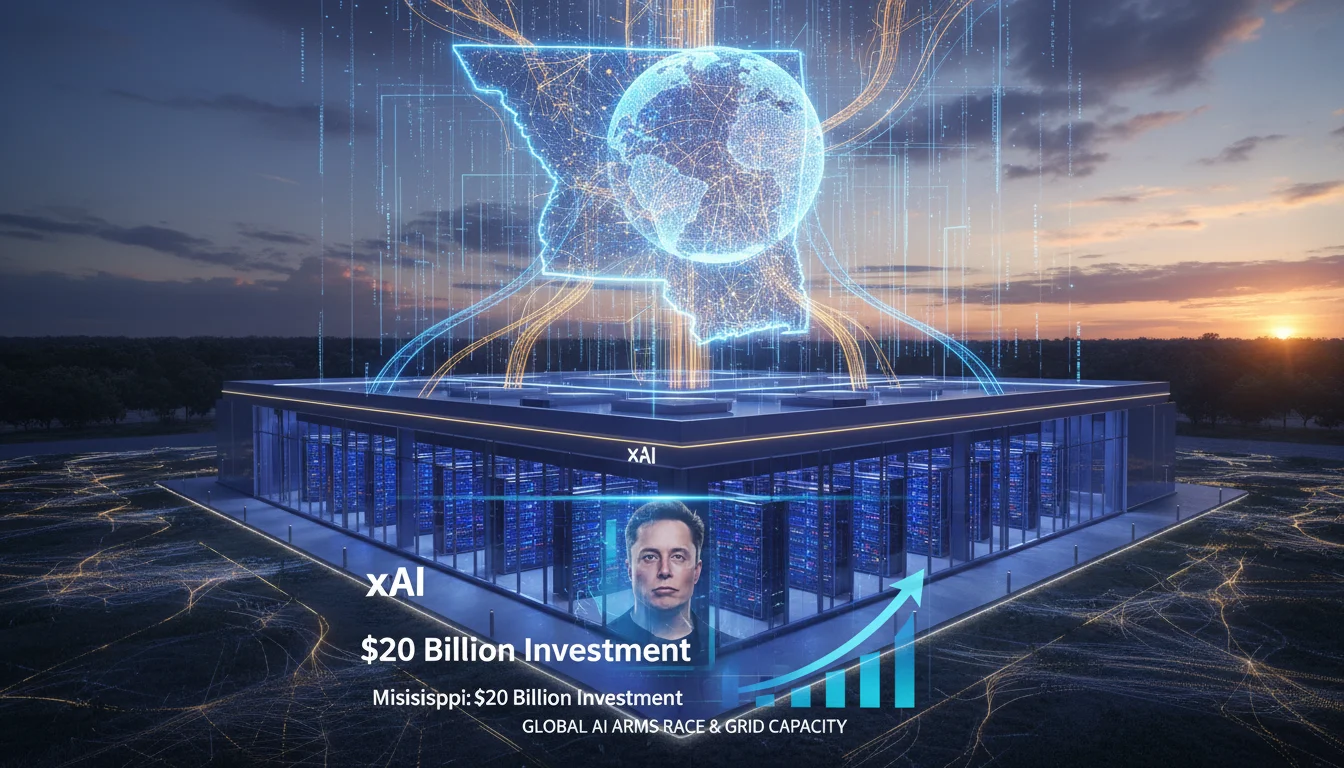

In a move that has sent shockwaves through the tech world and the Deep South alike, Elon Musk’s artificial intelligence company, xAI, has officially announced a staggering $20 billion investment to build a massive data center in Southaven, Mississippi. Dubbed MACROHARDRR, this facility represents not just the largest private investment in the state’s history, but a pivotal moment in the global "AI arms race."
While state officials are celebrating the economic windfall, local residents and industry experts are asking critical questions: What will be the real-world xAI Mississippi data center impact on the local economy, the power grid, and the daily lives of Southaven residents? This post breaks down the details of this mega-project and what it signals for the future of AI infrastructure.
The Economic Boom: Jobs and Revenue in DeSoto County
The headline figure is hard to ignore: $20 billion. To put that in perspective, this single investment dwarfs the GDP of many small nations. Governor Tate Reeves has championed the project as a game-changer for Mississippi, promising that it will cement the state’s status as a burgeoning tech hub.
- Job Creation: The project is expected to create hundreds of high-paying permanent jobs in engineering, facility management, and security, alongside thousands of temporary construction roles as the 810,000-square-foot facility is retrofitted.
- Tax Revenue: Despite tax incentives typically offered to attract such giants, the sheer scale of the operation is expected to generate significant indirect revenue for Southaven and DeSoto County through increased property values and local commerce.
The Grid Capacity Challenge: Can the Power Hold?
The most contentious aspect of the xAI Mississippi data center impact lies in its colossal energy appetite. The facility is aiming for nearly 2 gigawatts (GW) of computing power. For context, 2 GW is roughly the output of two standard nuclear reactor units and is enough to power approximately 1.5 million homes.
This massive demand raises serious questions about grid stability in a region where extreme weather already tests infrastructure resilience. Unlike the facility in nearby Memphis, which faced scrutiny for using unpermitted gas turbines to bridge power gaps, the Southaven site is reportedly being developed in proximity to a newly acquired power plant site. This suggests xAI plans to be somewhat self-reliant, potentially mitigating strain on the public grid—though environmental groups remain wary of the emissions associated with gas-fired backup generation.
Southaven vs. Memphis: The Emerging AI Cluster
The Southaven facility isn’t operating in isolation. It is part of a growing "compute cluster" straddling the Tennessee-Mississippi border, joining the "Colossus" supercomputer in Memphis. This geographic concentration allows xAI to leverage the region’s logistics infrastructure while diversifying its regulatory risks across two states.
For Southaven, this means the city is no longer just a suburb of Memphis but a key player in the Silicon Valley supply chain. However, it also means the area effectively becomes a testbed for the environmental and infrastructural limits of AI scaling.
What’s Next for Residents?
As construction ramps up for a target operational date in early 2026, Southaven residents should expect rapid changes. The xAI Mississippi data center impact will likely include:
- Infrastructure Upgrades: Accelerated improvements to local roads and utilities to support the tech giant.
- Noise and Environmental Concerns: Continued debates over noise pollution (a major complaint at the Memphis site) and water usage for cooling systems.
- Real Estate Shifts: A potential rise in housing demand as tech workers migrate to the area.
Elon Musk’s bet on Mississippi is a high-stakes gamble that could transform Southaven into a modern tech fortress. As MACROHARDRR comes online, the world will be watching to see if the local grid—and the local community—can handle the load.