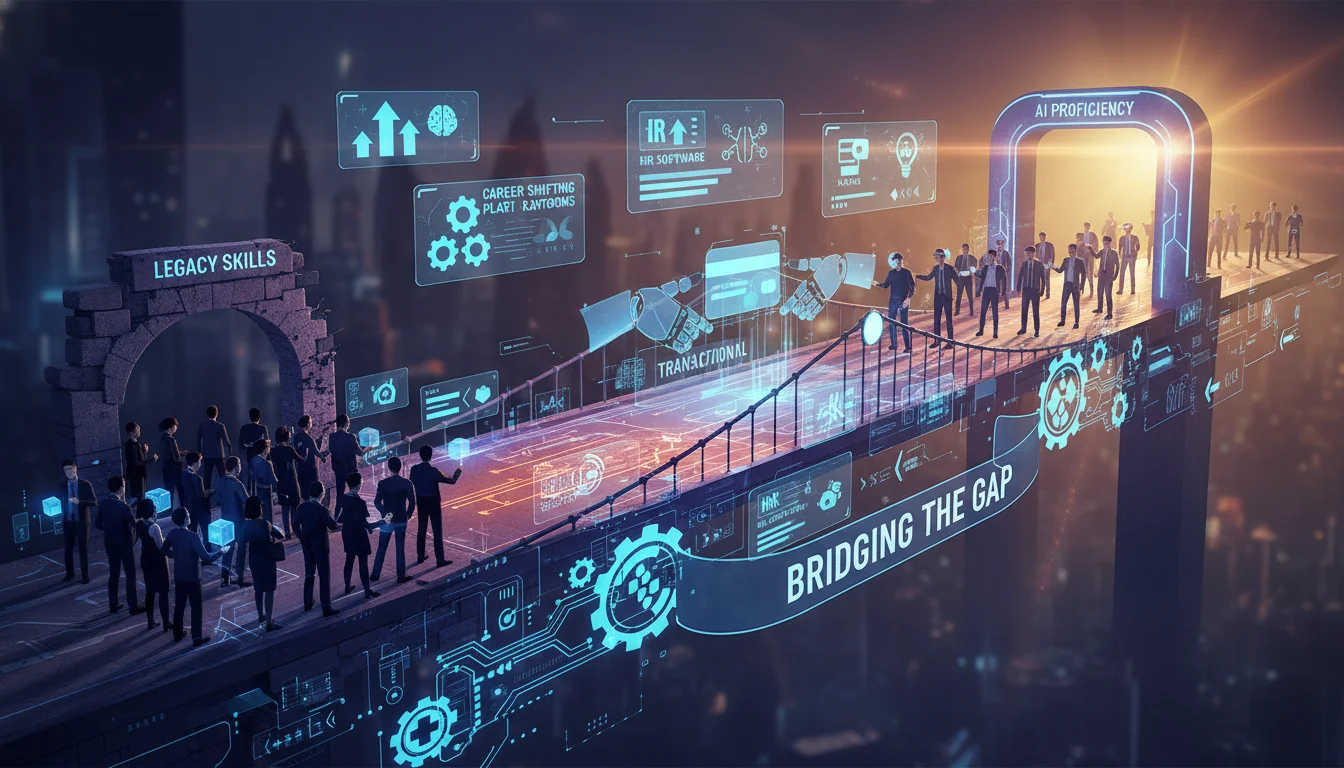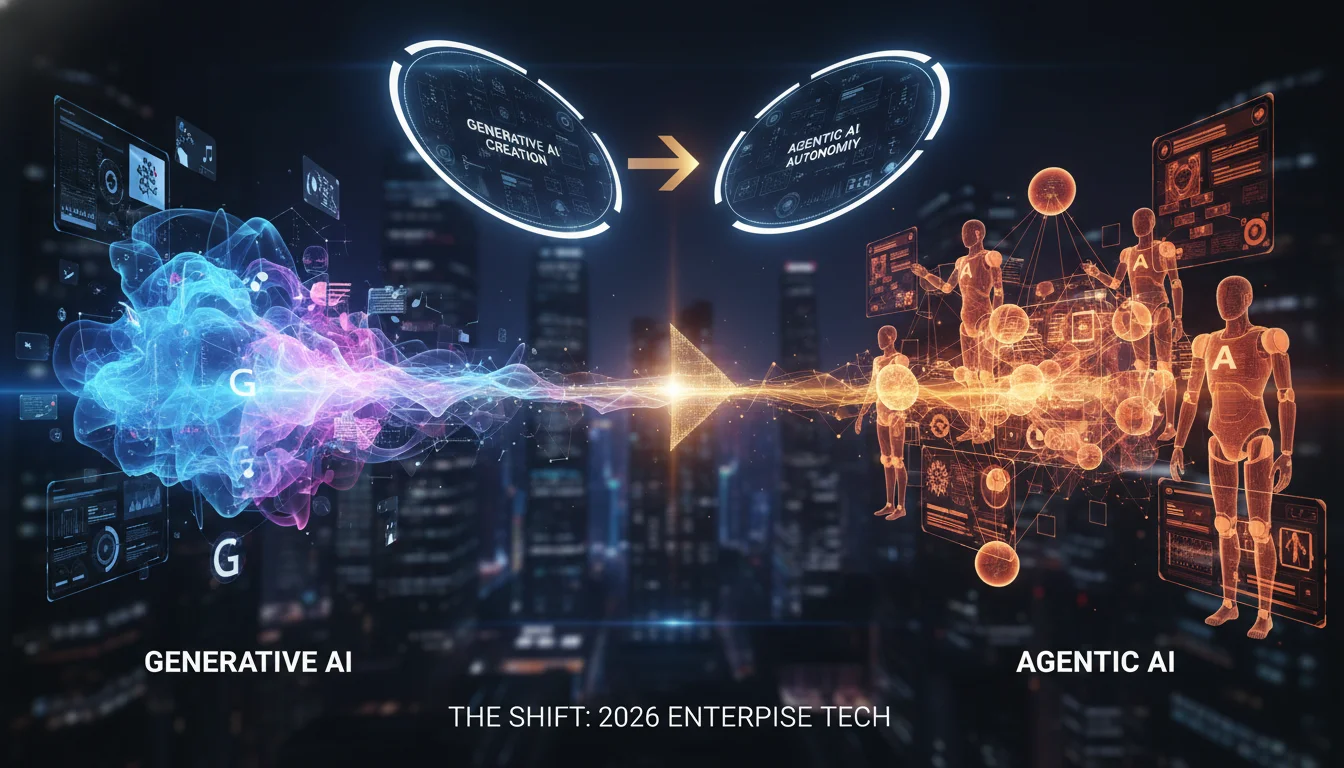

If 2023 was the year the world discovered it could talk to machines, and 2024 was the year we learned to generate content at scale, 2026 is the year the machines started doing the work. The conversation in boardrooms has shifted dramatically. The question is no longer “How can we use AI to draft emails?” but rather “How can we deploy an agentic workforce to manage the entire supply chain?”
For enterprise leaders, distinguishing between Generative AI and Agentic AI is not just a semantic exercise—it is the defining competitive advantage of the next decade. While Generative AI (GenAI) revolutionized creativity and information retrieval, Agentic AI is revolutionizing execution.
This comprehensive guide utilizes semantic analysis to break down the technical and functional differences between these two paradigms, exploring why the industry is pivoting toward autonomous agents and how your organization can prepare for the agentic future.
Defining the Core Concepts: Semantics and Function
To understand the shift, we must first define the entities. The confusion often stems from the fact that Agentic AI usually relies on Generative AI as its “brain.” However, their functions in a business context are distinct.
What is Generative AI? (The Creator)
Generative AI refers to deep learning models—primarily Large Language Models (LLMs) and diffusion models—designed to generate new data that resembles the training data. It is probabilistic in nature, predicting the next token, pixel, or audio wave based on a specific input (prompt).
- Core Function: Creation and Synthesis.
- Interaction Model: Transactional (Human prompts → AI outputs).
- Limitation: It is passive. A GenAI model generates a marketing strategy, but it cannot post the ads, track the analytics, or adjust the budget based on performance without human intervention.
What is Agentic AI? (The Doer)
Agentic AI refers to systems that act as autonomous agents capable of perceiving their environment, reasoning about how to achieve a specific goal, and executing actions via tools (APIs) to achieve that goal. Agentic systems utilize LLMs for reasoning but wrap them in a control loop that allows for planning, memory, and self-correction.
- Core Function: Decision Making and Execution.
- Interaction Model: Goal-Oriented (Human sets goal → AI iterates until completion).
- Key Differentiator: Agency. It has the authority to use tools—browsers, code interpreters, CRMs—to change the state of the world.
Agentic AI vs Generative AI: 5 Critical Differences
For IT decision-makers and CTOs, understanding the architectural divergence is key to selecting the right stack.
1. Passive Output vs. Active Loops
Generative AI is linear. You provide an input; it provides an output. It is a “feed-forward” process. Agentic AI operates in a loop (often referred to as an OODA loop: Observe, Orient, Decide, Act). It assesses the current state, plans a step, executes it, observes the result, and if the result isn’t what was expected, it corrects its own course. This iterative reasoning allows agents to solve complex, multi-step problems that would stump a standard LLM.
2. Tool Use and Integration
A standard ChatGPT session (GenAI) is trapped within its context window. It knows what it was trained on. Agentic AI is defined by its ability to interface with the outside world. Through function calling and API integrations, an agent can query a SQL database, send a Slack message, deploy code to a staging server, or update a Salesforce record. GenAI suggests the code; Agentic AI runs the code and fixes the errors.
3. Memory and State Management
Generative AI sessions are typically stateless or limited to the immediate conversation history. Agentic AI requires robust long-term memory (often using vector databases like Pinecone or Weaviate) to maintain the state of a project over days or weeks. An autonomous billing agent remembers that it emailed a client on Tuesday and knows to follow up on Friday if no payment is received, without a human reminding it.
4. The Human-in-the-Loop Dynamic
With GenAI, the human is the pilot. The AI is the co-pilot. The human drives every step of the creation process. With Agentic AI, the human moves to a supervisory role—the “human-on-the-loop.” You define the parameters and the definition of done (DoD), and the agent executes autonomously, only asking for help if it encounters a critical error or requires authorization.
5. Probabilistic vs. Deterministic Outcomes
While the “brain” of an agent is probabilistic (the LLM), the actions are often deterministic. When an agent executes a Python script to calculate payroll, the math is exact. Agentic workflows combine the creativity of GenAI with the precision of traditional software automation (RPA), bridging the gap between “guessing” and “knowing.”
Why 2026 is the Year of the Agentic Workforce
Why is this trending now? Several technological convergences have matured in 2026 to make this possible:
- Cost of Intelligence: The cost per million tokens for reasoning models has plummeted, making it economically viable to have agents run “loops” (thinking thousands of times per task) without bankrupting the IT budget.
- Reasoning Capabilities: New model architectures (System 2 thinking) allow agents to plan further ahead without hallucinating or losing the plot.
- Standardized Agent Protocols: The rise of the Agent Protocol and standardized interface layers implies that agents from different vendors (e.g., a Sales Agent and a Legal Agent) can now communicate and collaborate in multi-agent swarms to close deals.
Strategic Implementation: Moving from Chatbots to Agents
Deploying Agentic AI requires a different readiness assessment than deploying GenAI.
Identify High-Friction, Multi-Step Workflows
Don’t use agents for writing blog posts; use them for SEO auditing. Don’t use them for writing code snippets; use them for refactoring entire codebases. Look for processes that require:
1. Access to multiple software tools.
2. Decision trees based on variable data.
3. Persistent follow-up.
Governance and Guardrails
Autonomy introduces risk. If an agent can send emails, it can send wrong emails. Enterprise agentic frameworks in 2026 prioritize “Guardrail Layers”—deterministic code that validates agent actions before they are executed. Never deploy an agent without a strict permission set.
Frequently Asked Questions (FAQ)
Is Agentic AI the same as AGI (Artificial General Intelligence)?
No. Agentic AI is capable of autonomous action within a specific domain or set of tools, but it lacks the general consciousness or adaptability of theoretical AGI. It is, however, a significant step closer to AGI than static GenAI.
Does Agentic AI replace Robotic Process Automation (RPA)?
It evolves it. RPA is brittle; if a button moves on a website, the bot breaks. Agentic AI uses vision and reasoning to adapt to changes in the UI or process flow. It is “resilient automation.”
What are the risks of Agentic AI?
The primary risks are compounding errors (an agent making a mistake and then basing future actions on that mistake) and unauthorized resource usage. Strict monitoring and “human-in-the-loop” authorization for high-stakes actions are essential.
Can small businesses use Agentic AI?
Absolutely. By 2026, “Agent-as-a-Service” (AaaS) platforms allow SMBs to hire virtual AI marketing managers or supply chain analysts for a monthly subscription, leveling the playing field with large enterprises.
Conclusion: The Outcome Economy
The transition from Generative AI to Agentic AI marks the shift from an Output Economy to an Outcome Economy. We are no longer paying for the words, the code, or the images. We are investing in the results—the booked meeting, the deployed feature, the reconciled ledger.
For business leaders, the mandate is clear: Stop building better prompters and start building better managers. The workforce of the future is hybrid, and the agents are ready to work.