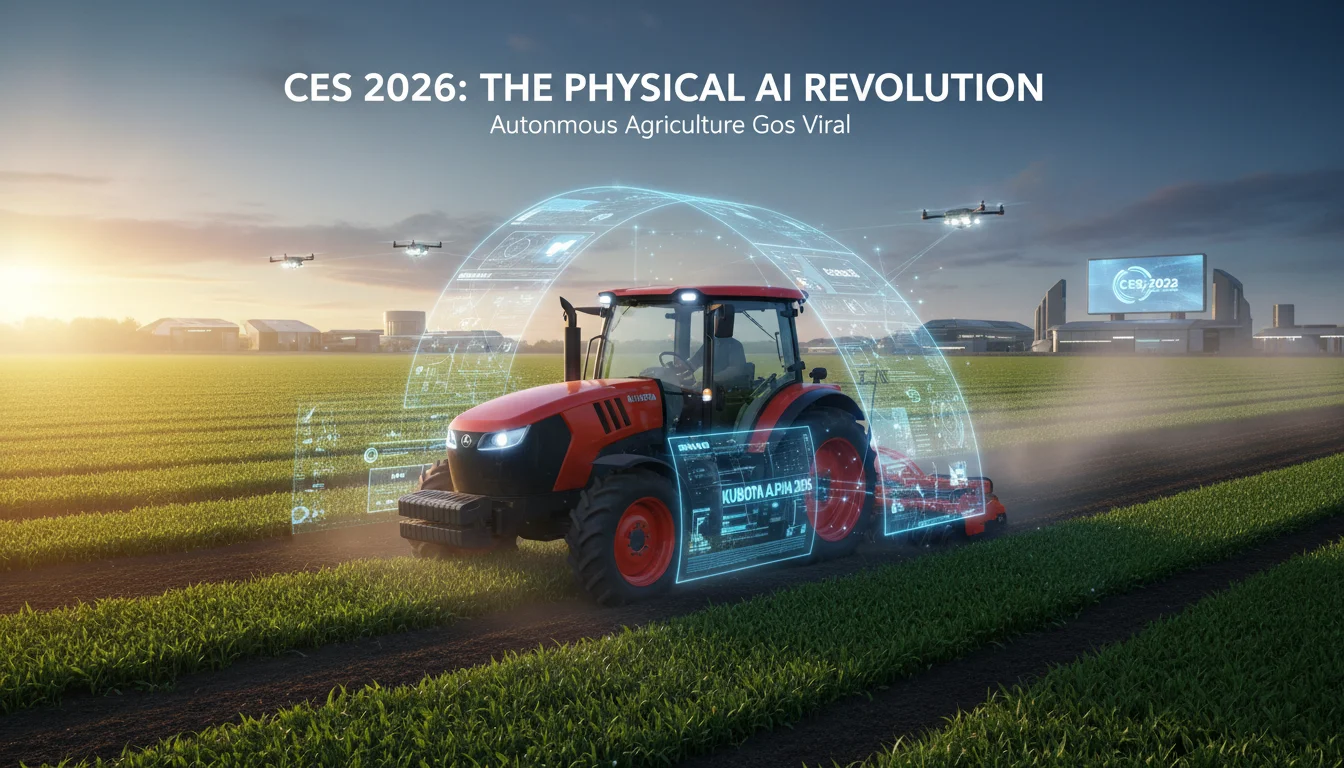

The agricultural landscape is undergoing a seismic shift in 2026, driven by the convergence of heavy machinery and advanced computation. At CES 2026, Kubota unveiled a suite of autonomous solutions that signal a move from concept to commercial reality. This article explores Kubota’s “Physical AI” innovations, focusing on the autonomous M5 Narrow tractor and the versatile KVPR robot.
What is the Kubota M5 Narrow Autonomous Tractor?
The Kubota M5 Narrow is a 105.7-horsepower diesel tractor equipped with a fully integrated autonomous driving system designed specifically for vineyards and orchards. Developed in partnership with Agtonomy, it combines traditional diesel power with advanced edge computing to perform complex tasks without human intervention.
Unlike previous concept models that were purely electric or strictly prototypes, the M5 Narrow is a commercial-ready solution tackling immediate industry pain points. It addresses the critical labor shortage in specialty crop farming by automating repetitive tasks like mowing, spraying, and harrowing in tight rows.
- Engine Power: 105.7 HP Diesel engine for sustained high-torque operations.
- Navigation: Lidar and camera fusion for obstacle detection and row tracking.
- Connectivity: Real-time telematics for remote monitoring via smartphone app.
- Application: Optimized for high-value crops like wine grapes, apples, and nuts.
How Does Kubota’s KVPR ‘Transformer’ Robot Work?
The Kubota KVPR (Concept Versatile Platform Robot) is a four-wheeled, electric autonomous vehicle that physically transforms its shape to suit different agricultural tasks. By adjusting its ground clearance, tread width, and wheelbase, the KVPR can replace multiple specialized machines on a single farm.
Nicknamed the “Transformer,” this robot represents the pinnacle of Kubota’s “Physical AI” strategy. It is not just a tractor; it is a modular platform. The independent wheel motors allow for crab steering and zero-radius turns, making it exceptionally maneuverable in confined spaces. The KVPR eliminates the need for a separate tractor, sprayer, and hauler by adapting its chassis to the implement attached.
What Is Physical AI in Agriculture?
Physical AI refers to the integration of artificial intelligence directly into the hardware of agricultural machinery, allowing for real-time decision-making on the edge without relying on cloud connectivity. For Kubota, this means machines can instantly recognize obstacles, analyze crop health, and adjust operations millisecond-by-millisecond.
In the context of CES 2026, Physical AI is the differentiator between a remote-controlled toy and a professional farming tool. The M5 Narrow and KVPR process data locally. If a person walks in front of the tractor, it stops immediately—not because a server miles away sent a signal, but because the on-board AI perceived the threat directly. This latency-free response is critical for safety and efficiency, and staying informed via a 2026 security update is also vital for protecting such high-tech connected hardware.
Why Did the Kubota KATR Win a CES Innovation Award?
The Kubota KATR is a four-wheeled robot designed with a self-leveling cargo deck that remains stable even when traversing steep slopes or uneven terrain. It won the CES 2026 Best of Innovation Award for its unique ability to transport heavy loads in hilly environments where traditional vehicles would tip over.
The KATR features four articulating legs that extend and retract hydraulically to keep the center of gravity low and the payload level. This capability is essential for mountain agriculture, such as hillside vineyards in Japan or Europe, where automation has historically been impossible due to dangerous terrain.
- Stability: Active self-leveling suspension system.
- Payload: Designed to carry up to 240 kg (approx. 529 lbs).
- Power Source: Available in both electric and combustion engine variants.
- Control: Operable via remote control or onboard joystick.
What Are the Specs of the Kubota M5 Narrow Autonomous System?
The M5 Narrow autonomous system features a comprehensive sensor suite including 360-degree cameras, Lidar, and ultrasonic sensors powered by Agtonomy’s Teleo-Supervised Autonomy software. These are among the important tools and software features that allow for “teach and repeat” operations where an operator drives a path once, and the tractor repeats it indefinitely.
The integration is deep; this is not an aftermarket kit bolted onto a steering wheel. The software controls the transmission, hydraulics, and PTO (Power Take-Off). This allows the tractor to automatically disengage implements at the end of a row, make a three-point turn, and re-engage the implement for the next pass, all while maintaining precise RPMs for optimal fuel efficiency.
How Does the M5 Narrow Solve Labor Shortages?
The M5 Narrow solves labor shortages by allowing a single operator to manage a fleet of tractors simultaneously from a tablet, rather than sitting in the cab of just one. This force-multiplication effect drastically reduces the man-hours required for routine field operations.
With the average age of farmers rising globally and fewer young workers entering the sector, “force multiplication” is a survival necessity. A vineyard manager can deploy three M5 units to mow different blocks and monitor their progress from the office. However, managing these digital platforms requires awareness of common cybersecurity challenges faced by small businesses in the agricultural sector today.
Is the Kubota M5 Narrow Electric or Diesel?
The commercially available Kubota M5 Narrow is powered by a diesel engine, whereas the concept KVPR and KATR models feature electric powertrains. Kubota prioritizes diesel for the M5 to ensure it has the runtime and torque density required for immediate adoption in heavy-duty agricultural workflows.
While electrification is the long-term goal, current battery technology struggles to provide the 10+ hours of continuous high-load operation needed during harvest seasons. By using a diesel powertrain with autonomous control, Kubota offers a bridge technology: the efficiency of robotics with the reliability and refueling infrastructure of traditional diesel equipment.
What Is the Difference Between Kubota KATR and KVPR?
The KATR is a specialized stability robot for uneven terrain and logistics, while the KVPR is a multi-purpose field robot designed to replace a tractor for crop management tasks. KATR focuses on hauling and stability on slopes; KVPR focuses on versatility and shape-shifting for different row widths.
Think of the KATR as a robotic “pack mule” that can go anywhere, ensuring supplies get to hard-to-reach areas. The KVPR is a “Swiss Army Knife,” transforming its physical structure to spray, seed, or harvest depending on the attachment. Both share the same underlying Physical AI architecture but serve distinct operational roles on the farm.
FAQ
When will the Kubota autonomous tractor be available?
The Kubota M5 Narrow autonomous tractor is commercially available now for select markets, specifically targeting vineyard and orchard operations in North America. The KVPR and KATR are currently concept and pre-production models, respectively.
Does the Kubota M5 Narrow require GPS?
Yes, the M5 Narrow utilizes high-precision GPS (RTK) combined with local vision sensors (Lidar/Cameras) to navigate. This fusion ensures that if the GPS signal is temporarily lost under tree canopies, the visual sensors can maintain safe operation.
Can the Kubota KVPR drive on public roads?
Current regulations generally prohibit fully autonomous vehicles like the KVPR from operating on public roads without a human operator. Its design is primarily for off-road agricultural environments within private farmland boundaries.
What is the price of the Kubota M5 autonomous tractor?
Pricing for the autonomous M5 Narrow varies based on dealer configurations and software subscription packages. Interested buyers should contact local Kubota dealerships for specific quotes, as the autonomous tech stack is often sold as an integrated premium feature.
Conclusion
Kubota’s showing at CES 2026 demonstrates that the future of farming is not just about bigger machines, but smarter ones. By leveraging Physical AI, the M5 Narrow, KVPR, and KATR offer practical, immediate solutions to the labor crisis. For modern farmers, these tools are no longer science fiction—they are the new standard for operational efficiency and sustainability.