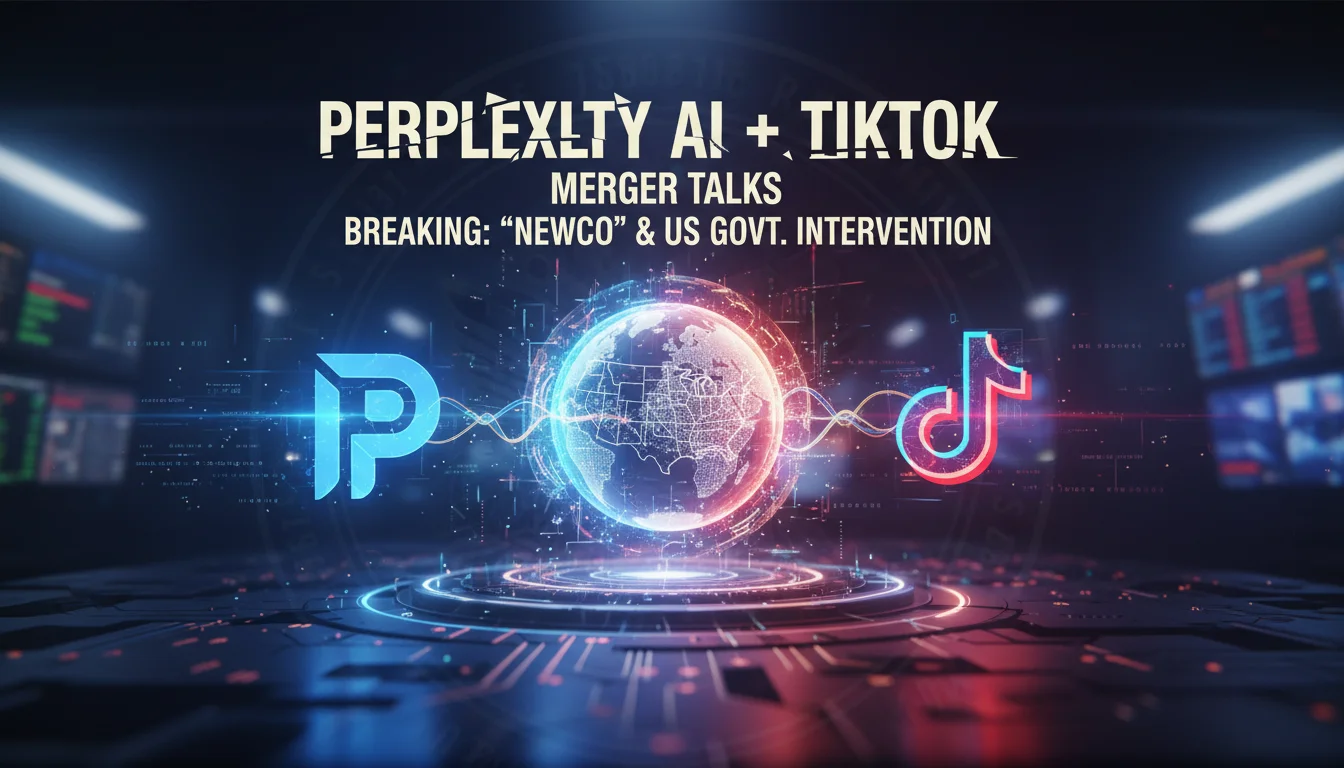

In a move that has sent shockwaves through the tech industry and Washington D.C. alike, Perplexity AI has emerged as a dark horse contender to acquire TikTok’s US operations. The breaking news centers on a bold, unprecedented structure: a holding company tentatively dubbed ‘NewCo’ that would see the United States government taking a massive 50% equity stake to prevent a nationwide ban.
As the clock ticks down on the divestiture deadline mandated by US law, this proposal from the AI search challenger offers a potential lifeline for the app’s 170 million American users. But it also raises profound questions about the convergence of artificial intelligence, social media, and state power. This article breaks down the mechanics of the Perplexity AI TikTok merger, the strategy behind ‘NewCo,’ and what this means for the future of the digital landscape.
The ‘NewCo’ Proposal: A 50-50 Split with Uncle Sam
The core of the Perplexity AI proposal is unlike any standard tech acquisition. Instead of a straightforward buyout by a tech giant like Oracle or Microsoft, Perplexity—led by CEO Aravind Srinivas—is proposing a merger of equals with a twist designed to appease national security hawks.
According to reports, the plan involves creating a new entity, “NewCo,” which would combine Perplexity’s AI search capabilities with TikTok’s US user base and video infrastructure. The defining feature? The US government would effectively own 50% of this new entity following a planned Initial Public Offering (IPO), targeted at a valuation of over $300 billion.
Key Deal Terms
- Structure: A merger between Perplexity AI and TikTok US operations.
- Government Stake: The US government would hold a non-voting 50% equity stake, addressing concerns about foreign adversary control.
- Algorithm: Reports suggest ByteDance would retain its core recommendation algorithm, while NewCo would likely rebuild the feed using Perplexity’s AI stack.
- Valuation: The combined entity targets a massive $300B+ market cap upon going public.
Why Perplexity? The Strategic Logic
On the surface, a search engine startup buying a short-form video app seems incongruous. However, the synergy lies in the shifting nature of how users—especially Gen Z—consume information.
The Search-Video Convergence
TikTok is increasingly used as a search engine. Users look for “best restaurants in NYC” or “how to fix a leaky faucet” on TikTok as often as they do on Google, often preferring its video-first approach over the best news apps with personalized feeds currently on the market. Perplexity AI, which positions itself as an “answer engine” rather than a link aggregator, sees TikTok as the ultimate dataset to train its models and deliver multimodal answers.
By integrating Perplexity’s Large Language Models (LLMs) directly into TikTok, the app could evolve from an entertainment platform into a super-app for information discovery, serving as a powerful AI news aggregator for students and researchers, directly challenging Google’s dominance in both search and video advertising.
The National Security Angle: Why the US Govt?
The primary driver of the TikTok ban threat is the fear of Chinese Communist Party (CCP) influence via ByteDance. Previous proposals, such as “Project Texas” (partnering with Oracle for data storage), failed to fully satisfy lawmakers who argued that as long as ByteDance retained ownership, the risk remained.
The ‘NewCo’ model attempts to solve this by making the US government a literal shareholder. This “sovereign equity” approach is rare in the US tech sector but could provide the ultimate guarantee against foreign data exfiltration. If the US government owns half the company, the logic goes, it can ensure strict adherence to US privacy laws and algorithmic transparency. This emphasis on data sovereignty mirrors the concerns of organizations that utilize offline AI privacy tools for business to secure their digital infrastructure.
Potential Roadblocks and Challenges
Despite the innovative structure, the deal faces significant hurdles.
1. ByteDance’s Approval
Beijing has previously stated it would oppose a forced sale, especially one that involves transferring algorithmic technology. If the deal requires rebuilding the algorithm from scratch (using Perplexity’s tech), ByteDance might be more amenable to a financial exit, but it remains a geopolitical wild card.
2. The “State Media” Concern
Critics argue that the US government owning 50% of a major media platform raises First Amendment concerns. Would the government have influence over content moderation? The proposal specifies non-voting shares to mitigate this, but the optics of a “government-owned social network” are politically sensitive.
3. Technical Feasibility
Can Perplexity, a relatively small team compared to tech giants, handle the infrastructure of TikTok? Merging an LLM-based search engine with a high-velocity video feed is an engineering nightmare that could degrade the user experience if not executed perfectly.
FAQ: Understanding the Merger
Is the Perplexity TikTok merger confirmed?
No, it is currently a proposal. It is one of several options being discussed to prevent the ban, competing with other bids from private equity groups and tech consortiums.
Will the TikTok algorithm change?
Most likely. If ByteDance refuses to sell the source code for its famous “For You Page” (FYP) algorithm, the new owners (Perplexity) would need to build a new recommendation engine, likely powered by their own AI.
What is NewCo?
NewCo is the temporary name for the proposed holding company that would result from the merger of Perplexity AI and TikTok US. It is designed to facilitate the US government’s ownership stake.
Will TikTok be banned if this deal fails?
The risk remains high. If a divestiture—whether to Perplexity or another buyer—is not completed by the deadline, app stores will be legally required to remove TikTok in the US.
Conclusion
The Perplexity AI TikTok merger news represents a fascinating pivot in the saga of the world’s most popular app. By proposing a ‘NewCo’ with government equity, Perplexity is not just trying to buy a competitor; it’s attempting to rewrite the rules of tech sovereignty. Whether this bold gamble pays off or gets entangled in geopolitical red tape remains to be seen, but one thing is clear: the future of search and social media is colliding, and the result will reshape the internet for the next decade.