
For decades, the pharmaceutical industry has been haunted by Eroom’s Law—the observation that drug discovery is becoming slower and more expensive over time, despite improvements in technology. Developing a single new drug historically takes over a decade and costs upwards of $2.6 billion. The industry is at a breaking point.
Enter Artificial Intelligence (AI). It is no longer a futuristic concept but a practical, dominating force in modern pharmacology. By 2025, AI has moved beyond theoretical models to delivering actual clinical candidates.
This guide explores the most high-impact AI in drug discovery use cases. We will dissect how machine learning, generative models, and biological data are converging to save billions of dollars and, more importantly, save lives.
The Shift: Why AI is the “Digital Antibody” for Pharma
Traditional drug discovery is a game of chance. Scientists screen millions of compounds hoping to find a “hit” that binds to a disease target. It is searching for a needle in a haystack, where the haystack is the size of the universe.
AI changes this dynamic by inverting the process. Instead of screening randomly, Generative AI and Deep Learning models predict which molecules will work before they are physically synthesized. This shift is driven by three factors:
- Data Availability: The explosion of “omics” data (genomics, proteomics).
- Compute Power: The rise of GPUs specifically designed for biological simulation (e.g., NVIDIA BioNeMo).
- Algorithmic Breakthroughs: Tools like AlphaFold that solved the protein folding problem.
Top 5 AI in Drug Discovery Use Cases
To understand the real value, we must look at where AI is applied in the pipeline. Here are the five critical use cases driving the current market.
1. Target Identification and Validation (The “What” Phase)
Before you can design a drug, you must identify the biological target (usually a protein) driving the disease. Traditionally, this involved years of basic research. AI accelerates this via Natural Language Processing (NLP) and Knowledge Graphs.
How it works: AI agents scour millions of scientific papers, patents, and clinical trial results to map relationships between genes, diseases, and proteins. They identify obscure correlations that human researchers might miss.
- Example: Identifying that a specific protein overexpression is linked to a rare form of fibrosis.
- Tech Stack: Knowledge Graphs, NLP, Multi-omics integration.
2. De Novo Drug Design (The “Generative” Phase)
This is arguably the most exciting use case. Instead of screening existing libraries of molecules, Generative AI creates entirely new molecules from scratch—a process called de novo design.
Using architectures like Generative Adversarial Networks (GANs) and Transformers, AI “imagines” chemical structures that meet specific criteria: high potency, low toxicity, and good solubility.
Real-World Impact: Companies like Insilico Medicine used this approach to design a novel drug for Idiopathic Pulmonary Fibrosis (IPF) in under 18 months—a fraction of the standard time.
3. Lead Optimization & ADMET Prediction
Finding a molecule that kills a virus is easy; finding one that kills the virus without killing the patient is hard. This is where ADMET (Absorption, Distribution, Metabolism, Excretion, and Toxicity) comes in.
AI models predict how a drug will behave inside the human body with high accuracy. Deep learning algorithms analyze chemical structures to forecast potential toxicity issues early, preventing costly late-stage failures.
- Benefit: Reduces the “fail rate” in Phase I clinical trials.
- Key Concept: Multi-parameter optimization (balancing safety vs. efficacy).
4. Lab-in-the-Loop & Automation
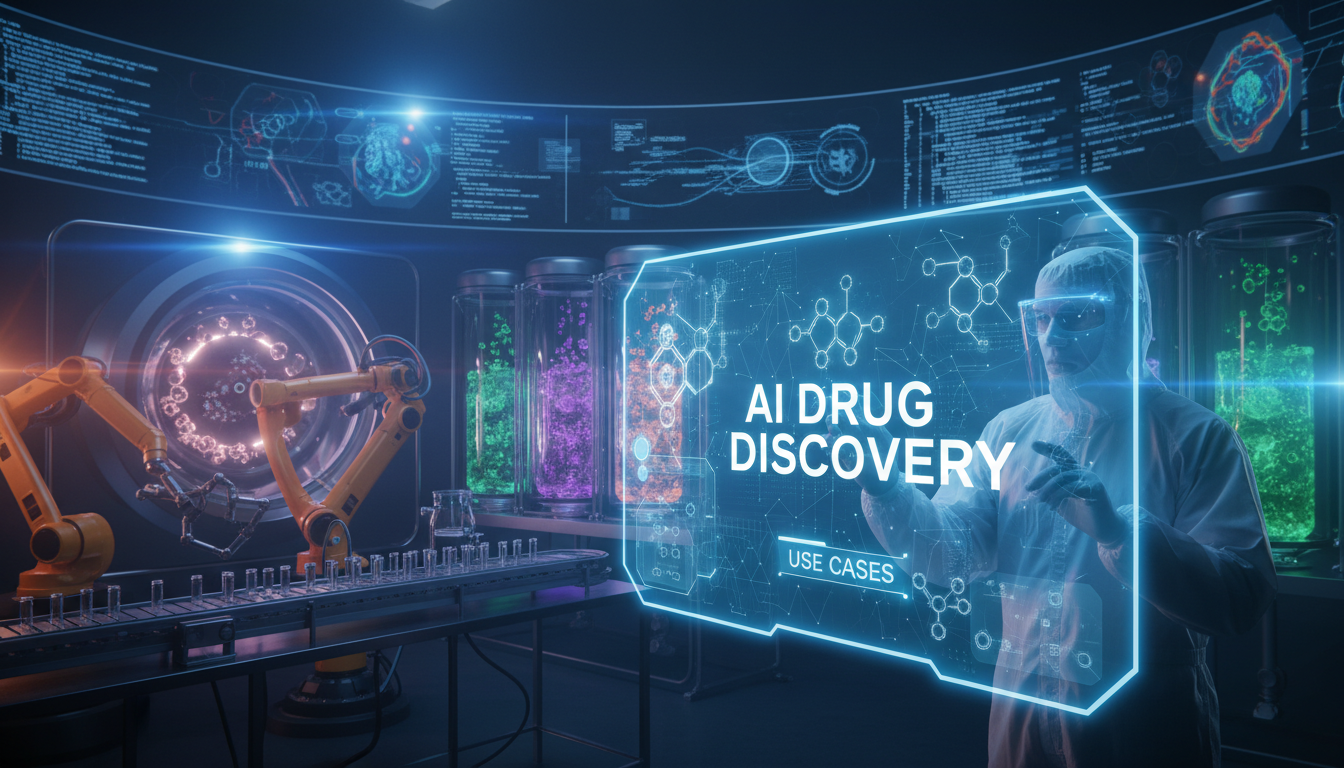
The future of the lab is autonomous. Leading biotech firms are building “closed-loop” systems where AI designs an experiment, robots execute it, and the results are fed back into the AI to improve the next round of design.
Recursion Pharmaceuticals is a pioneer here, treating biology as a data problem. Their massive automated wet labs generate petabytes of biological image data, which trains their AI, creating a virtuous cycle of improvement. This industrializes discovery, turning it from an artisanal craft into a scalable pipeline.
5. Clinical Trial Optimization & Synthetic Control Arms
Clinical trials are the bottleneck of drug development, consuming 80% of total costs. AI optimizes this through:
- Patient Stratification: Identifying which patient subgroups are most likely to respond to the treatment based on genetic markers.
- Synthetic Control Arms: Using historical patient data to create a “digital twin” control group. This reduces the number of patients needed for the placebo group, making trials faster and more ethical.
- Company to Watch: Unlearn.AI is leading the charge in creating digital twins to shrink trial timelines.
Case Studies: Who is Winning the Race?
Insilico Medicine: The End-to-End Pioneer
Insilico’s platform, Pharma.AI, demonstrated the first fully AI-designed drug to reach Phase II clinical trials for a novel target. They used AI for target discovery (PandaOmics) and molecule generation (Chemistry42), proving that the technology is mature enough for real-world medicine.
DeepMind & AlphaFold
While not a drug developer itself, Google DeepMind’s AlphaFold revolutionized the industry by predicting the 3D structure of nearly all known proteins. This solved a 50-year-old grand challenge in biology, giving drug hunters the “maps” they need to design drugs for previously “undruggable” targets.
Challenges and Ethical Considerations
Despite the hype, challenges remain:
- Data Quality: AI is only as good as the data it is fed. “Garbage in, garbage out” is a major risk in biology, where experimental data can be noisy.
- The “Black Box” Problem: Chemists need to understand why an AI model suggests a specific molecule. Explainable AI (XAI) is crucial for building trust.
- IP and Regulation: Who owns a molecule invented by a machine? Patent laws are still catching up to generative AI.
Future Outlook: 2026 and Beyond
The next frontier involves Quantum Machine Learning. As quantum computers mature, they will simulate molecular interactions with perfect accuracy, essentially turning drug discovery into a software problem. We also expect to see the rise of “Self-Driving Labs,” where AI manages the entire discovery lifecycle with minimal human intervention.
Frequently Asked Questions (FAQ)
How does AI reduce drug discovery costs?
AI reduces costs by predicting failures early. Instead of synthesizing 5,000 compounds in a wet lab, AI can virtually screen millions and suggest the best 50 to test, saving millions in reagents and labor.
What is de novo drug design?
De novo design is the process of using computer algorithms to generate novel chemical structures from scratch, rather than searching through a database of existing molecules.
Can AI replace scientists in drug discovery?
No. AI is a tool that augments scientists. While it handles data processing and pattern recognition, human expertise is still required for strategic decision-making, ethical oversight, and complex biology interpretation.
Conclusion
The integration of AI in drug discovery use cases represents the most significant shift in medicine since the discovery of antibiotics. By compressing timelines from years to months and turning biological chaos into structured data, AI is not just saving money—it is bringing hope to patients with untreated conditions faster than ever before. For pharma companies, adopting these frameworks is no longer optional; it is survival.