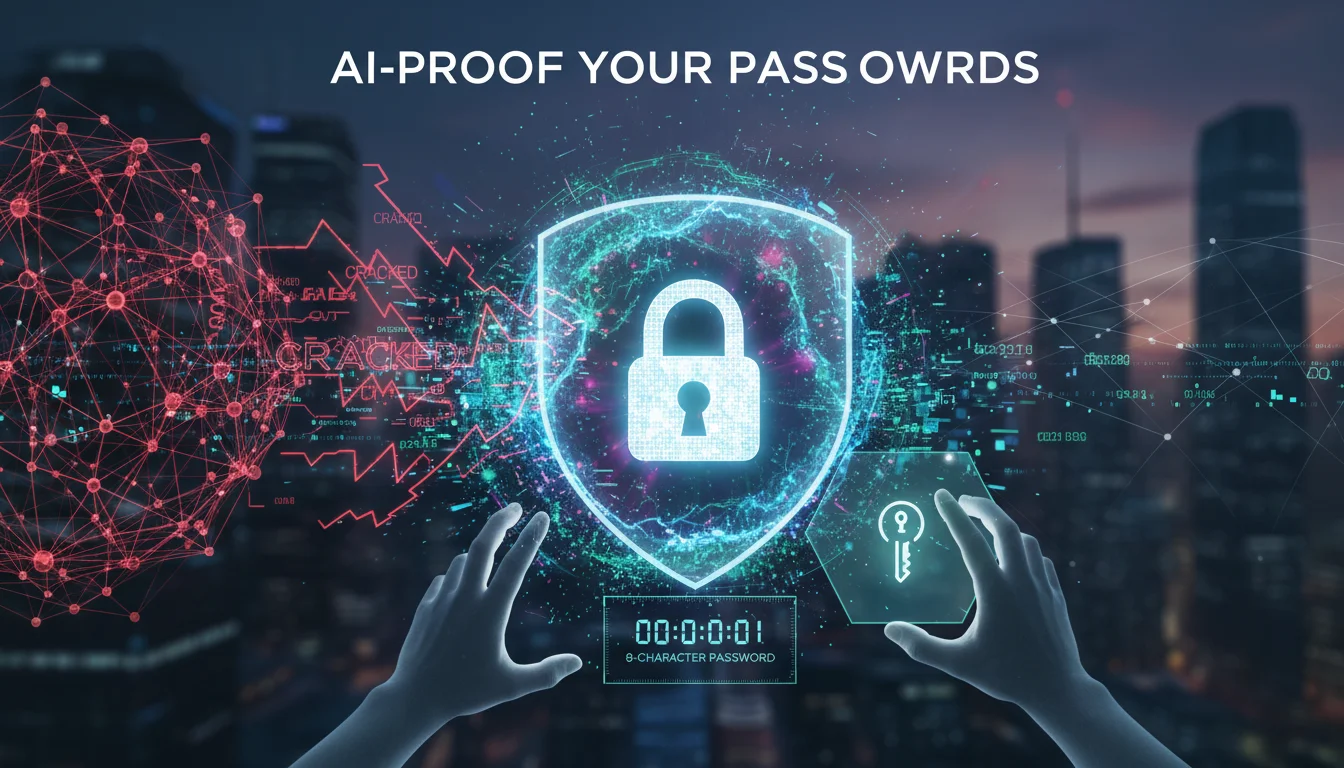

The cybersecurity landscape shifted violently with the release of recent studies showing that AI-driven tools, such as PassGAN, can crack 51% of common passwords in less than a minute. For years, users were told that an 8-character password with a capital letter and a number was sufficient. Today, that advice is not just outdated—it is dangerous, highlighting the perils of weak passwords.
As Artificial Intelligence evolves from simple automation to generative learning, the methods used by cybercriminals have become exponentially more efficient. This reality has terrified users and IT managers alike, driving a surge in searches for AI password cracker protection methods. How do you defend against an adversary that never sleeps, never gets tired, and learns from every failed attempt?
At PassHulk, we believe that understanding the technology is the first step to defeating it. This guide utilizes a semantic SEO framework to deconstruct the threat of AI password cracking and provides a comprehensive, authoritative blueprint for securing your digital life against the next generation of cyber threats.
Understanding the Threat: How AI Cracks Passwords
To implement effective protection, one must first understand the mechanism of the attack. Traditional password cracking relied on Brute-Force attacks (trying every combination) or Dictionary attacks (using lists of common words). These were limited by computing power and pre-defined lists.
The Rise of PassGAN and Generative Adversarial Networks
The game changer is the introduction of Generative Adversarial Networks (GANs). Tools like PassGAN do not simply guess randomly; they learn. By analyzing millions of passwords from real-world data leaks (knowing what to do after a data breach is essential), these AI models understand the structure of human password creation.
Humans are predictable. We use dates, names, and patterns like replacing ‘a’ with ‘@’. AI detects these patterns instantly. Where a traditional brute-force script might take years to guess a complex 8-character string, an AI model effectively ‘predicts’ the most likely variations, reducing the cracking time to mere seconds.
Why 8 Characters is Dead: The Mathematics of Entropy
In the context of information theory, password entropy is a measure of how unpredictable a password is. AI lowers effective entropy by predicting human behavior. Therefore, the only defense against AI is mathematical unpredictability combined with extreme length.
Recent benchmarks suggest:
- 8 Characters: Cracked instantly.
- 10 Characters: Cracked in minutes to hours.
- 12 Characters: Cracked in weeks.
- 18+ Characters: Takes millions of years (currently).
The threshold for safety has moved. The ‘Sweet Spot’ for AI password cracker protection is now a minimum of 15 to 18 characters.
Core AI Password Cracker Protection Methods
Implementing AI-proof security requires a shift in mindset from ‘complexity’ to ‘length and randomness’. Here are the definitive strategies.
1. The Passphrase Method
Since AI struggles with length, but humans struggle with memory, the Passphrase Method is the most user-friendly defense. Instead of Tr0ub4dor&3 (which looks complex but is short), use a string of four to five random, unrelated words.
Example: Correct-Horse-Battery-Staple-Purple
This method drastically increases the bit-strength of the password, pushing the cracking time beyond the capabilities of current AI models.
2. Eliminate Human Patterns
AI is trained on human patterns. To AI-proof your credentials, you must remove the ‘human’ element. Avoid:
- Keyboard walks (e.g., QWERTY, ASDF).
- Personal information (Birth years, pet names).
- Common substitutions (e.g., P@ssw0rd).
3. Use a Password Manager with High-Entropy Generation
The most effective protection method is to ensure you never know your own passwords. Using a reputable password manager like PassHulk allows you to generate 20+ character strings of pure random noise for every account. Since these strings have no semantic pattern, AI models cannot use predictive learning to shortcut the guessing process.
Advanced Defense: Beyond the Password
Even a 50-character password can be bypassed if the attacker uses other vectors. A holistic security posture includes the following layers.
Multi-Factor Authentication (MFA)
MFA is the kryptonite to password cracking. Even if an AI deciphers your password, it cannot replicate the second factor. However, avoid SMS-based 2FA, which is susceptible to SIM swapping. Instead, utilize:
- Authenticator Apps: (Google Authenticator, Authy).
- Hardware Keys: (YubiKey).
- Biometrics: (FaceID, Fingerprint).
Salting and Peppering (For Developers)
If you are a developer reading this, storing passwords securely is your responsibility. You must use modern hashing algorithms like Argon2 or Bcrypt. Additionally, implementing unique Salts (random data added to the password before hashing) and Peppers (secret keys stored separately) renders pre-computed AI tables useless.
How PassHulk Secures Your Data Against AI
At PassHulk, we have anticipated the rise of AI in cyberwarfare. Our architecture is designed to render AI cracking attempts futile.
- AES-256 Encryption: The industry standard for military-grade security.
- Zero-Knowledge Architecture: We do not know your master password. Even if an AI breached our servers, it would find only unreadable encrypted blobs.
- AI-Driven Breach Monitoring: We fight fire with fire. PassHulk uses AI to monitor the dark web for your credentials, alerting you the moment a breach occurs so you can change your password before the hackers use it.
Frequently Asked Questions (FAQ)
Can AI crack a 12-character password?
Yes, depending on the complexity. If a 12-character password consists only of lowercase letters or common words, AI can crack it quickly. However, a 12-character string including uppercase, numbers, and special symbols is significantly harder, though 15+ is recommended for true future-proofing.
Is my fingerprint safe from AI hackers?
Generally, yes. While biometric spoofing exists, it is a targeted attack requiring physical proximity or high-resolution photos. It is not scalable like remote password cracking. Biometrics remain a highly secure secondary layer of defense.
Do special characters still matter?
Yes. While length is king, expanding the character set (increasing the pool of possible characters from 26 to 90+) exponentially increases the number of combinations an AI must test.
How often should I change my password?
Contrary to old advice, NIST guidelines now suggest not changing passwords arbitrarily, as this leads to users choosing weaker, repetitive patterns. Only change your password if you suspect a breach or if alerted by your password manager.
Conclusion: Adaptation is Survival
The news of AI cracking passwords in seconds is not fear-mongering; it is a technological reality check. The era of the 8-character password is over. By adopting AI password cracker protection methods—specifically increasing length, utilizing high-entropy generation via PassHulk, and enabling MFA—you can stay ahead of the curve.
Security is not a product; it is a process. Start today by auditing your most critical accounts and upgrading them to AI-proof standards.