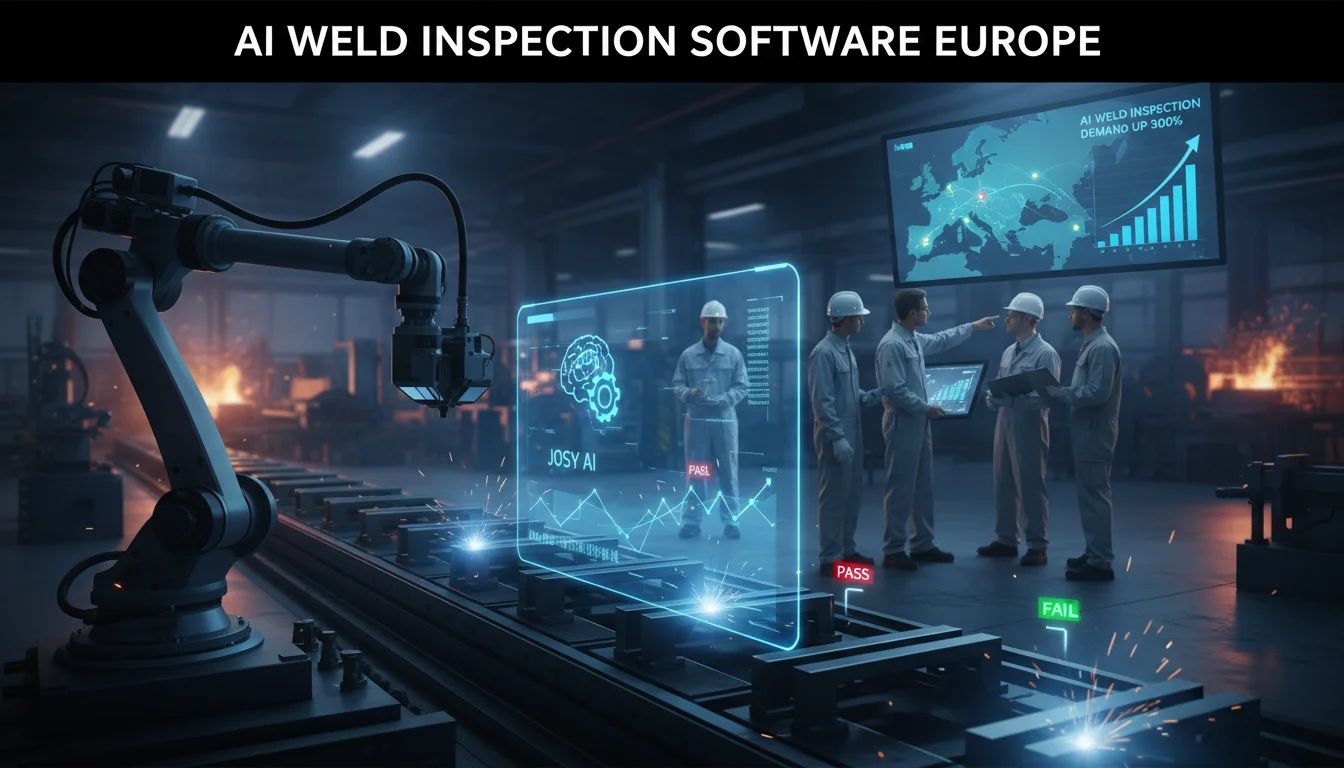

In the heart of Europe’s manufacturing powerhouse, a quiet revolution is taking place. While the headlines often focus on generative AI in consumer apps, the real industrial transformation is happening on the factory floors of Stuttgart. Specifically, the convergence of AI weld inspection software and advanced 3D metrology is rewriting the rulebook for automotive and heavy industry quality control.
For decades, European manufacturers—particularly in the German automotive sector—relied on a mix of manual visual inspection and basic 2D camera systems. These methods were prone to human error, fatigue, and an inability to detect depth-based defects like throat thickness variations or subtle undercuts. However, recent breakthroughs, such as the JOSY system by SmartRay showcased at the European Industrial AI Innovation Hub, have signaled the end of the "random sampling" era.
This article explores the rising trend of AI-powered weld inspection in Europe, dissecting the technology, the regulatory landscape (ISO 5817), and the business case for making the switch to 100% inline inspection.
The Shift: Why 2D Visual Inspection is Failing Modern Industry
To understand the surge in demand for AI weld inspection software in Europe, one must first understand the limitations of the legacy approach. Traditional Automated Optical Inspection (AOI) relies on 2D images. While effective for checking if a component is present, 2D systems struggle with the complex geometry of a weld seam.
A weld is a three-dimensional entity. Its quality is defined not just by surface appearance, but by volume, geometry, and depth. A 2D camera might see a shadow; a 3D laser triangulation sensor sees a crater. This distinction is critical in industries like Electric Vehicle (EV) battery manufacturing, where a single micro-pore in a battery frame weld can compromise the structural integrity or safety of the entire vehicle.
The "Zero-Slippage" Standard
European OEMs (Original Equipment Manufacturers) are increasingly moving toward a "zero-slippage" quality standard. This means 100% of welds must be inspected, not just a statistical sample. Manual inspectors, no matter how skilled, cannot maintain 100% attention rates over an 8-hour shift, nor can they inspect welds moving at robot speeds of 400mm/s. This is the gap that AI software is filling.
The Stuttgart Breakthrough: JOSY and the Closed-Loop Revolution
The recent buzz around AI weld inspection in Europe can be traced back to innovations emerging from Stuttgart, a global hub for industrial automation. The JOSY (JOining SYstem), developed by SmartRay, represents a leap forward by combining high-speed 3D sensors with AI-driven software.
But the hardware is only half the story. The true breakthrough lies in the software integration, specifically the collaboration with partners like Wandelbots and Grid Dynamics. Here is why this specific ecosystem is driving the trend:
- CAD-to-Path Automation: Historically, programming a robot to inspect a complex weld path took days of manual teaching. The new AI workflows allow engineers to generate inspection paths directly from the CAD model in minutes.
- Closed-Loop Manufacturing: The AI doesn’t just flag a defect; it categorizes it (e.g., "Gas pore, 0.5mm"). Advanced iterations of this technology are moving toward sending feedback to the welding robot to adjust parameters (amperage, travel speed) in real-time to prevent the defect in the next cycle.
- Semantic Understanding: Unlike basic pixel matching, modern AI weld inspection software understands the topology of a good weld versus a bad one, reducing false positives caused by surface reflections or oil stains.
Core Technology: How 3D Laser Triangulation Meets Deep Learning
The superior performance of European AI inspection systems comes from the fusion of hardware physics and software intelligence.
1. Laser Triangulation (The Eyes)
The system projects a laser line onto the weld seam. A camera sensor captures the deformation of this line as it moves across the surface. By calculating the angle of deformation, the system builds a high-density 3D point cloud of the weld profile. This happens at incredible speeds—often up to 4 kHz (4,000 profiles per second).
2. AI Processing (The Brain)
Raw point cloud data is noisy. This is where the AI software steps in. It filters out "noise" (like spatter that doesn’t affect integrity) and measures critical dimensions against pre-set thresholds. Key metrics include:
- Throat Thickness (a): The critical stress-bearing dimension.
- Leg Length (z): The distance from the root to the toe.
- Undercuts: Grooves melted into the base metal (a major stress riser).
- Porosity: Gas trapped inside the weld metal.
Navigating Regulations: ISO 5817, VDA 5, and Traceability
For B2B buyers in Europe, compliance is non-negotiable. One of the strongest value propositions of AI weld inspection software is its ability to automate compliance with strict standards.
ISO 5817 & ISO 10042
These international standards define quality levels for imperfections in fusion-welded joints (Steel and Aluminum, respectively). AI software can be pre-configured to "Evaluation Group B" (Stringent) or "Group C" (Intermediate). The software automatically grades every millimeter of the weld against these ISO limits, providing an objective pass/fail decision that removes human subjectivity.
VDA 5 Capability
In the German automotive industry, VDA 5 governs the capability of measurement processes. High-end AI systems like JOSY are "VDA 5 ready," meaning they offer the statistical stability and repeatability required by German car manufacturers (Audi, BMW, Mercedes-Benz). This level of certification is often the deciding factor for procurement teams in Europe.
Implementation Strategies: Hardware vs. Software-Only
When sourcing these solutions, European plant managers typically face two implementation models:
1. Turnkey Solutions (The JOSY Model)
Best for: New production lines or high-speed robotics.
This involves buying the sensor heads and the software as a unified package. The advantage is calibration; the sensor and software are perfectly tuned, ensuring sub-millimeter accuracy immediately.
2. Retrofit / Software-Overlay
Best for: Legacy lines with existing 2D cameras.
Some startups are offering AI software that attempts to interpret data from existing vision hardware. While cheaper, this often lacks the depth data required for critical structural welds and is less common in high-stakes automotive applications.
Future Outlook: The "Self-Healing" Assembly Line
The trajectory of AI weld inspection in Europe points toward Adaptive Welding. Currently, inspection is a "gatekeeper"—it stops bad parts from leaving. The future is "process control."
Imagine a scenario where the inspection system detects a trend: "Throat thickness is decreasing by 1% every 10 cycles." The AI software communicates with the welding robot controller to increase wire feed speed slightly, correcting the drift before a defect ever occurs. This transition from Defect Detection to Defect Prevention is the holy grail of Industry 4.0.
FAQ: AI Weld Inspection in Europe
What is the difference between AOI and AI Weld Inspection?
AOI (Automated Optical Inspection) typically uses 2D images and contrast matching. AI Weld Inspection (specifically 3D) uses laser triangulation to measure volume and depth, and uses Deep Learning to interpret complex topography, resulting in far fewer false alarms and higher accuracy for structural defects.
Is JOSY the only system available in Europe?
While SmartRay’s JOSY is a market leader and currently trending due to its recent innovations in Stuttgart, other players like Vitronic and localized integrators also serve the market. However, JOSY is often cited as the benchmark for high-speed 3D inline inspection in the automotive sector.
How does this software handle reflective surfaces like aluminum?
Reflective metals are a nightmare for traditional cameras. High-quality 3D AI systems use specialized lasers (often blue lasers) and advanced filtering algorithms to ignore reflections and focus only on the surface geometry, making them ideal for EV battery casings (aluminum) and copper welding.
What is the ROI on AI weld inspection software?
The ROI typically comes from three areas: 1) Elimination of manual labor costs. 2) Reduction of scrap (early detection prevents adding value to a bad part). 3) Avoidance of recalls. In the automotive industry, a single recall due to a faulty frame weld can cost millions; preventing this offers an immediate ROI.
Conclusion
The rise of AI weld inspection software in Europe is not a fleeting trend—it is a structural shift driven by the dual pressures of labor shortages and uncompromising quality standards. Innovations emerging from Stuttgart, particularly the integration of AI path planning with 3D metrology, are setting a new global benchmark.
For European manufacturers, the question is no longer "Can we afford to automate inspection?" but rather "Can we afford the risk of remaining manual?" As technologies like JOSY mature, the factory of the future—intelligent, self-correcting, and flawlessly precise—is fast becoming a reality.