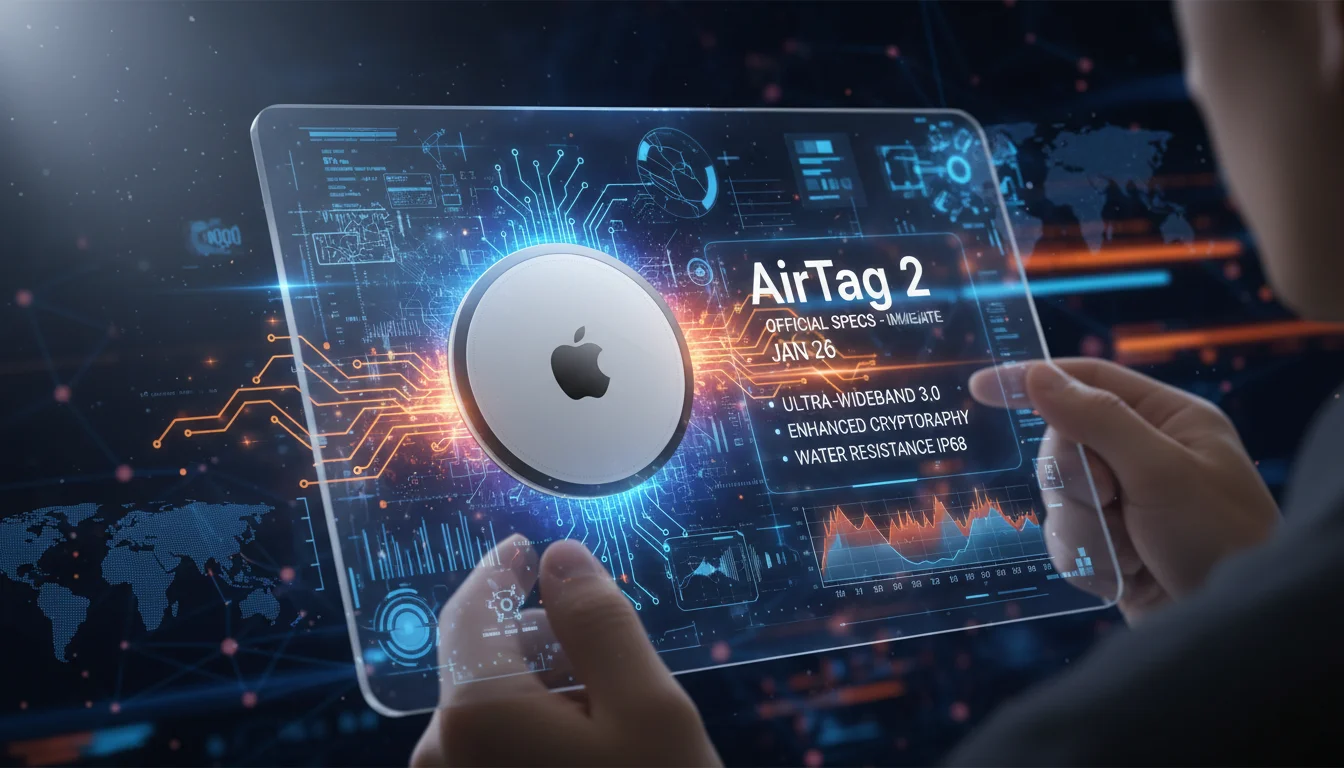

It happened. After nearly five years of speculation, leaks, and a seemingly endless wait since the original 2021 release, Apple dropped the AirTag 2 in a surprise announcement on January 26, 2026. There was no flashy keynote event, just a press release that sent the tech world into a frenzy. Users have been clamoring for better range, louder sound, and updated anti-stalking measures, and it appears Cupertino has been listening.
If you are looking for the definitive breakdown of the AirTag 2 official launch specs, you have arrived at the right place. As a tech industry veteran, I have dissected the press materials and technical documents to bring you a comprehensive analysis of what has changed, what has stayed the same, and whether this $29 puck is worth the upgrade.
The Headlines: AirTag 2 at a Glance
Before we dive into the granular technical details, here is the high-level overview of the AirTag 2. Apple has adhered to its “evolution, not revolution” philosophy here, keeping the iconic form factor while supercharging the internals.
- Release Date: January 26, 2026 (Available for order now, delivery Jan 28).
- Price: $29 for one, $99 for a 4-pack (Unchanged from Gen 1).
- Chipset: Second-Generation Ultra Wideband (UWB) Chip.
- Range: Precision Finding now works at 1.5x the distance.
- Audio: 50% louder speaker for easier locating.
- Battery: User-replaceable CR2032 (confirmed).
- Durability: IP67 Water and Dust Resistance.
Deep Dive: The Second-Generation Ultra Wideband (UWB) Chip
The single most significant upgrade in the AirTag 2 is the silicon. The original AirTag relied on the U1 chip, which was revolutionary for its time. The AirTag 2 graduates to Apple’s second-generation UWB chip, the same silicon powering the iPhone 17 lineup and the Apple Watch Ultra 3. This advancement follows the trend of high-efficiency silicon seen in recent Apple hardware performance benchmarks across their entire product range.
Why UWB 2 Matters
Ultra Wideband technology is what enables “Precision Finding”—that magical on-screen arrow that guides you to your keys when you are within Bluetooth range. The first-generation chip had a functional range of about 15-30 feet depending on interference. The new UWB chip extends this range by approximately 50%.
In real-world terms, this means you can start getting directional guidance from across a large house or a busy airport terminal, rather than needing to wander aimlessly until your phone picks up the signal. This enhanced sensitivity also penetrates walls and furniture more effectively, reducing the “Searching for signal…” dead zones that frustrated users of the first model.
Precision Finding: Now on Your Wrist
One of the most requested features has finally arrived. Thanks to the integration of the new UWB chip, Precision Finding is now natively supported on Apple Watch Series 9, Ultra 2, and newer models. Previously, the Apple Watch could only show you a basic directional approximation or play a sound. Now, you get the full haptic and visual feedback loop directly on your wrist.
This is a game-changer for quick retrieval. Imagine holding your groceries or luggage; you don’t want to fish your iPhone 17 out of your pocket. A glance at your wrist now points you directly to your tagged item with tactile pulses intensifying as you get closer.
Audio Engineering: Louder and clearer
A common complaint with the original AirTag was that it could be easily muffled. If your keys slipped between sofa cushions or were buried deep in a backpack, the faint chirping was often inaudible. Apple has re-engineered the internal acoustic chamber of the AirTag 2.
The new official specs claim the speaker is 50% louder than its predecessor. The sound profile has also been tuned to cut through ambient noise more effectively. This isn’t just a convenience feature; it is a security one. A louder sound makes it much harder for a malicious actor to hide an AirTag on a person without them noticing the anti-stalking alert. This is a critical addition to modern protection methods that focus on user safety and digital privacy.
Design and Durability: The “If It Ain’t Broke” Approach
Visually, the AirTag 2 is nearly identical to the first generation. It features the same white plastic cap and stainless steel back. However, there are subtle differences for the keen-eyed observer.
Weight and Build
The new unit is slightly heavier, weighing in at 11.8 grams compared to the original’s 11 grams. This weight increase is likely due to the larger magnet assembly for the louder speaker and the reinforced chassis.
Tamper-Resistant Construction
Following years of concerns regarding “silent AirTags” (modified units with disabled speakers sold on the grey market), Apple has reportedly made the internal architecture significantly harder to tamper with. The speaker mechanism is now integrated more deeply into the chassis, making it difficult to disable without destroying the device entirely.
Water Resistance
The device maintains an IP67 rating, meaning it can withstand submersion in one meter of water for up to 30 minutes. While some hoped for an IP68 upgrade, IP67 is generally sufficient for keys, luggage, and backpacks.
Battery Life: The CR2032 Stays
There was rampant speculation that Apple might switch to a rechargeable battery, similar to the Apple Watch. However, the AirTag 2 retains the user-replaceable CR2032 coin cell battery.
This is a win for longevity and convenience. A rechargeable battery would eventually degrade, rendering the device e-waste after 3-4 years. A replaceable battery means the AirTag 2 can theoretically last indefinitely. Apple cites a battery life of “more than one year,” identical to the first generation, despite the more powerful chip and louder speaker. This suggests significant efficiency gains in the new Bluetooth protocol and UWB architecture.
Software Integration: Share Item Location
Alongside the hardware launch, Apple is highlighting the Share Item Location feature in iOS 26. This allows users to securely share the location of an AirTag with third parties, such as airlines. Apple has partnered with SITA (a major airline IT provider) to integrate this directly into baggage handling systems. If your luggage is lost, you can generate a temporary, secure link that allows the airline to pinpoint your bag on their own systems, bridging the gap between “I know where my bag is” and “The airline knows where my bag is.”
Verdict: Is the AirTag 2 Worth It?
If you already own a fleet of AirTags that are working fine, the upgrade is not urgent unless you frequently struggle with range issues. However, for new buyers, the AirTag 2 is a no-brainer. It costs the same but performs significantly better. The extended range and Apple Watch integration solve the two biggest friction points of the original product.
Frequently Asked Questions (FAQ)
Does the AirTag 2 have a rechargeable battery?
No, the AirTag 2 uses a standard, user-replaceable CR2032 coin cell battery, just like the original model. This ensures the device has a long lifespan and doesn’t become e-waste once a built-in battery degrades.
Is the AirTag 2 waterproof?
The AirTag 2 is rated IP67 for water and dust resistance. It is splash, water, and dust resistant, capable of surviving submersion in up to 1 meter of water for 30 minutes.
Does Precision Finding work with older iPhones?
Precision Finding on the AirTag 2 works best with iPhones equipped with the UWB chip (iPhone 11 and later). To get the full benefit of the “extended range,” you will likely need an iPhone 15 or newer that supports the second-gen UWB standard, though it remains backward compatible with older UWB devices at standard ranges.
Can I use my old AirTag accessories with AirTag 2?
Yes. The AirTag 2 maintains the exact same dimensions as the first generation, so all your key rings, loops, and mounts will fit perfectly.
How is the AirTag 2 different from the AirTag 1?
The main differences are the 2nd Gen UWB chip (enabling 1.5x longer range), a 50% louder speaker, and native Precision Finding support for newer Apple Watch models.
Conclusion
The AirTag 2 may not look different on the outside, but it represents a mature refinement of Apple’s tracking technology. By addressing the core limitations of the first model—range and volume—Apple has solidified its dominance in the Bluetooth tracker market. With the price remaining at $29, it is an accessible and essential accessory for anyone deep in the Apple ecosystem. For those interested in how the company’s hardware stack is evolving, checking out the latest Apple hardware comparisons provides broader context on their upcoming product launches.