
For the past few years, the narrative around Artificial Intelligence in the small business sector has been dominated by Generative AI. Business owners have learned to use ChatGPT to draft emails, write blog posts, and brainstorm marketing strategies. But for many, the promise of “automation” felt incomplete. You still had to copy-paste the email. You still had to log into the CRM to update the lead status. You were still the bottleneck.
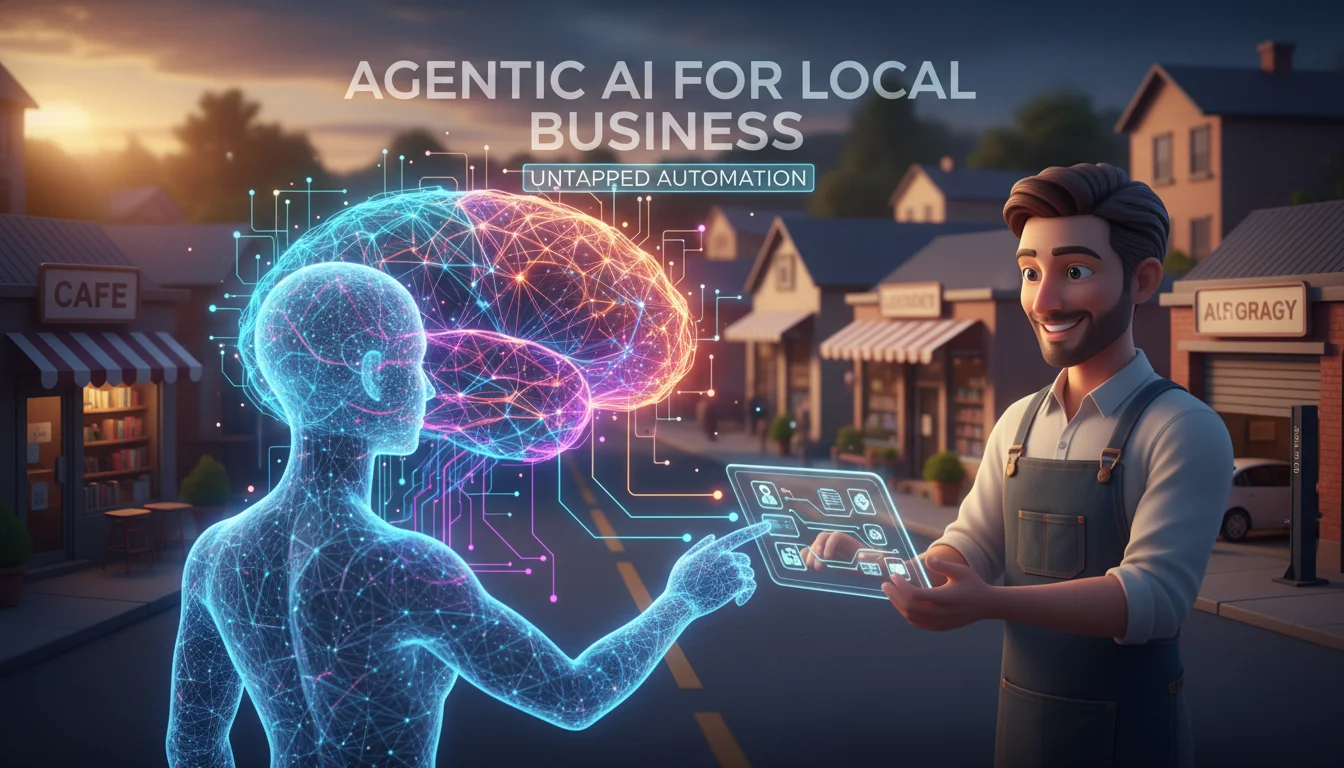
Enter Agentic AI. This is the pivot point where AI transitions from a passive consultant to an active employee. Unlike standard LLMs (Large Language Models) that wait for a prompt to generate text, AI Agents are designed to pursue goals, execute multi-step workflows, and interact with other software autonomously.
For small businesses operating on thin margins and limited headcount, Agentic AI isn’t just a trend; it is the great equalizer. It allows a three-person team to operate with the output of a thirty-person department. In this comprehensive guide, we will move beyond the hype to explore the semantic structure of Agentic AI, its practical applications for SMBs, and a step-by-step framework for implementation.
What is Agentic AI? (Understanding the “Digital Worker”)
To implement this technology effectively, we must first define the entity. In the context of semantic SEO and technical definition, Agentic AI refers to AI systems capable of autonomous decision-making and action execution to achieve a specified objective.
The Difference Between Generative AI and AI Agents
Understanding this distinction is critical for your implementation strategy:
- Generative AI (The Thinker): You ask it to write a follow-up email for a client. It gives you the text. You must send it.
- Agentic AI (The Doer): You give it a goal: “Follow up with all leads from the webinar who haven’t responded in 3 days.” The Agent checks your CRM, identifies the leads, drafts personalized emails based on their profile, sends them via your email client, and updates the CRM status to ‘Contacted’.
For a small business, Agentic AI acts as a layer of logic that connects your disconnected tools—Slack, HubSpot, QuickBooks, and Gmail—turning them into a unified, autonomous workflow.
Why Small Businesses Are the Perfect Soil for Agentic AI
While enterprise companies are bogged down by governance committees and legacy infrastructure, small businesses have the agility to adopt Agentic workflows rapidly. The barrier to entry has lowered significantly due to the rise of No-Code Agent builders.
Key Benefits for SMBs:
- 24/7 Asynchronous Operations: Agents don’t sleep. Your customer support agent can resolve tickets at 3 AM.
- Drastic Cost Reduction: Instead of hiring a virtual assistant for $20/hour for repetitive tasks, an Agentic workflow costs a fraction of a cent per execution.
- Elimination of Context Switching: Human employees lose productivity when switching between tabs. Agents thrive on it.
High-Impact Use Cases: Where to Deploy Agents First
When implementing Agentic AI, avoid the trap of trying to automate everything at once. Focus on high-volume, rules-based processes where human error is common.
1. The Autonomous Customer Support Agent
Modern AI agents can go beyond simple chatbots. By integrating with your knowledge base and order management system, an agent can:
- Verify order numbers.
- Process refunds within set limits.
- Escalate complex emotional issues to human staff with a summary of the conversation.
2. The Sales Development Representative (SDR) Agent
Small business owners often despise cold outreach. An AI Agent can be tasked with:
- Scraping LinkedIn for prospects matching a specific persona.
- Enriching lead data using tools like Clearbit.
- Drafting and sending personalized introductory emails.
- Booking meetings directly to your calendar if a prospect shows intent.
3. The Operational Logistics Agent
For e-commerce SMBs, agents can monitor inventory levels. When stock dips below a threshold, the agent can autonomously draft a purchase order for the supplier and send it to the owner for one-click approval, streamlining supply chain management.
Step-by-Step Framework: Implementing Agentic AI in Your Workflow
This implementation guide follows a semantic progression: Audit, Select, Train, and Deploy.
Step 1: The Workflow Audit (The Logic Map)
Before touching software, map your processes. Identify workflows that have:
- A clear trigger: (e.g., “When a new lead arrives in Gmail…”)
- Defined logic: (e.g., “If the lead is B2B, do X. If B2C, do Y.”)
- A specific outcome: (e.g., “Update CRM.”)
Step 2: Choosing Your Tech Stack
You do not need to be a Python developer to use Agentic AI. The market has bifurcated into code-heavy and no-code solutions.
- For Non-Technical Owners (No-Code): Tools like Zapier Central, Make.com (formerly Integromat), and custom OpenAI GPTs are the entry point. These allow you to build agents by describing behavior in plain English.
- For Tech-Savvy Teams (Low-Code): Platforms like Microsoft AutoGen, CrewAI, or LangChain allow for the creation of “Swarms” where multiple agents interact with each other to solve complex problems.
Step 3: Guardrails and Governance
Agentic AI executes actions. This carries risk. If an agent hallucinates, it might send an incorrect discount code to 1,000 people.
Implementation Rule: Always keep a “Human-in-the-Loop” (HITL) for the first 30 days. Configure the agent to draft actions (draft emails, draft invoices) and require human approval before execution. Once the accuracy rate exceeds 99%, switch to full autonomy.
Future-Proofing: The Rise of Multi-Agent Systems
The immediate future of SMB automation is Multi-Agent Systems (MAS). Instead of one AI doing everything, you will deploy a team. One agent researches, another writes, and a third critiques the work. This “Manager-Worker” architecture reduces hallucinations and improves output quality. Small businesses starting today with single agents will be best positioned to scale into MAS architectures as the technology matures in late 2026.
Frequently Asked Questions (FAQ)
What is the difference between automation (Zapier) and Agentic AI?
Traditional automation (like standard Zapier zaps) is linear: If A happens, do B. It breaks if the input is unexpected. Agentic AI is dynamic: it can reason. If ‘A’ happens, it analyzes the context of ‘A’ and decides whether to do ‘B’, ‘C’, or ask for help.
Is Agentic AI expensive for small businesses?
No. Most no-code agent platforms operate on a subscription model (often under $50/month) or token-usage models. The ROI is typically realized within the first month by saving hours of human labor.
Do I need to know how to code to use AI Agents?
Not anymore. With the advent of natural language programming, you can configure agents using plain English instructions. However, understanding logic flows (algorithms) is helpful.
Is my data safe with AI Agents?
Data privacy is a valid concern. When implementing, choose platforms that are SOC2 compliant and allow you to toggle off “data training,” ensuring your proprietary business data isn’t used to train public models.
Conclusion
Implementing Agentic AI in a small business is no longer a futuristic concept—it is a survival mechanism for the modern economy. By shifting your mindset from “using AI tools” to “hiring AI workers,” you unlock a level of scalability previously reserved for Fortune 500 companies.
Start small. Audit one painful, repetitive workflow today (like invoice processing or meeting scheduling). Deploy a pilot agent. Monitor, refine, and then scale. The era of the one-person unicorn company is here, and Agentic AI is the engine driving it.