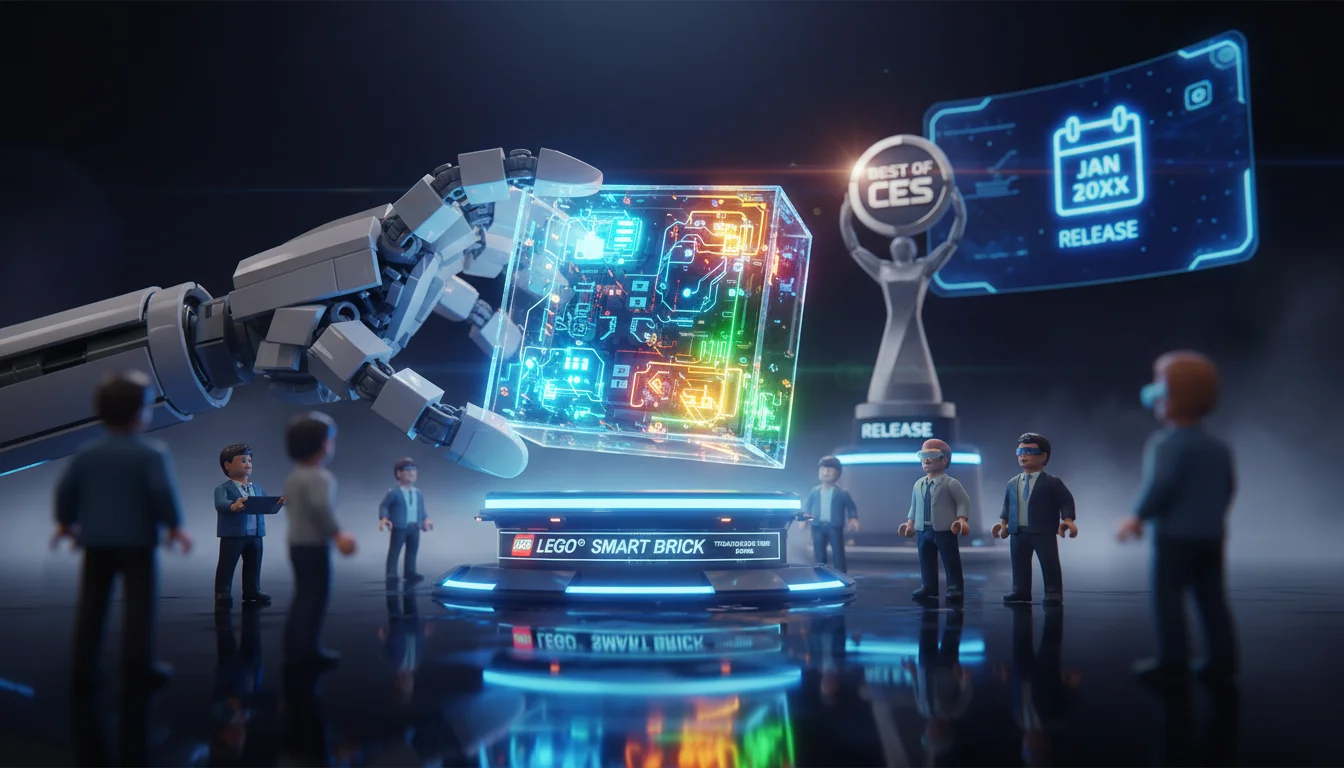

It’s not often that a toy captures the imagination of the tech world so completely that it walks away with a “Best of CES” award. Yet, that is exactly what happened at CES 2026. Amidst a sea of AI agents and next-gen robotics, the Lego Smart Brick stood out as a beacon of tangible, magical innovation. For tech enthusiasts and AFOLs (Adult Fans of Lego) alike, the question on everyone’s lips has been: When can we get our hands on it?
The official Lego Smart Brick release date has been confirmed for March 1, 2026, with pre-orders having already opened in select markets as of January 9th. This launch marks the debut of the Lego Smart Play system, a tech-infused ecosystem designed to bridge the gap between physical construction and digital interaction without relying on screens.
In this comprehensive guide, we dive deep into the technical specifications, the launch lineup featuring iconic Star Wars ships, and why this tiny, sensor-packed brick is being hailed as the biggest innovation in Lego history since the minifigure.
The Lego Smart Brick Release Date and Availability
Lego has officially announced that the Smart Brick will hit shelves on March 1, 2026. However, the rollout strategy is notably exclusive. Initially, the Smart Play sets will only be available in six key markets:
- United States
- United Kingdom
- France
- Germany
- Poland
- Australia
For eager fans in these regions, pre-orders went live on January 9, 2026, at LEGO.com. If you are located outside these territories, global availability details remain under wraps, though industry analysts expect a wider rollout closer to the 2026 holiday season.
What is the Lego Smart Brick? (Tech Specs & Innovation)
At first glance, the Smart Brick looks deceptively simple—a transparent 2×4 stud brick. But inside, it is a marvel of miniaturization. Unlike previous attempts at tech integration (like the bulky battery hubs of Mindstorms or Powered Up), the Smart Brick is self-contained and standard-sized.
Under the Hood
The “Best of CES” judges were impressed by the important tools and software features crammed into this 1.6cm x 3.2cm enclosure:
- Custom ASIC Chip: A dedicated processor handles real-time inputs without needing a constant smartphone connection.
- Sensor Suite: It includes an accelerometer, gyroscope, light sensor, and proximity/gesture sensors. This allows the brick to know if it’s upside down (flying a loop-the-loop) or if a hand is approaching.
- Audio & Visuals: A built-in synthesizer (not just a playback device) generates dynamic sounds, paired with RGB LEDs that react to gameplay.
- Connectivity: Using a local mesh network dubbed “BrickNet” (based on Bluetooth Low Energy and NFC), Smart Bricks communicate with each other, Smart Minifigures, and Smart Tags instantly.
- Wireless Charging: No AA batteries required. The bricks charge via induction, compatible with new wireless charging plates included in the sets.
The “Screen-Free” Philosophy
The most critical differentiator is the absence of a required app for play. While firmware updates are handled via mobile, the actual play experience is entirely offline. Lego’s goal is to keep children (and adults) focused on the bricks, not a tablet screen. In an era where parents often have to secure your Roblox account and other digital profiles, the logic resides in the brick itself—it knows it’s part of an X-Wing because of the “Smart Tag” embedded in the build, and it behaves accordingly.
Launch Lineup: The Star Wars Wave
Lego is launching the Smart Play system with its most powerful license: Star Wars. The inaugural wave consists of three sets that demonstrate the system’s capabilities:
1. Luke’s Red Five X-Wing (Set #75423)
Estimated Price: $99.99
This set features a Smart Brick that detects flight patterns. Swoosh the model upwards, and the engine pitch rises. Dive down, and it creates deceleration sounds. The RGB lights flicker to mimic engine exhaust. It includes Smart Minifigures of Luke Skywalker and R2-D2. When Luke is placed in the cockpit, the brick acknowledges him with a specific voice line or beep.
2. Darth Vader’s TIE Fighter (Set #75421)
Estimated Price: $69.99
Similar to the X-Wing but programmed with the menacing roar of TIE engines. The proximity sensors allow for “dogfighting” logic—if the TIE Fighter gets too close to the X-Wing (communicating via BrickNet), it triggers laser blast sounds and hit reactions.
3. Throne Room Duel & A-Wing (Set #75427)
Estimated Price: $159.99
The flagship set of the wave. It includes two Smart Bricks to manage complex interactions between the environment and the vehicles. It simulates the lightsaber clashes and the Emperor’s lightning usage through sound and strobe lighting effects triggered by physical motion.
Why It Won “Best of CES 2026”
The tech industry’s obsession with the Lego Smart Brick stems from its execution of “Ambient Computing.” Technology is weaving itself into the fabric of everyday objects, much like a next generation password manager simplifies the user experience, becoming invisible yet magical.
Judges noted that while other toys are pushing generative AI chatbots, Lego went the opposite direction: enhancing physical reality. The latency-free response of the bricks creates a feedback loop that feels organic. When you attach a “Smart Tag” (a passive conductive tile) to the brick, it instantly reprograms itself. Snap on a “Blaster” tag, it makes shooting sounds. Snap on a “Engine” tag, it hums. This modularity is a technical feat that revitalizes the core “system of play.”
Pros and Cons of the Smart Play System
Pros
- Immersive: Sound and light effects are dynamic, not repetitive recordings.
- Backwards Compatible: Physically fits all existing Lego bricks.
- No Screens: Solves the parental pain point of excessive screen time.
- Rechargeable: environmentally friendlier than disposable batteries.
Cons
- Price: The cost per set is roughly 20-30% higher than non-smart equivalents.
- Limited Initial Availability: Only 6 countries at launch.
- Proprietary Ecosystem: Smart Bricks require specific Smart Tags/Minifigs to unlock full potential.
Frequently Asked Questions (FAQ)
Is the Lego Smart Brick waterproof?
No. While durable, the Smart Brick contains sensitive electronics and a speaker mesh that are not rated for water submersion. It is splash-resistant but should be kept dry.
Can I buy the Smart Brick separately?
At launch, the Smart Brick is only available within the specific Smart Play sets. Lego has not announced a standalone “Creative Box” yet, though it is highly requested.
How long does the battery last?
Lego claims the battery lasts for roughly 4-6 hours of continuous active play. The standby time is significant, preserving charge for weeks when not in use.
Do I need an app to use it?
No app is required for gameplay. An app is only needed if you wish to update the firmware or customize specific sound profiles later down the line.
Conclusion
The Lego Smart Brick represents a bold leap forward, proving that even the most analog of toys can evolve without losing its soul. By securing the “Best of CES 2026” title, Lego has signaled that the future of play isn’t just about screens—it’s about smart, tactile experiences.
With the release date set for March 1, 2026, fans in the launch regions should act fast. If history is any indicator, these initial Star Wars sets will sell out rapidly. Whether you are a collector or a parent looking for the ultimate gift, the Smart Play system promises to bring a galaxy far, far away right into your living room.