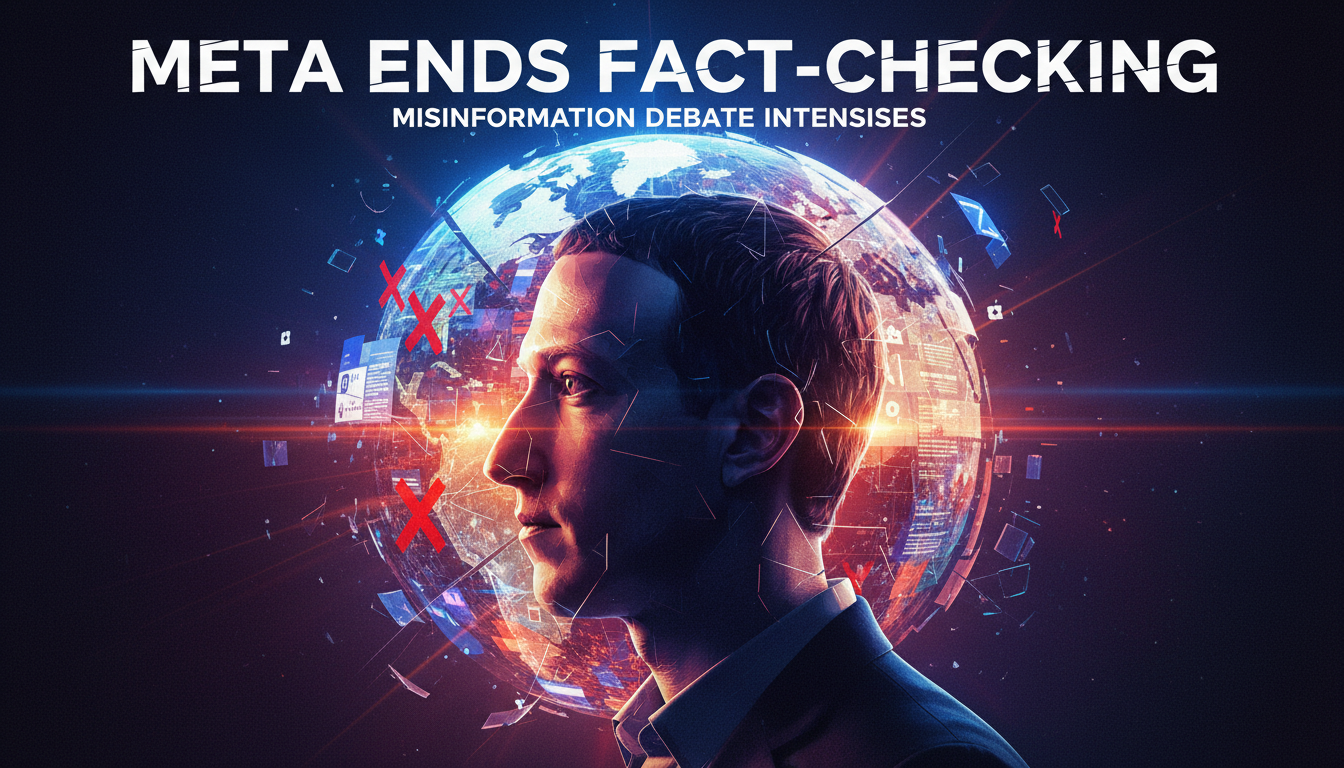

In a seismic shift for the social media landscape, Meta CEO Mark Zuckerberg has announced that Facebook and Instagram are ending their long-standing third-party fact-checking programs. The decision, which marks a significant pivot from the platform’s post-2016 stance on misinformation, introduces a new user-led moderation system: Community Notes.
This move has ignited an intense debate across the tech industry, politics, and civil society. Is this a victory for free expression, or a dangerous retreat in the fight against online disinformation? As an expert in tech policy and digital trends, I’ve broken down exactly what is changing, why it matters, and how it will impact your daily scrolling experience.
The Announcement: What Zuckerberg Actually Said
In a video announcement that reverberated through Silicon Valley, Mark Zuckerberg declared that the current system of relying on independent organizations to verify content had become “too politically biased” and, in his view, had “destroyed more trust than it created.”
Zuckerberg cited the recent political climate—specifically referencing the 2024 U.S. election cycle—as a “cultural tipping point” that necessitated a return to “prioritizing speech.” The core of the announcement involves three major changes:
- Ending Third-Party Partnerships: Meta is severing ties with the network of independent fact-checking organizations it has paid since 2016 to review and label false content.
- Introduction of Community Notes: A crowd-sourced system similar to the one deployed on X (formerly Twitter) will now be the primary method for adding context to misleading posts.
- Policy Simplification: The platform is rolling back restrictive policies on sensitive topics like immigration and gender, focusing enforcement only on illegal content and high-severity violations (e.g., terrorism, fraud).
From Experts to the Crowd: How Meta’s Community Notes Will Work
The most tangible change for users will be the disappearance of “False Information” warning screens applied by experts. In their place, you will soon see Community Notes.
How It Works
Modeled closely after X’s system, Meta’s Community Notes relies on the user base to police itself. Here is the mechanism:
- User Flagging: Users can sign up to become contributors. When they see a post they believe is misleading, they can write a note providing context or correction.
- Consensus Algorithm: A note does not appear publicly immediately. It must first be rated as “Helpful” by users with diverse perspectives. The algorithm specifically looks for agreement between users who typically disagree (e.g., users who tend to interact with left-leaning content agreeing with users who interact with right-leaning content).
- Context Labels: Once a note achieves this cross-partisan consensus, it is displayed directly below the post, offering additional context without removing the original content.
This system aims to decentralize truth-seeking, moving the responsibility from a select group of “arbiters” to the collective wisdom of the community.
Why the Shift? The “Free Expression” Argument
Meta’s reversal is rooted in a growing criticism that the previous model was paternalistic and prone to over-enforcement. Executives have admitted that the company’s content moderation practices had “gone too far,” inadvertently silencing legitimate political debate and scientific inquiry under the guise of safety.
By moving to a community model, Meta aims to:
- Reduce Allegations of Bias: By removing paid third-party gatekeepers, Meta hopes to alleviate concerns from conservative critics that the platform was systematically suppressing specific viewpoints.
- Restore Trust: Zuckerberg argues that users trust their peers more than faceless institutions. A transparent, open-source-style approach to context could theoretically rebuild the platform’s credibility.
- Cut Costs and Complexity: Managing contracts with dozens of fact-checking organizations globally is expensive and operationally complex. A user-generated model is more scalable.
The Debate: Will This Fuel Misinformation?
While free speech advocates are celebrating the move, disinformation researchers are sounding the alarm. The concern is that removing professional oversight opens the floodgates for coordinated manipulation.
The Risks of Crowd-Sourcing Truth
Critics argue that Community Notes systems, while innovative, are slower and more vulnerable to “brigading”—where organized groups swarm to upvote or downvote notes to suit an agenda. Unlike professional fact-checkers who follow journalistic standards, anonymous users may lack the expertise to verify complex claims about health, science, or breaking news.
On X, Community Notes have been praised for debunking viral hoaxes but criticized for failing to appear on high-velocity false claims until millions have already seen them. Meta’s massive user base presents an even larger challenge: scaling this consensus model to billions of users without it devolving into a partisan tug-of-war.
What This Means for Users and Advertisers
For the Everyday User
Expect to see fewer blurred-out posts and more “context boxes” below controversial topics. Your feed may become “noisier,” with more content that would have previously been downranked now remaining visible. You will also have the option to customize the amount of political content you see, putting the curation power back in your hands.
For Advertisers and Brands
The end of professional fact-checking introduces new “brand safety” risks. Advertisers generally prefer environments free from controversy and falsehoods. If the Community Notes system fails to catch toxic misinformation quickly, brands might worry about their ads appearing alongside unverified conspiracy theories. However, Meta has assured partners that it will continue to moderate “high-severity” content like hate speech and violence strictly.
Frequently Asked Questions (FAQ)
When does the “Community Notes” system start?
The transition is beginning immediately in the United States, with a rollout expected to expand over the coming months. Meta plans to refine the system domestically before launching it globally.
Is Meta removing all moderation?
No. Meta will continue to use automated systems and human review to remove illegal content, such as child exploitation, terrorism, scams, and direct incitements to violence. The change specifically targets the policing of “misleading” political and social discourse.
Can anyone write a Community Note?
Eventually, yes, but there is an onboarding process. Users must typically meet certain criteria—such as account age, verified phone number, and a history of policy compliance—to become eligible contributors.
What happens to the old fact-checks?
Existing fact-checks may remain, but the mechanism for generating new professional ratings is being dismantled. The focus is now entirely forward-looking with the community model.
Conclusion
Meta’s decision to end its fact-checking program is more than just a policy update; it is a philosophical realignment of the social web. By trading professional gatekeepers for community consensus, Mark Zuckerberg is betting that the “wisdom of the crowd” can survive the chaos of the internet age.
Whether this leads to a renaissance of free expression or a new dark age of disinformation remains to be seen. What is certain is that the era of the platform as the “arbiter of truth” is officially over. Now, the truth is up to us.