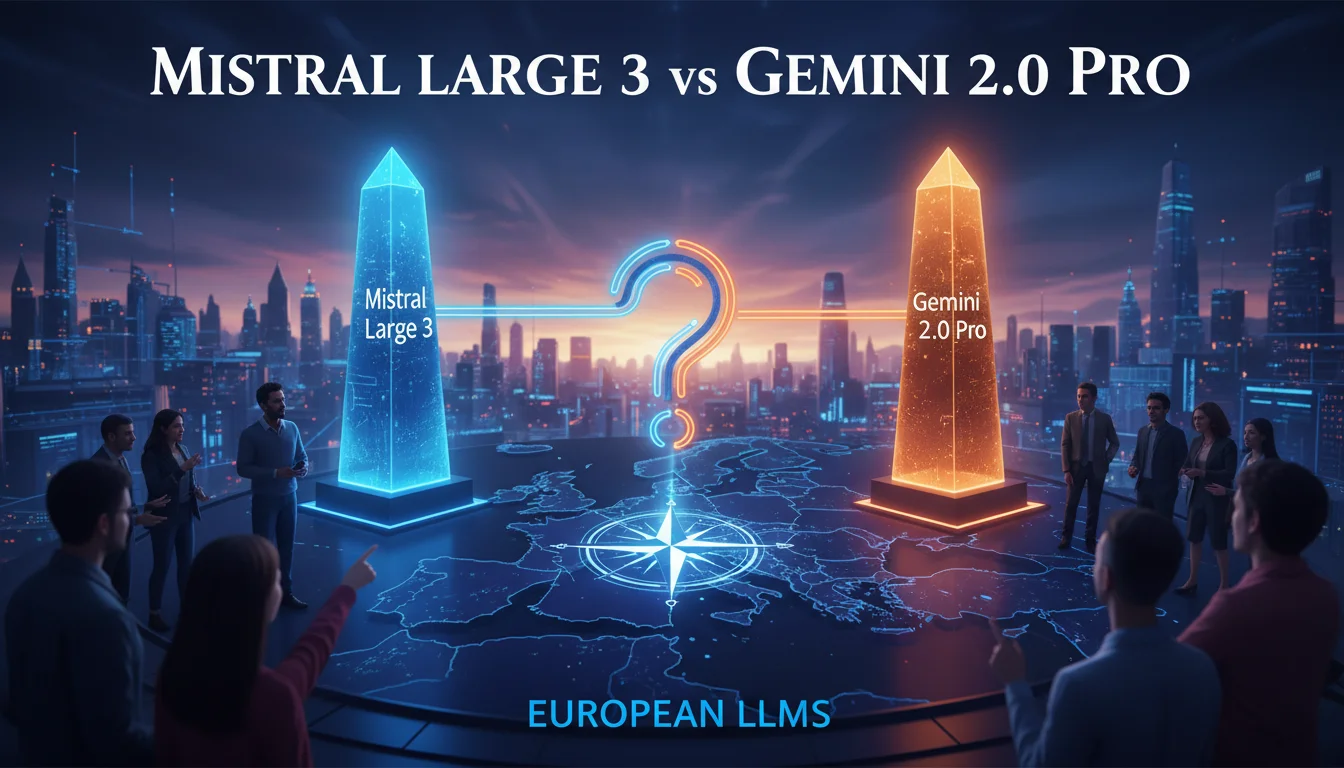

As we settle into 2026, the narrative of “US dominance” in Artificial Intelligence is being rewritten. While Google’s Gemini 2.0 Pro continues to push the boundaries of multimodal reasoning and massive context windows, a challenger from Paris has firmly planted its flag on the frontier. Mistral Large 3 is not just an alternative; for many European enterprises and open-source advocates, it is the superior choice.
The tech industry is currently witnessing a massive pivot towards AI Sovereignty—the idea that nations and companies should control their own intelligence infrastructure. Mistral Large 3, with its open-weight Apache 2.0 license, has become the standard-bearer for this movement, directly challenging the “black box” API model of Gemini 2.0 Pro.
In this comprehensive analysis, we dissect these two heavyweights using the Koray Tuğberk GÜBÜR Semantic SEO Framework to help you decide: Do you need the raw, integrated power of Google, or the transparent, efficient sovereignty of Mistral?
Quick Verdict: The Core Differences
- Mistral Large 3: Best for enterprises requiring data privacy (GDPR), self-hosting, multilingual nuance (especially European languages), and cost-efficiency via fine-tuning. It utilizes a highly efficient Mixture-of-Experts (MoE) architecture.
- Gemini 2.0 Pro: Best for massive context tasks (2M+ tokens), complex agentic workflows, seamless integration with the Google Workspace ecosystem, and multimodal input/output (video/audio).
1. Technical Architecture & Specifications
To understand the performance differences, we must look under the hood. The architectural philosophies of Google DeepMind and Mistral AI have diverged significantly in 2026.
Mistral Large 3: The Efficiency King
Released in late 2025, Mistral Large 3 builds upon the success of its predecessors with a refined Sparse Mixture-of-Experts (SMoE) design. By activating only a fraction of its parameters (roughly 41B active out of 675B total) per token, it achieves “frontier-level” intelligence with the inference latency of a much smaller model.
- Architecture: Sparse MoE (675B Total / ~41B Active).
- Context Window: 256k Tokens.
- License: Apache 2.0 (Open Weights).
- Deployment: Single-node deployability on H200/Blackwell GPUs.
Gemini 2.0 Pro: The Context Behemoth
Google’s Gemini 2.0 Pro doubles down on the company’s “infinite context” strategy. It is designed to hold entire codebases or legal libraries in active memory, allowing for reasoning across vast datasets without the need for RAG (Retrieval-Augmented Generation) in many cases.
- Architecture: Dense, Multimodal Transformer (Proprietary).
- Context Window: 2 Million Tokens.
- License: Proprietary (API Access Only).
- Capabilities: Native Audio, Video, and Image understanding.
2. Performance Benchmarks: Logic, Coding, and Language
In 2026, “vibes” are no longer enough. We look at the hard numbers from the latest evaluations (MMLU-Pro, HumanEval, and internal enterprise benchmarks).
Multilingual Proficiency
This is where Mistral Large 3 shines. Trained heavily on a diverse European corpus, it outperforms Gemini 2.0 Pro in French, German, Spanish, and Italian nuances. For companies operating in the EU, Mistral captures cultural context that US-centric models often miss.
Coding & Reasoning (HumanEval / SWE-bench)
Gemini 2.0 Pro holds the edge here. Its ability to ingest 2 million tokens allows it to understand entire repositories structure in a way Mistral cannot. For complex refactoring tasks or agentic coding loops, Gemini 2.0 Pro remains the gold standard.
However, Mistral Large 3 is no slouch. Its “fill-in-the-middle” capabilities and low latency make it superior for real-time code completion in AI-native development environments where speed is critical.
3. The “Sovereignty” Factor: Why Europe Loves Mistral
The trending interest in Mistral Large 3 isn’t just technical—it’s political and operational. European regulations (AI Act) and corporate governance policies are pushing CIOs away from US-hosted black boxes.
Data Privacy & GDPR
Using Gemini 2.0 Pro means sending data to Google’s servers. Even with enterprise guarantees, this is a non-starter for strictly regulated industries (Defense, Healthcare, Banking) in Europe. Mistral Large 3 can be air-gapped and hosted on-premise or in a sovereign cloud (e.g., OVHcloud, Scaleway), ensuring zero data leakage.
Vendor Lock-in
Building on Gemini creates a dependency on Google’s pricing and API stability. Building on Mistral Large 3 offers freedom. If the API costs rise, you can switch to self-hosting or a different inference provider (Groq, Together AI, etc.) without changing the underlying model logic.
4. Cost Comparison (2026 Pricing)
Pricing dynamics have shifted. While Google has lowered costs for Flash models, the Pro tier remains premium.
| Metric | Mistral Large 3 (API) | Gemini 2.0 Pro |
|---|---|---|
| Input Cost (per 1M tokens) | ~$2.00 | ~$2.00 |
| Output Cost (per 1M tokens) | ~$5.00 | ~$12.00 |
| Self-Hosted Cost | Hardware Dependent (low recurrent cost) | N/A (Not possible) |
Note: Mistral Large 3’s output is significantly cheaper, making it ideal for high-volume generation tasks like report writing or translation.
5. Use Cases: When to Choose Which?
Choose Gemini 2.0 Pro if:
- You need to analyze hours of video or audio content natively.
- Your prompt requires analyzing 50+ PDF documents in a single pass (Deep Context).
- You are deeply integrated into the Google Workspace (Docs, Drive) ecosystem.
- You are building autonomous agents that require extensive tool use and web searching.
Choose Mistral Large 3 if:
- Data Residency is a legal requirement.
- You are building a customer-facing chatbot for a multilingual European market.
- You want to fine-tune the model on your proprietary data to create Mistral Large 3 agentic workflows for specialized tasks.
- You are optimizing for Tokens-Per-Second (TPS) and latency.
FAQ: Mistral Large 3 vs Gemini 2.0 Pro
Is Mistral Large 3 really open source?
Yes, it is released under the Apache 2.0 license. This is a permissive license that allows for commercial use, modification, and redistribution, unlike the restrictive “open” licenses of some competitors.
Can Mistral Large 3 handle images?
Yes, Mistral Large 3 possesses native vision capabilities, allowing it to interpret charts, invoices, and photographs, though Gemini 2.0 Pro generally has broader multimodal support (including video).
Which model is better for coding?
For large-scale architecture and debugging entire repos, Gemini 2.0 Pro is superior due to its context window. For individual function generation and code completion within an IDE, Mistral Large 3 is preferred for its speed and accuracy.
How do I access Mistral Large 3?
You can access it via Mistral’s “La Plateforme” API, through cloud providers like Azure and AWS Bedrock, or download the weights from Hugging Face to host it yourself using vLLM.
Conclusion
The battle between Mistral Large 3 vs Gemini 2.0 Pro is not a zero-sum game; it is a choice between two distinct philosophies. Google offers a powerful, all-encompassing service that abstracts away complexity at the cost of control. Mistral offers a high-performance, transparent engine that puts the power back in the hands of the developer.
For the European tech ecosystem in 2026, Mistral Large 3 is more than a model—it is proof that open-weight AI can compete with, and in specific metrics defeat, the proprietary giants of Silicon Valley.