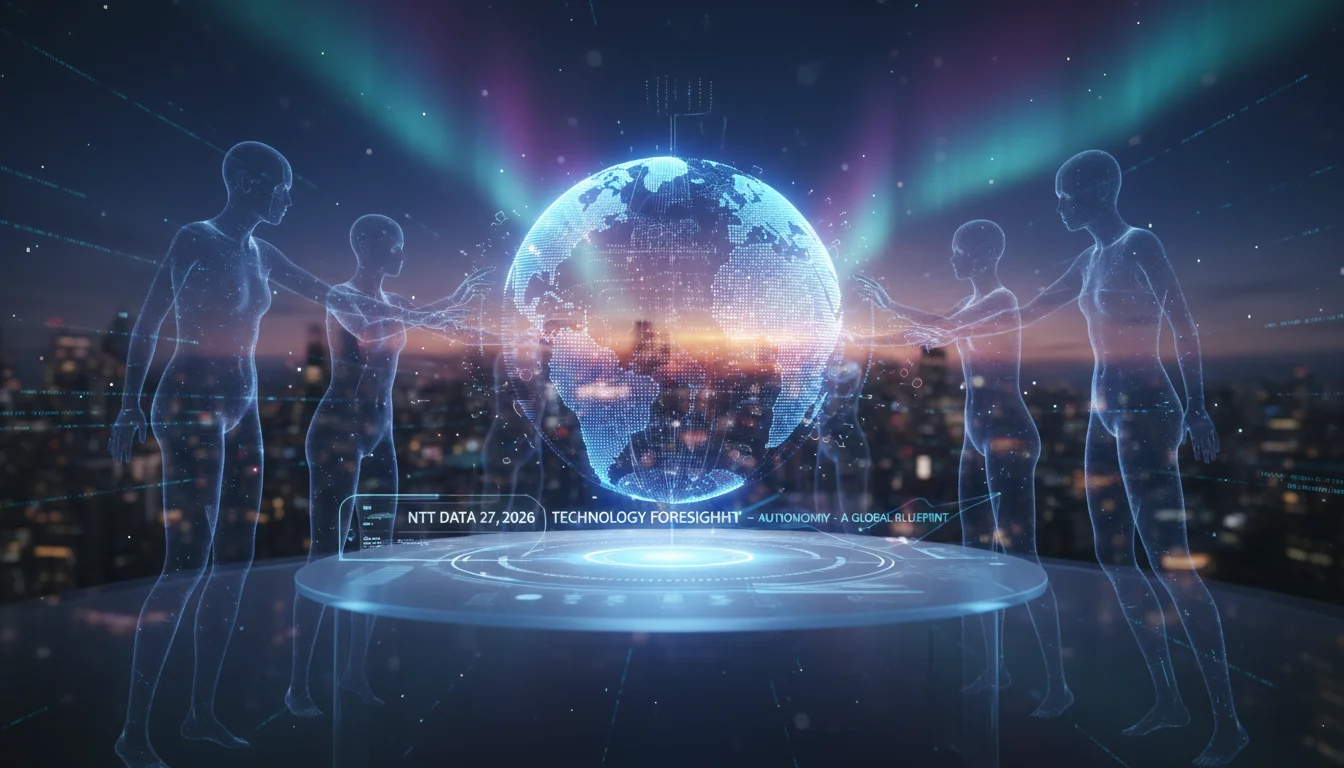

On January 27, 2026, NTT DATA released its highly anticipated Technology Foresight 2026. For over a decade, this annual report has served as a compass for CIOs and IT leaders navigating the digital frontier. While previous years focused on the emergence of Generative AI and the foundational layers of the IOWN (Innovative Optical and Wireless Network) initiative, the 2026 edition signals a profound paradigm shift: the era of Human-Orchestrated Autonomy.
As we stand in early 2026, the conversation is no longer about AI replacing humans or mere digital transformation. It is about a symbiotic relationship where human intent directs autonomous systems with unprecedented precision and scale. This post dissects the report’s core findings, applying a semantic analysis of the trends that will dominate the tech landscape for the next 12 to 36 months.
What is Human-Orchestrated Autonomy?
The central thesis of the NTT DATA Technology Foresight 2026 is that autonomy has graduated from experimental pilots to systemic orchestration. In 2024 and 2025, businesses grappled with “Human-in-the-loop” workflows. In 2026, we are moving to “Human-on-the-loop” architectures.
Human-Orchestrated Autonomy refers to a technological ecosystem where AI agents and physical robotics operate independently to execute complex tasks, yet remain bound by high-level human strategic intent and ethical governance. It is not automation for automation’s sake; it is autonomy designed to amplify human capability rather than bypass it.
The Shift from Generation to Agency
One of the critical distinctions made in the report is the evolution of Artificial Intelligence. We have transitioned from the Generative Era (creating text, code, images) to the Agentic Era (executing decisions, managing supply chains, and negotiating transactions). The report highlights that by the end of 2026, 40% of enterprise interactions will be handled by autonomous agents orchestrating workflows across legacy systems.
Key Trends from the 2026 Foresight Report
The report categorizes its predictions into three primary vectors: The Seamless Interconnection of Space-Time, The Agentic Economy, and Regenerative Society. Below, we break down these high-level concepts into actionable insights.
1. The Maturity of IOWN and the All-Photonics Network
For years, NTT DATA has championed the IOWN (Innovative Optical and Wireless Network) concept. The 2026 Foresight confirms that IOWN has moved from R&D to commercial reality. The All-Photonics Network (APN) is now enabling data transmission with 1/100th the power consumption and virtually zero latency.
- Impact on Remote Operations: The report cites “haptic internet” breakthroughs where remote surgery and heavy machinery operation are performed across continents with real-time tactile feedback, enabled by IOWN’s low latency.
- Sustainable Computing: With data centers consuming record amounts of energy due to AI workloads, the optical computing shift is positioned as the primary solution for keeping the digital economy carbon-neutral.
2. The Rise of ‘Soft’ Robotics and Physical AI
Human-Orchestrated Autonomy requires a bridge between the digital and physical worlds. The report predicts a surge in Embodied AI—robots equipped with advanced LLMs (Large Language Models) that can understand vague human commands and navigate unstructured environments.
Unlike the rigid industrial robots of the past, 2026’s emerging robotics leverage “soft” computing to interact safely alongside humans in retail, healthcare, and logistics. The foresight suggests that by 2027, the ratio of humanoid robots to human workers in logistics hubs will approach 1:5.
3. Digital Twin Computing (DTC) for Societal Resilience
The concept of the Digital Twin has expanded beyond jet engines and factories. The 2026 report details the arrival of Bio-Digital Twins. These are comprehensive virtual replicas of human physiological and behavioral patterns used for personalized medicine and workforce safety.
In a Human-Orchestrated Autonomy framework, these twins allow organizations to simulate the impact of new policies or environmental changes on human well-being before physical implementation. This predictive capability is touted as a key driver for “Regenerative Society,” a core value of NTT DATA’s long-term vision.
Strategic Implications for IT Leaders
For CTOs and CIOs, the NTT DATA Technology Foresight 2026 serves as a warning against complacency. Adopting these trends requires a fundamental re-architecture of the enterprise stack.
The Move to Intent-Based Networking
To support autonomous agents, networks must become self-healing and intent-based. IT leaders must invest in infrastructure that can interpret business goals (e.g., “prioritize video traffic for the executive town hall”) and automatically configure the underlying IOWN-based optical fabric to deliver.
Governance as Code
With agents making decisions, governance cannot be a manual retrospective process. The report advocates for “Governance as Code,” where ethical guardrails, compliance mandates, and brand safety rules are hard-coded into the orchestration layer of autonomous systems.
FAQ: Understanding the 2026 Foresight
When was the NTT DATA Technology Foresight 2026 released?
The report was officially released globally on January 27, 2026.
What is the main theme of the 2026 report?
The central theme is “Human-Orchestrated Autonomy,” focusing on how human intent guides autonomous AI and robotic systems.
How does IOWN fit into the 2026 trends?
IOWN acts as the infrastructure backbone, providing the optical, low-latency, and energy-efficient network required to run massive autonomous AI workloads sustainably.
Is this relevant for non-tech industries?
Yes. The report highlights heavy impacts on healthcare (Bio-Digital Twins), logistics (Embodied AI), and urban planning (Smart City orchestration).
Conclusion: The Orchestration Mandate
The NTT DATA Technology Foresight 2026 is more than a list of gadgets; it is a roadmap for the coexistence of human creativity and machine efficiency. As we move further into 2026, the competitive advantage will belong to those who do not just automate tasks, but who orchestrate outcomes.
The release on January 27 has set the tone for the year: the technology is ready. The question remains—are we ready to conduct the orchestra? Businesses must now pivot from exploring AI to governing it, ensuring that as our systems become more autonomous, they remain deeply aligned with human values.