
Tesla Robotaxi Austin: Safety Driver Removal Marks Historic Shift in Autonomous Tech
The landscape of autonomous transportation just witnessed a seismic shift. As of late January 2026, Tesla has officially begun removing human safety drivers from its Robotaxi fleet in Austin, Texas. This move signals a transition from supervised beta testing to true, commercial-grade autonomous vehicle operations.
For industry watchers and residents of Austin, this isn’t just a headline—it is the tangible arrival of a future promised for over a decade. But with the removal of the “safety monitor” comes a wave of regulatory scrutiny, technological questions about unsupervised FSD (Full Self-Driving), and local curiosity about safety protocols.
In this deep dive, we unpack the technical milestones that allowed this transition, the specific regulatory permits granted by the Texas Department of Licensing and Regulation (TDLR), and the reality of “chase cars” and remote monitoring that still support this driverless fleet.
The Milestone: Unsupervised Rides in Austin
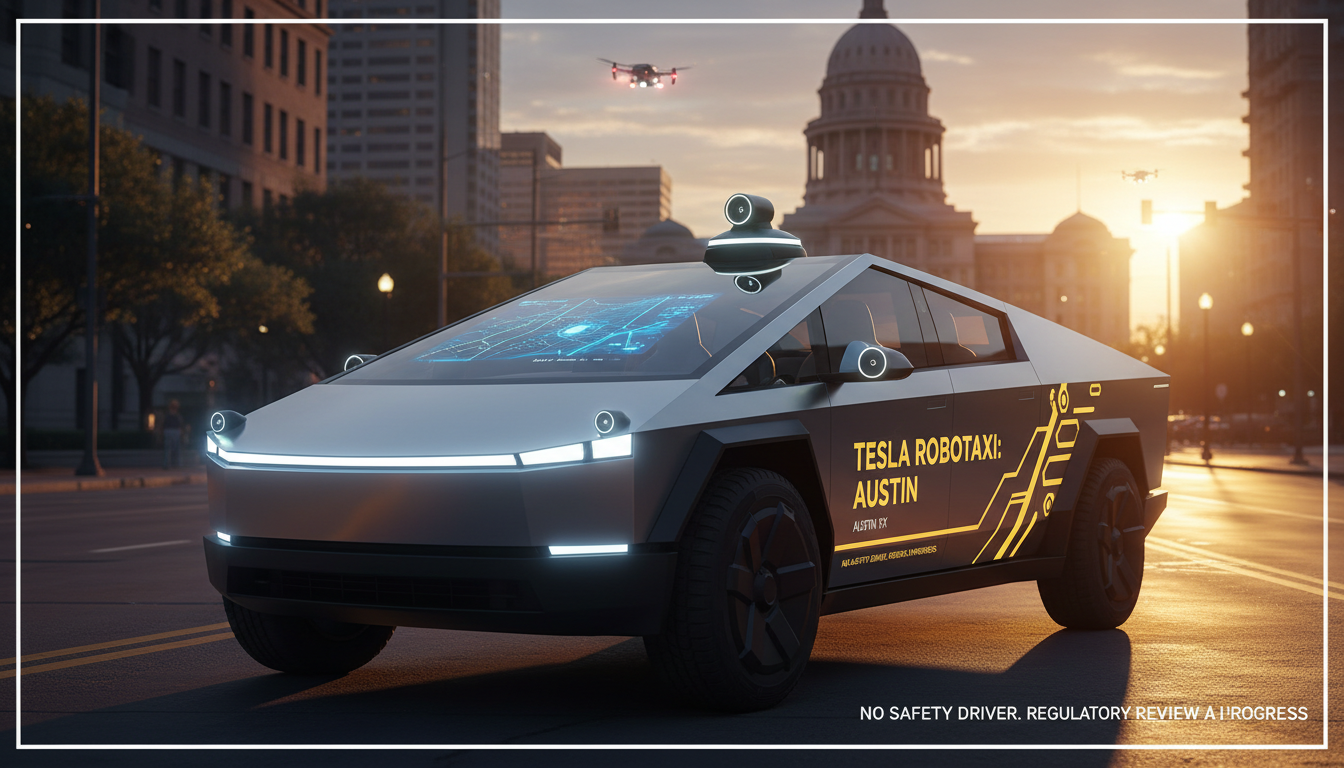
On January 22, 2026, social media platforms X and YouTube flooded with user footage showing Model Y Robotaxis navigating downtown Austin without a human in the driver’s seat. Unlike previous iterations where a Tesla employee sat ready to intervene, these vehicles are now operating with empty front seats, a classification often referred to as SAE Level 4 autonomy within a geofenced area.
From “Safety Monitor” to Remote Oversight
Previously, Tesla’s testing in Austin required a “safety monitor”—an employee trained to disengage the autonomous system immediately if it faltered. The removal of this human element suggests Tesla’s internal data has met a critical safety threshold. However, “driverless” does not mean “unmonitored.”
- Remote Operations Center: Tesla has established a localized command center in Austin where remote operators monitor video feeds and telemetry in real-time.
- Chase Vehicles: Early reports and sightings confirm that while the Robotaxi itself is empty, it is often trailed by a “chase car” containing Tesla engineers. This is a standard industry practice during the initial phase of driverless deployment to ensure rapid response to edge cases.
Regulatory Landscape: Why Austin?
Texas has emerged as the premier sandbox for autonomous vehicle (AV) deployment, rivaling California’s Bay Area. The regulatory environment in Texas, specifically under the guidance of the TDLR and favorable state laws (Senate Bill 2205), allows for easier deployment of AVs without steering wheels or human operators, provided they meet insurance and compliance standards.
The TDLR Permit Advantage
Tesla secured a specific permit allowing for the operation of a Transportation Network Company (TNC) without human drivers. Unlike California’s DMV, which requires disengagement reports and has historically stricter permitting processes for heavy deployment, Texas allows companies to self-certify safety to a larger degree. This regulatory arbitrage is a primary reason why the Cybercab and driverless Model Y fleets are scaling faster in Austin than in San Francisco.
Technology: FSD v14 and the Cybercab
The software powering this transition is reported to be an advanced iteration of FSD, often cited by insiders as v14.x. This neural network-based architecture has moved completely to end-to-end AI, meaning the vehicle uses video input to directly generate control outputs (steering, braking, acceleration) without heuristic code in the middle.
Cybercab Sightings
While the current public rides utilize the Model Y platform, residents have spotted the dedicated Tesla Cybercab—a two-seater vehicle with no steering wheel or pedals—testing on Austin highways and downtown streets. The removal of safety drivers from the Model Y fleet is the final validation step needed before the Cybercab can enter mass production and public service, targeted for later in 2026.
Safety Concerns and Local Reaction
The transition has not been without controversy. Local safety advocacy groups have raised concerns about the lack of independent data verification compared to competitors like Waymo, which publishes detailed safety methodologies. The NHTSA (National Highway Traffic Safety Administration) continues to monitor Tesla’s “FSD” branding and performance, particularly how the system handles complex urban environments like Austin’s 6th Street district.
Despite this, the initial rollout in late January 2026 has been reported as smooth, with vehicles successfully navigating construction zones, erratic human drivers, and night-time conditions.
FAQ: Tesla Robotaxi Austin Update
Is the Tesla Robotaxi in Austin completely unmonitored?
No. While there is no driver in the seat, the vehicles are monitored by a remote operations team. Additionally, during this initial rollout phase, “chase cars” with Tesla employees are often following the driverless units to monitor performance physically.
Can anyone in Austin hail a driverless Tesla now?
Currently, the service is available to a select group of public beta testers and Tesla employees. However, with the removal of safety drivers, Tesla is expected to open the app to the broader Austin public within the coming months to compete with Uber and Lyft.
How does Tesla’s permit differ from Waymo or Cruise?
Tesla operates under Texas state regulations (TDLR) which are generally more permissive than California’s CPUC and DMV regulations. Texas focuses on insurance and liability compliance rather than pre-approval of specific software versions.
What happens if the Robotaxi gets into an accident?
Tesla assumes liability for the vehicle when it is in autonomous mode. The vehicles are equipped with redundant camera systems to capture evidence, and the remote operations center can communicate with law enforcement or first responders if necessary.
Conclusion
The removal of safety drivers from Tesla’s Austin Robotaxi fleet is a watershed moment for the autonomous vehicle industry. It vindicates years of investment in camera-only, end-to-end AI approaches and positions Texas as the global capital for self-driving innovation. As 2026 progresses, the world will be watching Austin’s streets to see if Tesla can scale from a few dozen unmonitored cars to a global autonomous network. For investors, tech enthusiasts, and daily commuters, the driverless future has officially pulled out of the driveway.