
The era of “one size fits all” artificial intelligence is effectively over. For the past three years, the tech world has been enamored with General Large Language Models (LLMs) like GPT-4, Claude, and Gemini. These foundational models are impressive polymaths—capable of writing poetry, debugging code, and summarizing history in a single breath. However, as enterprise adoption matures, a phenomenon known as General LLM Fatigue has set in.
CTOs and decision-makers are realizing that while a generalist model is good at everything, it is master of nothing. In highly regulated industries like healthcare, finance, and law, “good enough” is a liability. A hallucination in a creative writing prompt is an annoyance; a hallucination in a medical diagnosis or a legal contract is a lawsuit.
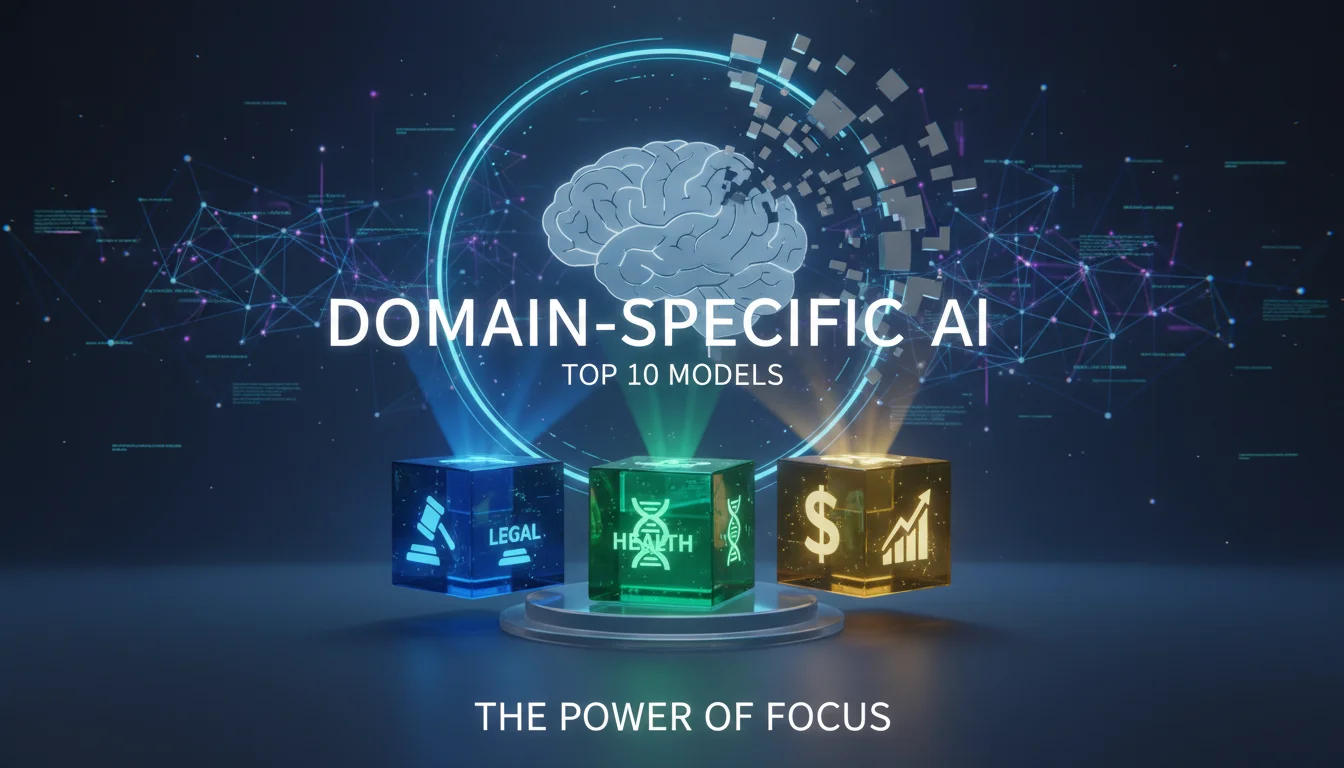
Enter Domain-Specific Language Models (DSLMs). These are the specialized surgeons of the AI world, trained on highly curated, vertical-specific datasets to deliver superior accuracy, lower latency, and significantly reduced inference costs. This guide explores the top 10 DSLMs defining the landscape in 2026, helping you move beyond the hype and into high-value implementation.
The Shift: Why Vertical AI is Winning
Before diving into the list, it is crucial to understand the economic and technical drivers behind this trend. General LLMs are trained on the “entire internet,” which introduces noise. DSLMs, by contrast, focus on signal.
- Accuracy & Compliance: DSLMs are fine-tuned on industry vernacular, reducing the risk of confident nonsense (hallucinations) in critical tasks.
- Data Privacy: Many DSLMs are designed to be self-hosted (on-premise), ensuring sensitive patient or financial data never leaves the corporate firewall.
- Cost Efficiency: A 7-billion parameter model trained on legal texts can often outperform a 1-trillion parameter generalist model at a fraction of the compute cost.
The Top 10 Domain-Specific Language Models of 2026
Category: Healthcare & Life Sciences
1. Med-PaLM 2 (Google)
The Enterprise Standard. While newer models emerge, Google’s Med-PaLM 2 remains the benchmark for proprietary medical AI. It was the first model to reach “expert” level performance on the U.S. Medical Licensing Examination (USMLE). Unlike general models, Med-PaLM 2 is tuned to align with medical consensus, making it safer for drafting clinical responses and summarizing complex patient histories.
2. BioMistral 7B
The Open-Source Efficiency King. For organizations that cannot rely on cloud-based APIs due to HIPAA or GDPR constraints, BioMistral is a game-changer. Built on top of the highly efficient Mistral architecture, this model is further pre-trained on the PubMed Central Open Access subset. It excels at processing biomedical literature and can be deployed locally on consumer-grade hardware, democratizing access to medical AI research.
Category: Finance & Economics
3. BloombergGPT
The “Big Money” Benchmark. Bloomberg shocked the industry by training a 50-billion parameter model strictly on their proprietary archive of financial data (The Terminal). While it is not open for public download, it proved a thesis: a model trained on financial tokens significantly outperforms general models on sentiment analysis, named entity recognition (NER), and financial news classification. It remains the gold standard against which other financial models are tested.
4. FinGPT
The Democratized Alternative. Recognizing that few entities have Bloomberg’s budget, the AI4Finance Foundation released FinGPT. It is an open-source framework that democratizes financial data access. FinGPT focuses on accessible fine-tuning methods (like LoRA) to allow small hedge funds and fintech startups to build custom analysts that can interpret Fed minutes or earnings call transcripts with high precision.
Category: Legal & Compliance
5. SaulLM-7B
The First True Legal LLM. Named after the famous TV lawyer, SaulLM-7B is designed explicitly for legal comprehension and generation. Unlike generic models prompted to “act like a lawyer,” SaulLM was continued-pretrained on over 30 billion tokens of English legal text. It shows state-of-the-art performance in understanding legal complexities, contract review, and identifying clauses, vastly outperforming generic 7B models in the LegalBench evaluation.
Category: Software & Cybersecurity
6. Code Llama
The Developer’s Companion. Meta’s Code Llama shifted the paradigm for coding assistants. By training on specific code-heavy datasets and allowing for massive context windows (up to 100k tokens), it can debug entire software architectures rather than just snippets. It supports obscure languages better than GPT-4 because it doesn’t dilute its weights with irrelevant natural language prose.
7. StarCoder2
The Enterprise Code Safe Bet. Developed by BigCode (a Hugging Face and ServiceNow collaboration), StarCoder2 is trained on The Stack v2—a dataset that strictly respects opt-out requests and licensing. This makes it the safest choice for enterprises worried about IP litigation associated with AI-generated code. It is the “compliant” alternative to models trained on gray-area data scrapings.
8. DarkBERT / SecLM
The Threat Hunter. Cybersecurity requires a distinct vocabulary of exploits, malware signatures, and dark web slang. DarkBERT was trained specifically on Dark Web data, allowing it to understand underground forum discussions and predict cyber threats before they surface. Similarly, SecLM variants are being adopted by SOC (Security Operations Center) teams to automate the triage of thousands of security alerts that human analysts face daily.
Category: Science & Specialized Reasoning
9. ClimateBERT
The ESG Specialist. As Environmental, Social, and Governance (ESG) reporting becomes mandatory, companies are drowning in climate data. ClimateBERT is a transformer-based model fine-tuned on climate-related texts. It helps analysts fact-check corporate claims against scientific papers and automate the extraction of climate risk data from annual reports, cutting through “greenwashing” with semantic precision.
10. DeepSeek-Math
The Reasoning Engine. While general models struggle with complex chain-of-thought logic, DeepSeek-Math (and its coding variants) has pushed the boundaries of what open-source models can calculate. By training on a massive corpus of mathematical content, it demonstrates that domain specificity isn’t just about vocabulary—it’s about logic patterns. It is increasingly used in academic research and quantitative analysis where standard LLMs fail at basic arithmetic reasoning.
How to Choose the Right DSLM for Your Enterprise
Selecting a domain-specific model is different from signing up for ChatGPT. It requires a strategic assessment of your infrastructure and data needs.
1. The “Build vs. Buy” Decision
Do you need a proprietary model like Med-PaLM 2 (Buy/API) which offers ease of use but lower data control? Or do you need an open-weights model like BioMistral or FinGPT (Build/Host) that requires engineering resources but offers total privacy?
2. RAG vs. Fine-Tuning
Often, you don’t need to retrain a model. Retrieval-Augmented Generation (RAG) allows you to connect a DSLM to your live company data. For example, using SaulLM-7B with a RAG vector database of your firm’s past contracts creates a powerful legal assistant without the cost of training a model from scratch.
Future Trends: The Rise of SLMs (Small Language Models)
The trend for 2026 is “Small is the New Big.” DSLMs are proving that a 7-billion parameter model, when trained on high-quality, domain-specific data, can outperform a 1-trillion parameter generalist model. This shift reduces energy consumption, lowers latency, and enables AI to run on edge devices—like a legal assistant running entirely on a lawyer’s laptop, offline and secure.
Frequently Asked Questions (FAQ)
What is the difference between an LLM and a DSLM?
An LLM (Large Language Model) like GPT-4 is a generalist designed to handle any task. A DSLM (Domain-Specific Language Model) is specialized. It is either trained from scratch on industry data (like BloombergGPT) or fine-tuned from a general model to excel in a specific vertical (like Med-PaLM).
Are DSLMs better than GPT-4?
In their specific niche, yes. For example, a legal DSLM will likely interpret a complex contract clause more accurately and with less hallucination than GPT-4, often at a much lower cost. However, GPT-4 will still outperform them in general creative tasks.
Can I run these models on my own servers?
Many of the models listed, such as BioMistral, FinGPT, SaulLM-7B, and StarCoder2, are “open weights.” This means you can download them from repositories like Hugging Face and run them on your own private cloud or on-premise hardware, ensuring total data sovereignty.
How do I reduce hallucinations in DSLMs?
While DSLMs naturally hallucinate less in their domain, the best practice is to combine them with RAG (Retrieval-Augmented Generation). This forces the model to cite sources from your trusted internal database before generating an answer.
Conclusion
The “Gold Rush” of General AI is settling, and the “Industrial Revolution” of Vertical AI has begun. For tech leaders and industry professionals, the opportunity in 2026 lies not in using the same generic tools as everyone else, but in leveraging Domain-Specific Language Models to build moats of expertise, efficiency, and trust.
Whether you are automating legal compliance with SaulLM or accelerating drug discovery with BioMistral, the tools are now available. The question is no longer “What can AI do?” but “What can AI do specifically for my industry?”