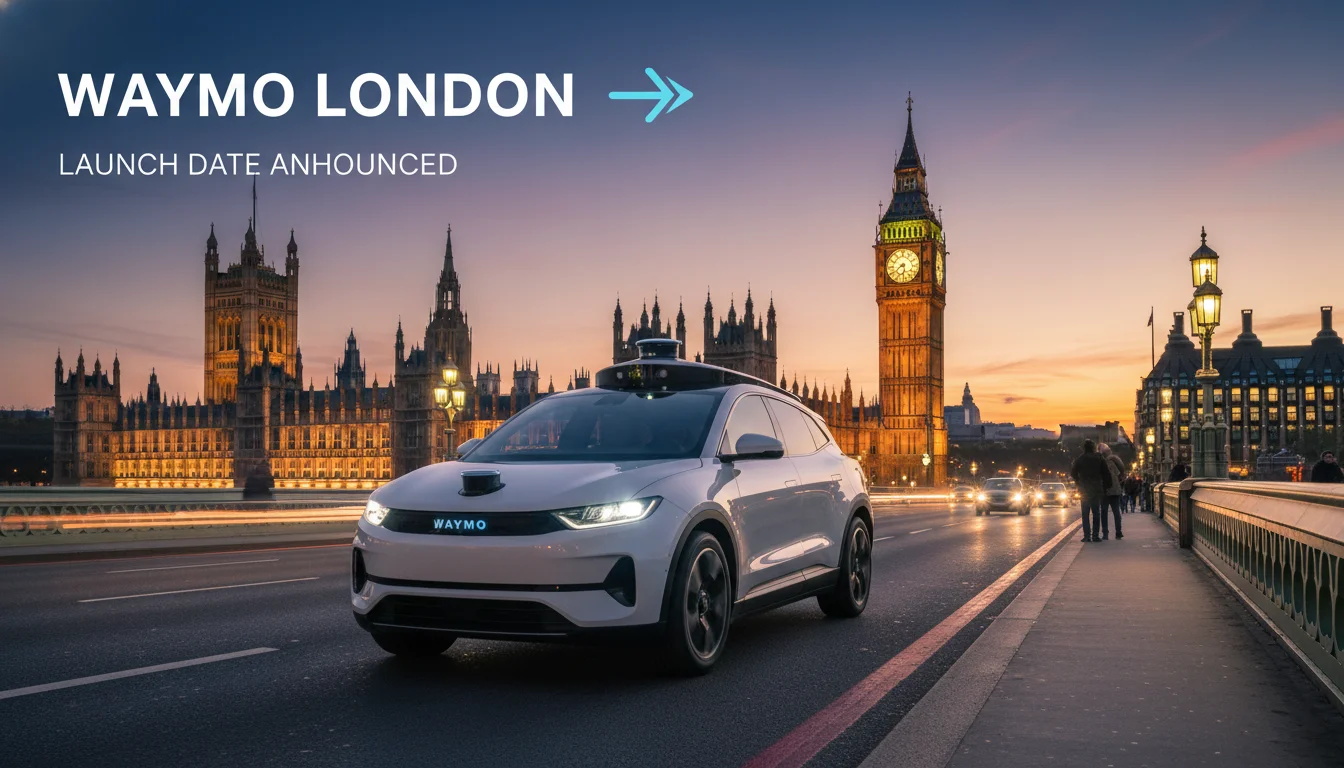

The race for autonomous mobility in Europe has officially entered its final lap. After years of speculation and closed-door testing, Waymo has confirmed its plans to launch a commercial robotaxi service in London in 2026.
This isn’t just another tech trial; it is a definitive signal that the autonomous vehicle (AV) industry is shifting from R&D to global scale. With the UK’s Automated Vehicles Act 2024 providing a concrete legal framework, London is set to become the first major European battleground for driverless technology.
For tech investors, urban planners, and future riders, the question is no longer if robotaxis are coming, but how they will integrate into one of the world’s most complex transit networks. In this deep dive, we break down the official timeline, the regulatory green light, and the looming technological showdown between Silicon Valley’s giant and the UK’s homegrown challenger, Wayve.
The Official Waymo London Launch Date & Timeline
According to the latest announcements and regulatory filings, Waymo’s entry into the London market will follow a phased approach designed to satisfy the rigorous safety standards of Transport for London (TfL).
- Pilot Phase (April 2026): The initial rollout is expected to begin in Spring 2026. This phase will likely be limited to specific user groups—such as Waymo employees and a select group of “trusted testers”—operating primarily in defined zones.
- Public Commercial Launch (Targeting September 2026): Following successful validation of the pilot data, a wider public launch is projected for late 2026. This would open the Waymo One app to general consumers, likely starting in central boroughs before expanding outward.
This timeline aligns perfectly with the UK government’s roadmap. While the Automated Vehicles Act received royal assent in 2024, the specific permit schemes for “automated passenger services” are set to go live in Spring 2026, allowing operators like Waymo to legally charge fares for driverless rides.
Why London? Why Now?
London represents a strategic “boss level” for autonomous driving systems. Unlike the wide, grid-structured avenues of Phoenix or Salt Lake City, London’s streets are narrow, medieval in layout, and teeming with unpredictable interactions—from aggressive black cabs to cyclists and jaywalkers. Mastering London proves that an AV stack can handle high-entropy urban environments globally.
The Regulatory Green Light: Automated Vehicles Act 2024
The catalyst for this 2026 launch is the UK’s forward-thinking regulatory environment. The Automated Vehicles Act 2024 is widely regarded as one of the most comprehensive legal frameworks for AVs in the world.
Key provisions enabling the launch include:
- Legal Liability Shift: Crucially, the Act shifts criminal and civil liability from the user (the passenger) to the “Authorized Self-Driving Entity” (ASDE)—in this case, Waymo. This legal clarity is essential for consumer trust and corporate insurance.
- No-User-in-Charge (NUIC) Operations: The legislation explicitly creates a category for vehicles that do not require a human driver to be ready to take control, clearing the way for fully steering-wheel-free experiences in the future.
- Permit Schemes: The government has fast-tracked secondary legislation to create permit schemes for commercial operators by 2026, ensuring that companies don’t just test, but can build sustainable businesses.
The Tech Showdown: Waymo vs. Wayve
While Waymo is the global heavyweight, it won’t be entering an empty market. London is the home turf of Wayve, an AV unicorn backed by Uber and SoftBank, which is also targeting a 2026 commercial rollout. This sets the stage for a fascinating clash of technological philosophies.
1. Waymo: The Modular & Map-Based Approach
Waymo’s “Driver” uses a hybrid modular architecture. It relies on:
- High-Definition (HD) Maps: Waymo vehicles pre-map cities in millimeter-level detail. The car knows exactly where the curb should be before it even sees it.
- Multi-Sensor Fusion: A robust suite of LiDAR, radar, and cameras provides redundant layers of safety.
- Rule-Based Safety: While it uses heavy Machine Learning (ML), Waymo’s stack still incorporates explicit safety constraints and heuristics.
The Pro: Incredible reliability and safety records. It is the gold standard for current Level 4 autonomy.
The Con: Scalability. Every new neighborhood needs to be mapped and maintained. If roadworks change a layout significantly, the map needs updating.
2. Wayve: The End-to-End AI Challenger
Wayve advocates for an “AV 2.0” End-to-End Learning approach. Their system:
- Map-Agnostic: It doesn’t rely on HD maps. Instead, it reads the road in real-time using cameras, much like a human driver.
- Pure AI Output: Raw sensor data goes in, and driving commands come out. The system learns driving behaviors from vast amounts of data rather than coded rules.
The Pro: rapid scalability. theoretically, a Wayve car could be dropped in a new city and drive immediately without weeks of pre-mapping.
The Con: Validation. Proving that a “black box” neural network will always make the safe decision in edge cases is a massive engineering challenge.
In 2026, Londoners will effectively be beta-testing these two diverging visions of the future. Will Waymo’s proven precision win out, or will Wayve’s adaptable AI prove more suited to London’s chaotic streets?
What to Expect: The Rider Experience
For those eager to hail their first robotaxi, here is what the service will likely look like:
The Vehicle: Jaguar I-PACE
Waymo will deploy its fleet of all-electric Jaguar I-PACE SUVs. These vehicles are already a common sight in Waymo’s US territories. They offer a premium, quiet ride, aligning with London’s Ultra Low Emission Zone (ULEZ) requirements.
The Service Partner: Moove
Waymo isn’t handling the fleet logistics alone. They have partnered with Moove, a mobility fintech company, to manage fleet operations, charging, and maintenance. This partnership ensures that while Waymo focuses on the software driver, the physical cars remain clean, charged, and serviced.
FAQ: Waymo in London
When exactly can I ride a Waymo in London?
We expect a closed pilot for employees and testers to begin in April 2026. If you are a member of the general public, look for a waitlist opening in mid-2026 for a potential commercial launch by September 2026.
Will there be a human driver in the car?
During the initial testing phases in late 2025 and early 2026, you will see Waymo cars with human safety drivers. However, the goal of the commercial launch in late 2026 is to be fully driverless, meaning no one will be in the front seat.
Is it safe?
Safety is the primary selling point. In the US, Waymo has driven over 7 million fully autonomous miles with a safety record that significantly outperforms human benchmarks, involving far fewer injury-causing crashes.
How much will it cost?
Pricing models have not been confirmed, but in US markets like San Francisco and Phoenix, Waymo fares are generally competitive with Uber and Lyft “Premier” tiers. Initially, prices may be subsidized to encourage adoption.
Conclusion
The confirmed 2026 launch of Waymo in London is a watershed moment for the European tech landscape. It signifies the maturity of autonomous technology and the readiness of regulators to embrace it. While the technical battle between Waymo’s mapping dominance and Wayve’s AI adaptability heats up, the ultimate winner will be the London commuter, who is finally on the verge of accessing a safer, greener, and more efficient mode of urban transport.