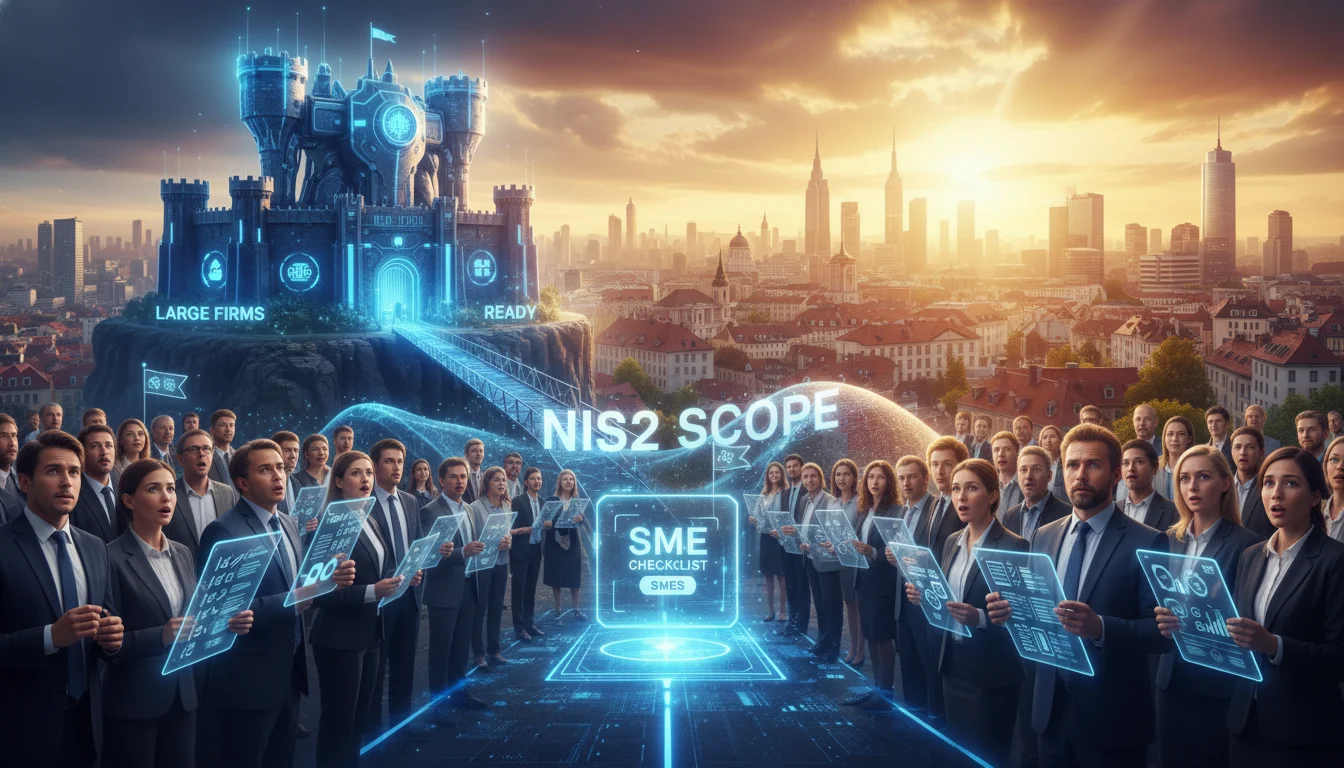

By early 2026, the grace period is effectively over. The transposition deadlines for the NIS2 Directive (Network and Information Security 2) have passed across the European Union, and national authorities are shifting gears from education to enforcement. For multinational corporations, this transition has been part of a multi-year roadmap. But for millions of small and medium-sized enterprises (SMEs)—specifically the mid-market companies that form the backbone of Europe’s supply chain—the reality is just hitting home.
If you are reading this, you likely just realized your company falls under the scope of NIS2 as an "Important Entity." Perhaps a major client sent you a security questionnaire demanding proof of compliance, or your legal team flagged the new liability clauses that hold C-level executives personally accountable.
This is not just another GDPR. NIS2 is about operational survival. It mandates strict cybersecurity risk management measures and reporting obligations. Failure to comply doesn’t just mean fines; it means being cut off from the supply chains of essential sectors like energy, transport, and healthcare.
This guide serves as a high-authority, actionable NIS2 compliance checklist tailored for SMEs. We will strip away the legalese and focus on what your IT and management teams need to implement now.
1. Determine Your Classification: Essential vs. Important
Before diving into the technical controls, you must confirm your status. NIS2 eliminates the old distinction between "Operators of Essential Services" and "Digital Service Providers." Instead, it categorizes entities based on size and sector criticality.
Are You an "Important Entity"?
Most SMEs reading this will fall into the Important Entity category. You are likely in scope if:
- You have between 50 and 250 employees.
- OR you have an annual turnover between €10 million and €50 million.
- AND you operate in one of the expanded sectors: Food production, Manufacturing (medical devices, machinery, vehicles), Chemicals, Waste Management, Postal/Courier Services, or Digital Providers (social networks, marketplaces).
Note: If you are a sole provider of a critical service (e.g., a specific DNS provider or a monopoly supplier to the energy grid), you might be bumped up to "Essential" regardless of size.
Why the Distinction Matters
While the security requirements are largely the same for both, the enforcement and fines differ:
- Essential Entities: Face proactive supervision (audits) and fines up to €10M or 2% of global turnover.
- Important Entities (SMEs): Face ex-post supervision (audited only after an incident occurs) and fines up to €7M or 1.4% of global turnover.
SEO Insight: Many SMEs mistakenly believe "ex-post supervision" means they can fly under the radar. This is dangerous. If you suffer a breach and are found non-compliant, the full weight of the penalties applies immediately.
2. Governance and Management Liability
NIS2 changes the game by placing responsibility directly on the shoulders of the "management body" (C-Suite and Board).
The Checklist:
- Executive Training: The board must undergo mandatory cybersecurity training to understand risk management.
- Approval of Measures: Management must explicitly approve cybersecurity risk assessment methodologies and policies.
- Liability Acknowledgement: Executives can be held personally liable for gross negligence in complying with NIS2. In some jurisdictions, this includes temporary bans from management roles.
Action Item: Schedule a board meeting this week to formally minute NIS2 responsibilities. Ignorance is no longer a legal defense.
3. The Comprehensive Risk Management Framework
You cannot secure what you don’t understand. NIS2 requires an "all-hazards" approach to risk management, meaning you must consider physical security, supply chain disruptions, and human error alongside digital threats.
The Checklist:
- Asset Inventory: Map all information systems, cloud assets, and shadow IT.
- Threat Modeling: Identify specific cybersecurity challenges faced by small businesses (e.g., ransomware, industrial espionage, insider threats).
- Regular Risk Assessments: Move from annual check-the-box audits to continuous risk monitoring.
4. Supply Chain Security (The SME Pain Point)
This is the primary reason mid-market firms are rushing to comply. "Essential" entities (your big clients) are legally required to secure their supply chains. They will audit you.
The Checklist:
- Supplier Vetting: If you use managed service providers (MSPs) or cloud vendors, you must verify their security posture and the differences between sovereign cloud vs public cloud providers.
- Contractual Clauses: Update contracts to ensure your suppliers notify you of breaches within NIS2 timelines.
- Security Questionnaires: Prepare a "Security Pack" (ISO 27001 certs, SOC2 reports, pentest summaries) to respond quickly to your clients’ demands.
5. Incident Handling and Reporting Protocols
NIS2 introduces extremely tight reporting windows that will test your incident response (IR) capabilities and your internal practical guide for what to do after a data breach.
The Checklist:
- 24-Hour Early Warning: You must notify the CSIRT (Computer Security Incident Response Team) within 24 hours of becoming aware of a significant incident.
- 72-Hour Incident Notification: A detailed assessment of the severity and impact is due within 72 hours.
- One-Month Final Report: A complete forensic report and root cause analysis is due within one month.
Action Item: Do you have a 24/7 contact point? If a breach happens on a Friday night, do you have the process to notify authorities by Saturday night? If not, you are non-compliant.
6. Business Continuity and Crisis Management
Resilience is the core theme of NIS2. It’s not just about stopping attacks; it’s about surviving them.
The Checklist:
- Backup Strategy: Implement immutable backups (offline or WORM storage) to defend against ransomware.
- Disaster Recovery Plan (DRP): Test your DRP annually. Can you restore critical operations within your defined Recovery Time Objective (RTO)?
- Crisis Communication: Draft templates for communicating with stakeholders, customers, and the public during a breach.
7. Cyber Hygiene and Basic Controls
NIS2 mandates "basic cyber hygiene" practices. These are non-negotiable technical baselines.
The Checklist:
- Zero Trust & Access Control: Implement strict Least Privilege principles.
- MFA (Multi-Factor Authentication): Mandatory for all remote access and administrative accounts.
- Patch Management: Automated processes to patch critical vulnerabilities within defined timeframes (e.g., 48 hours for critical CVEs).
- Network Segmentation: Separate IT (Information Technology) from OT (Operational Technology) networks to prevent lateral movement.
8. Cryptography and Encryption
Data must be protected at rest and in transit. NIS2 specifically highlights the use of cryptography.
The Checklist:
- End-to-End Encryption: Ensure sensitive data in transit is encrypted (TLS 1.2/1.3).
- Encryption at Rest: Full disk encryption on laptops and database encryption for servers.
- Key Management: Securely manage and rotate encryption keys.
9. Human Resources Security
People are often the weakest link. NIS2 requires technical and organizational measures to address human risk.
The Checklist:
- Security Awareness Training: Regular, mandatory phishing simulations and training for all staff.
- Background Checks: Screening for employees with access to critical systems (in accordance with local labor laws).
- Offboarding Procedures: Immediate revocation of access rights upon employee termination.
10. Auditing and Evidence
Since SMEs are subject to ex-post supervision, you must have the "receipts" ready when an incident occurs.
The Checklist:
- Log Management: Centralized logging (SIEM) to detect and investigate anomalies.
- Documentation: Maintain up-to-date policies, incident logs, and risk assessment reports.
- Internal Audits: Conduct an annual internal review of your compliance posture.
FAQ: NIS2 for SMEs
Does NIS2 replace GDPR?
No. GDPR protects personal data; NIS2 protects services and infrastructure. They are complementary. A data breach often triggers reporting obligations under both regulations.
I am a small manufacturer; why do I need to comply?
If you supply critical components to "Essential" sectors (e.g., energy, health, transport), you are part of the critical supply chain. Your clients will require your compliance to satisfy their own legal obligations.
What is the cost of non-compliance?
Beyond the fines (up to €7M for SMEs), the real cost is business exclusion. Large enterprise buyers are systematically offboarding non-compliant vendors to reduce their own third-party risk.
Conclusion: Turning Compliance into Competitive Advantage
The NIS2 Directive is undoubtedly a heavy lift for mid-market companies. However, in 2026, cybersecurity is no longer an IT issue—it is a license to operate. By proactively tackling this checklist, European SMEs can differentiate themselves. In a market where supply chain trust is paramount, being "NIS2 Compliant" is a powerful badge of trust that can win you contracts over less prepared competitors.
Don’t wait for a breach to test your readiness. Start with the governance, secure your perimeter, and build a culture of resilience today.