
The New Reality of European Cloud Infrastructure
For European technology leaders, the cloud calculation has fundamentally changed. As we move into 2026, the debate is no longer just about cost versus agility; it is about legal immunity versus feature density. With the European Commission’s introduction of the Sovereignty Effectiveness Assurance Level (SEAL) framework in late 2025, the ambiguity surrounding "digital sovereignty" has been replaced by hard metrics.
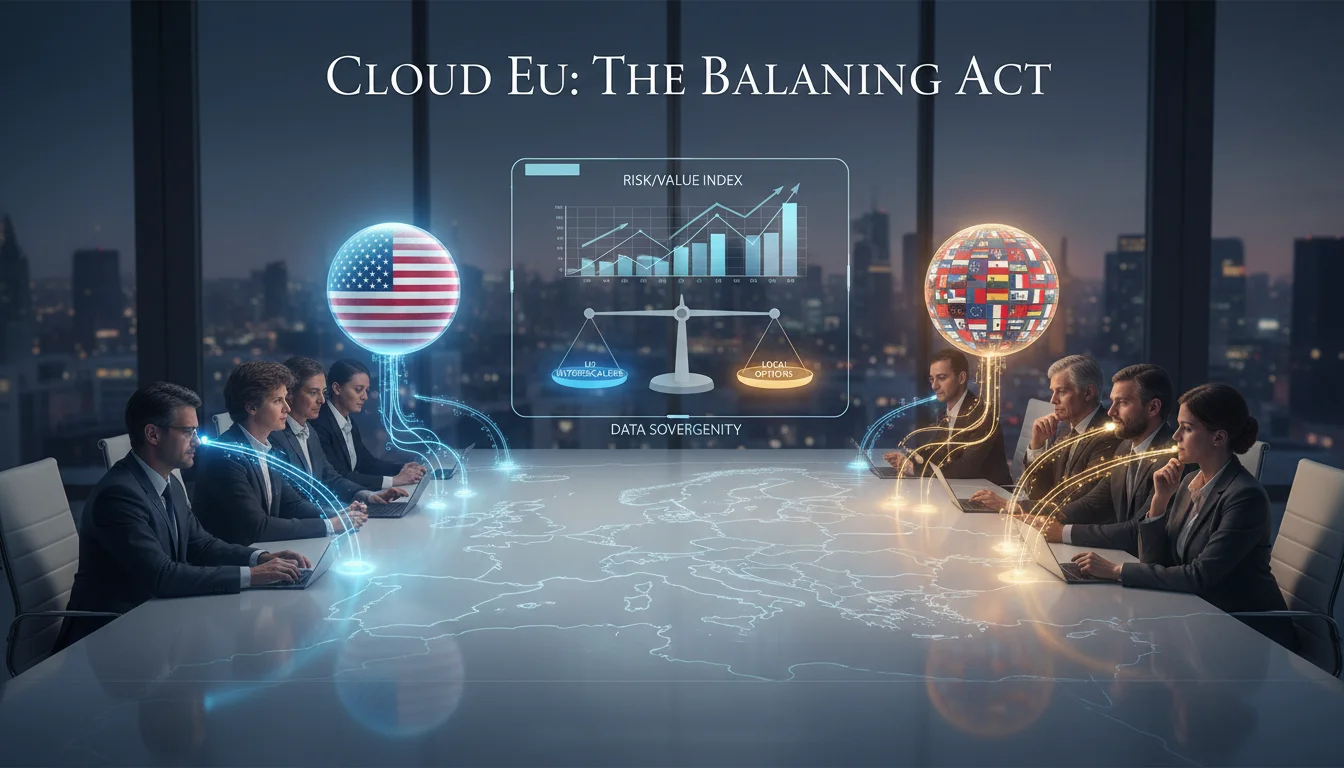
Decision-makers are now facing a critical fork in the road. On one side stand the US hyperscalers (AWS, Azure, Google), offering unmatched AI capabilities and ecosystem maturity but carrying the persistent baggage of the US CLOUD Act. On the other side are European sovereign providers (OVHcloud, Scaleway, T-Systems), offering genuine jurisdictional immunity and GDPR purity, yet often trailing in advanced platform services. This article provides a high-level, comparative analysis to help regulated industries and enterprises navigate the sovereign cloud vs public cloud Europe comparison.
The Core Conflict: Data Residency is Not Sovereignty
A common misconception derail cloud strategies: equating data residency (where the data sits) with data sovereignty (who controls the data). US hyperscalers have aggressively marketed "sovereign" solutions by building data centers in Frankfurt, Paris, and Dublin. However, the legal reality remains unchanged.
- The US CLOUD Act Factor: Enacted in 2018, this law allows US federal law enforcement to compel US-based technology companies to provide requested data, regardless of where that data is stored globally. Even if your data is on a server in Berlin, if that server is owned by a US subsidiary, it is reachable by US warrants.
- The GDPR Conflict: This creates a direct friction with GDPR Article 48, which prohibits transferring EU data to foreign courts without an international treaty. For European CIOs in healthcare, finance, and government, this "jurisdictional leak" is no longer an acceptable risk.
The 2026 Benchmark: Understanding the SEAL Framework
To standardize the market, the EU’s new Cloud Sovereignty Framework has introduced the SEAL rating system (0 to 4). Understanding this is crucial for procurement:
- SEAL Level 0 (No Sovereignty): Operations controlled by non-EU third parties. Typical public cloud offerings.
- SEAL Level 1 (Jurisdictional Sovereignty): EU law applies, but practical enforceability is limited due to foreign parent companies. (e.g., Standard US Hyperscaler EU Regions).
- SEAL Level 2 (Data Sovereignty): Data is processed locally, but dependencies on non-EU tech stacks remain.
- SEAL Level 3 (Digital Resilience): Technology and operations are under complete EU control, subject only to EU law, with no critical non-EU dependencies. This is the new "Gold Standard" for critical infrastructure.
Deep Dive: Sovereign Cloud vs. US Hyperscalers
When weighing European sovereign cloud providers vs US hyperscalers, the trade-offs are distinct. The following comparison highlights the current state of the market.
1. Legal Immunity and Compliance
European Sovereign Cloud: Providers like OVHcloud, Scaleway, and Hetzner offer native immunity to the US CLOUD Act. Their corporate headquarters, shareholder structures, and operational teams are entirely EU-based. For strict compliance with the NIS2 Directive and DORA (Digital Operational Resilience Act), these providers offer the path of least resistance.
US Hyperscalers: Offer "Sovereign Controls" packages (e.g., external key management, local support personnel). While these reduce the practical risk of data access, the theoretical legal risk remains non-zero. They are often sufficient for commercial entities but increasingly rejected for "RESTRICTED" or "SECRET" government classifications.
2. Feature Depth and Innovation Gap
US Hyperscalers: Unrivaled. If your business relies on advanced Generative AI pipelines, serverless event-driven architectures, or global edge computing, AWS and Azure are years ahead. They effectively commoditize innovation.
European Sovereign Cloud: The gap is closing but visible. While basic IaaS (Compute, Storage, Networking) is on par with hyperscalers—and often significantly cheaper—higher-level PaaS offerings (managed AI, IoT suites) are less mature. However, the rise of Open Source standards (Gaia-X, SCS) is allowing EU providers to offer standardized, portable alternatives that prevent vendor lock-in.
3. Cost and Predictability
European Sovereign Cloud: generally offers transparent, flat-rate pricing. Bandwidth costs (egress fees) are often non-existent or significantly lower. This makes them highly attractive for high-traffic workloads.
US Hyperscalers: notorious for complex pricing models where egress fees can balloon budgets. The premium paid is for the advanced ecosystem, not the raw infrastructure.
Strategic Framework: Which Cloud Strategy Fits You?
We recommend a Data Classification-Based Hybrid Strategy for 2026:
- Use EU Sovereign Clouds (SEAL 3) for: Personal Identifiable Information (PII) of EU citizens, health records, critical infrastructure telemetry, and intellectual property sensitive to industrial espionage.
- Use US Hyperscalers (SEAL 1/2) for: Customer-facing applications requiring global CDN reach, rapid prototyping of GenAI models (using sanitized data), and non-sensitive commercial workloads.
The Role of Encryption and “Bring Your Own Key” (BYOK)
For organizations forced to use US hyperscalers due to technical requirements, External Key Management (EKM) is the middle ground. By hosting encryption keys outside the hyperscaler (on a hardware security module managed by a European entity like Thales), you effectively render the data opaque to the provider. However, this often breaks advanced cloud features that require clear-text data processing (like AI indexing), re-introducing the functionality trade-off.
Conclusion
The choice between sovereign cloud vs public cloud in Europe is no longer binary. It is a spectrum of risk tolerance managed through the SEAL framework. While US hyperscalers remain the engine of global digital innovation, European sovereign clouds have evolved from niche players to essential pillars of a resilient digital strategy. For the regulated enterprise of 2026, the winning strategy is not "Cloud First," but "Sovereign Smart"—placing the right data in the right jurisdiction, every time.