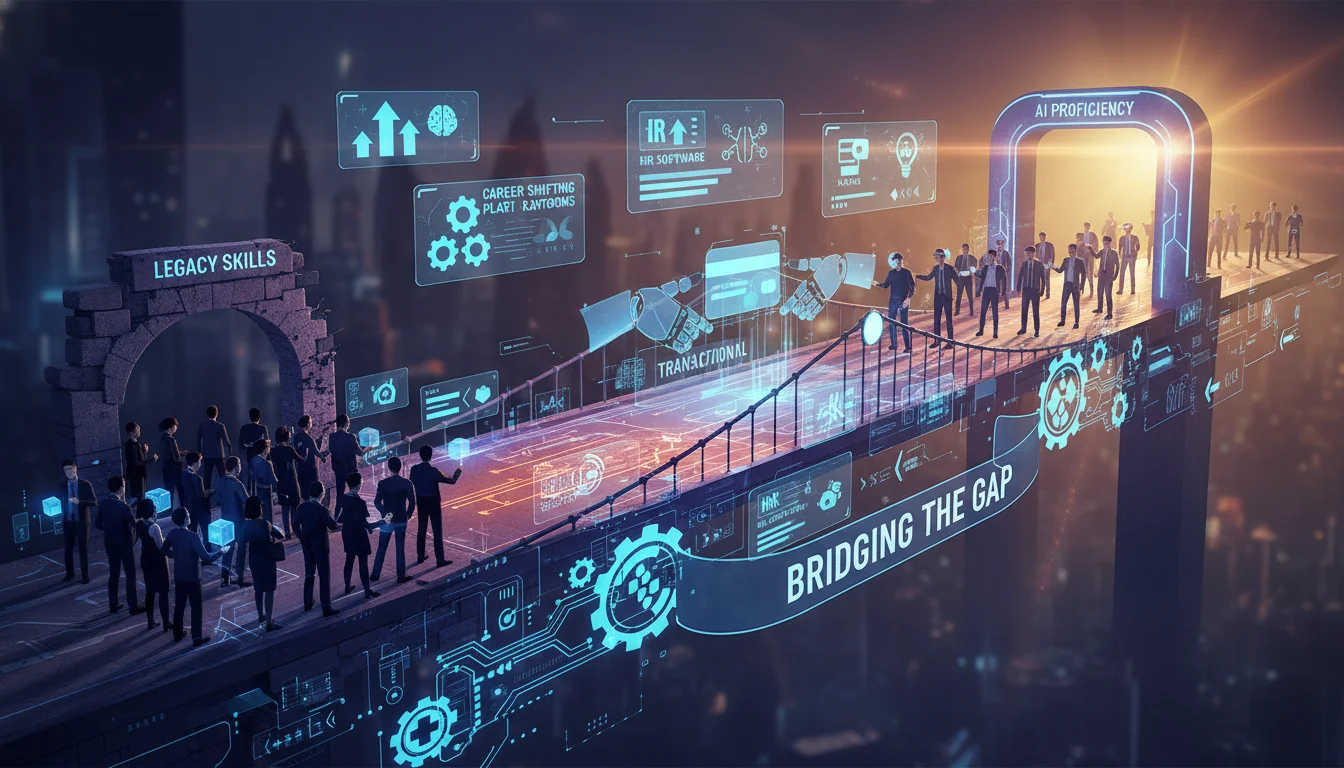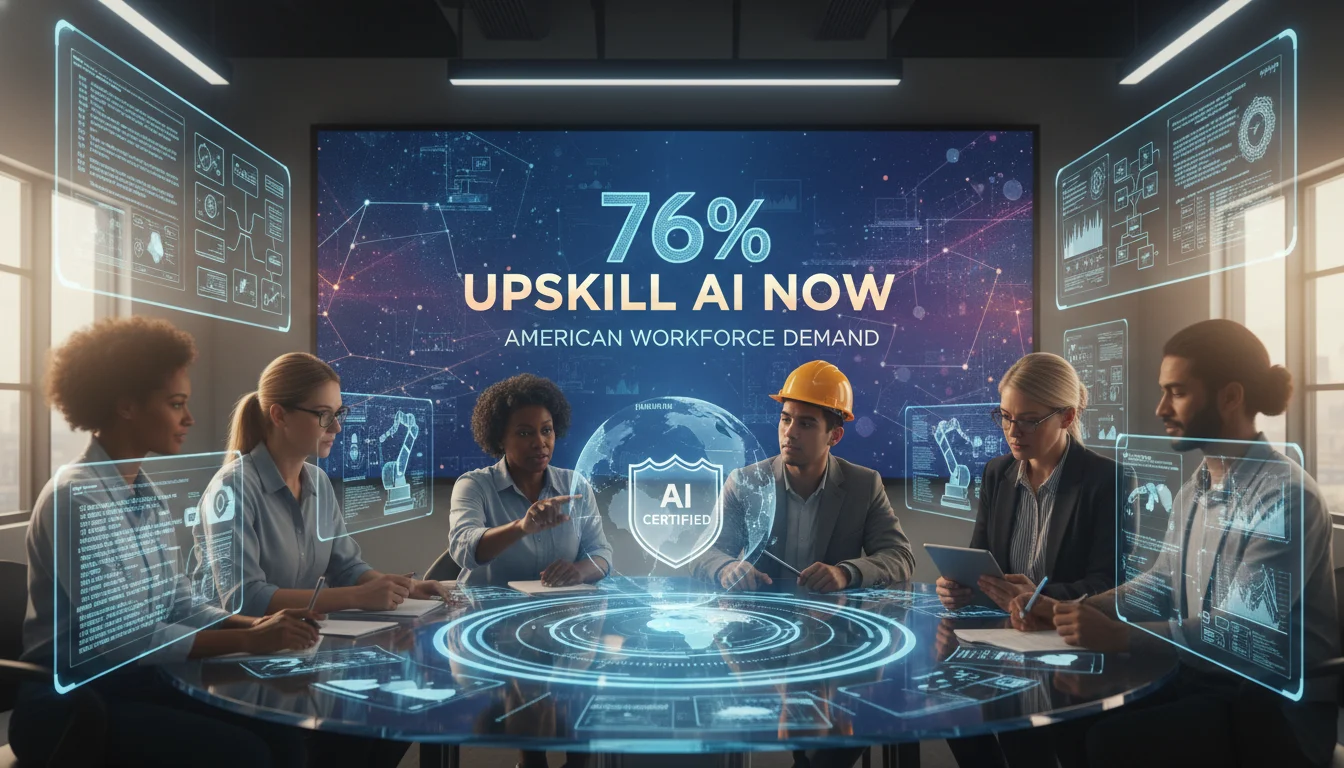

The American workforce is standing on the precipice of the largest skills transformation since the industrial revolution. With recent reports indicating that 76% of the workforce is actively looking to upskill to remain competitive, the race is no longer about if you should learn Artificial Intelligence, but how fast you can demonstrate proficiency.
For the average American worker—whether in manufacturing, administration, marketing, or logistics—the “AI revolution” can feel overwhelming. Is it just for coders? Do you need a degree? The answer is a resounding no. In 2025, AI literacy has become the new computer literacy. This guide uses the Koray Framework of semantic coverage to provide a comprehensive, localized roadmap for US workers seeking to secure their careers through AI upskilling.
The State of AI in the US Labor Market: Why Now?
The demand for AI skills in the US job market is not just growing; it is exploding. According to recent data from McKinsey and Indeed, job postings requiring “AI fluency”—the ability to use and manage AI tools rather than build them—have grown sevenfold in the last two years. This distinction is critical: employers are not just looking for computer scientists; they are looking for AI-literate project managers, HR professionals, and marketers.
The Wage Premium
Upskilling isn’t just about job security; it’s about income mobility. Recent labor statistics suggest that non-tech roles requiring AI skills (such as “Generative AI for Content Creation” or “AI-driven Data Analysis”) are commanding wage premiums of 10% to 25% over their non-AI counterparts. For specialized roles in finance and operations, that premium can jump to over 40%.
Top Federal and State-Funded AI Initiatives
One of the most overlooked resources for American workers is the government’s investment in workforce development. Unlike private bootcamps that can cost thousands, federal initiatives often provide free or subsidized pathways.
The WIOA and AI Literacy
The U.S. Department of Labor has issued guidance encouraging states to use Workforce Innovation and Opportunity Act (WIOA) funds to bolster AI literacy. If you are a dislocated worker or actively seeking employment, your local American Job Center may offer grant-funded access to AI certifications.
DOE and NSF: “Supercharging America’s AI Workforce”
The Department of Energy and National Science Foundation have launched the “Supercharging America’s AI Workforce” initiative. While often aimed at researchers, this program is trickling down to community colleges, funding new curriculums that make technical training accessible to those without 4-year degrees.
For Federal Employees
If you work for the government, the GSA (General Services Administration) has rolled out an AI Training Series specifically designed to upskill federal employees on ethical AI use, prompt engineering, and data literacy.
Best Private Sector AI Certifications (2025 Edition)
For those in the private sector, big tech has stepped in to fill the education gap with high-quality, often free, certifications. These are the current gold standards for non-technical workers.
1. Salesforce: The “AI for All” Initiative
Best For: Sales, Marketing, and CRM Administrators.
Cost: Free (through end of 2025).
Salesforce has invested over $50 million to offer free hands-on AI courses and certifications. Their focus is on practical application—how to use AI agents to automate customer service workflows and sales data analysis. Their “AI Associate” certification is an excellent entry-level badge for your LinkedIn profile.
2. Google: AI Essentials & Prompting Essentials
Best For: General Knowledge Workers and Office Staff.
Cost: Low cost (via Coursera) or free via scholarship programs.
Google’s “AI Essentials” is a non-technical course designed to be completed in under 10 hours. It teaches you how to use generative AI tools to brainstorm, write, and organize work. It is platform-agnostic, meaning the skills apply whether you use ChatGPT, Gemini, or Claude.
3. AWS “AI Ready” Program
Best For: Operations and Cloud-Adjacent Roles.
Cost: Free.
Amazon Web Services aims to train 2 million people by 2025 with its “AI Ready” commitment. They offer specific tracks for business leaders and non-technical staff, focusing on how generative AI can be deployed in business operations without writing a single line of code.
4. Microsoft & LinkedIn Learning
Best For: Corporate Professionals.
Microsoft’s “Career Essentials in Generative AI” is one of the most popular introductory courses. It covers the ethics of AI, basic prompt engineering, and how to use Microsoft Copilot in the 365 ecosystem (Word, Excel, PowerPoint).
Strategic Upskilling: A Roadmap for Workers
Randomly taking courses is not a strategy. To truly upskill, follow this semantic progression:
- Step 1: Foundational Literacy. Understand what LLMs (Large Language Models) are, their limitations, and how to use AI safely. (Recommended: Google AI Essentials)
- Step 2: Tool Proficiency. Master the tools specific to your trade. If you are in HR, learn AI for talent acquisition. If you are in coding, learn GitHub Copilot.
- Step 3: Process Integration. Learn how to redesign workflows. The most valuable employee is not the one who uses AI to write an email, but the one who uses AI to automate the entire weekly reporting process.
FAQ: AI Training for the US Workforce
Will AI replace my job if I don’t upskill?
It is less likely that AI will replace you, and more likely that a person using AI will replace you. Upskilling is your insurance policy against obsolescence.
Are these certifications recognized by US employers?
Yes. Major corporations recognize certifications from Google, Microsoft, and Salesforce. They signal to employers that you have a “growth mindset” and are proactive about technological shifts.
Can I get my employer to pay for AI training?
Absolutely. Most US companies have professional development budgets. Frame your request around ROI: “This $300 course will allow me to automate our weekly data reporting, saving the team 5 hours a week.”
Do I need to know how to code to learn AI?
No. The rise of “No-Code” and “Low-Code” AI tools means that critical thinking, domain expertise, and communication skills are now more important than Python for the average user.
Conclusion
The “AI Skills Gap” is real, but so is the opportunity. For American workers, 2025 serves as a pivotal year to embrace localized, accessible training programs. Whether you leverage federal WIOA grants or free private-sector certifications, the path to AI literacy is open. The future of work isn’t coming; it’s already here. The only question is: are you ready to train for it?