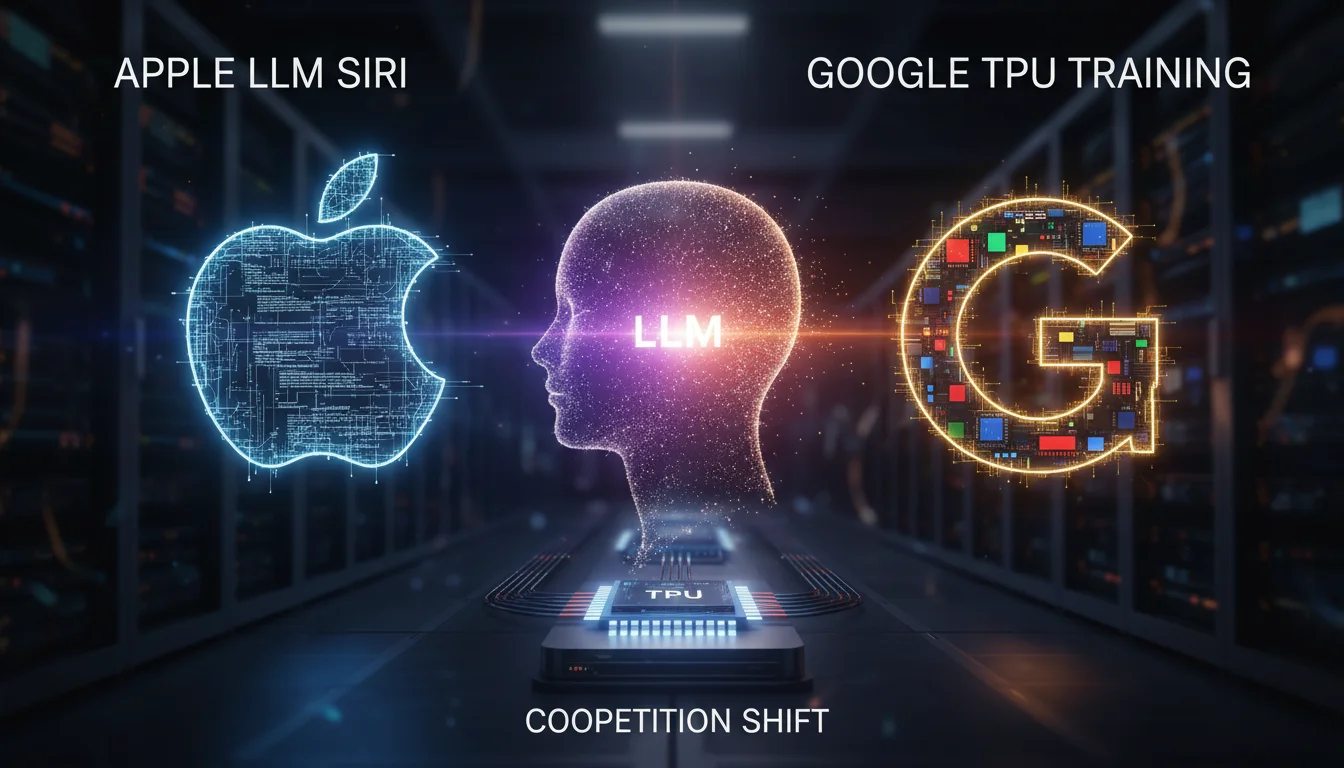

In the high-stakes arena of Artificial Intelligence, hardware is destiny. For years, the narrative has been dominated by a single player: Nvidia. However, recent technical disclosures regarding Apple Intelligence and the architecture behind the next-generation Siri have sent shockwaves through the industry. Apple is not building its massive Large Language Models (LLMs) solely on the ubiquitous Nvidia H100s; instead, they have leveraged a surprising ally: Google Cloud’s Tensor Processing Units (TPUs).
This development is more than a technical footnote—it is a geopolitical maneuver in the landscape of Big Tech. It signals a new era of “coopetition” where Apple, known for its vertical integration, is strategically diversifying its infrastructure dependencies. In this deep dive, we explore why Apple chose Google TPUs for Siri’s training, the technical specifications of the Apple Foundation Model (AFM), and the broader implications for the AI hardware market.
The Architecture of an Alliance: Apple’s AFM and Google TPUs
To understand the magnitude of this shift, we must look at the specific hardware utilized. according to Apple’s machine learning research, the foundational models powering the new conversational Siri—specifically AFM-on-device and AFM-server—were trained using Google’s custom silicon.
Breaking Down the Hardware Stack
Apple utilized two distinct generations of Google’s processors for different stages of the model development:
- TPUv4: Utilized for the initial training phases and smaller model iterations. These chips are arranged in pods of 4,096 chips, offering massive throughput for intermediate workloads.
- TPUv5p: Google’s most advanced AI accelerator, used for the heavy lifting of the larger server-side models. Apple linked together 8,192 TPUv5p chips to create a massive training cluster.
This decision highlights a critical bottleneck in the current AI ecosystem: the scarcity of GPUs. By utilizing Google’s TPU infrastructure, which is architecturally distinct from Nvidia’s GPU clusters, Apple effectively sidestepped the supply chain constraints plaguing competitors like OpenAI and Microsoft.
Strategic Coopetition: Why Google?
The term “coopetition”—cooperation between competitors—has rarely been more applicable. Apple and Google are fierce rivals in the mobile OS market (iOS vs. Android) and increasingly in the AI assistant space (Siri vs. Gemini). So, why trust a rival with the “brain” of your most important product?
1. Infrastructure Maturity and AXLearn
Google has been building TPUs for over a decade specifically for deep learning. Unlike general-purpose GPUs, TPUs are ASICs (Application-Specific Integrated Circuits) designed for matrix multiplication—the core math of AI. Apple built its training framework, AXLearn, on top of JAX, a Python library extensively supported by Google’s ecosystem. This software-hardware synergy likely offered efficiency gains that generic GPU clusters could not match without significant optimization.
2. Energy Efficiency and Cost
Training LLMs consumes gigawatts of power. Google’s TPUs, specifically the v5p, are renowned for their performance-per-watt efficiency. For a company like Apple, which emphasizes environmental goals, the energy footprint of training the Apple Foundation Model is a key metric. The 3D torus topology of TPU pods allows for more efficient data flow between chips, reducing the “tax” of moving data around during training.
3. Diversification from Nvidia
Relying entirely on Nvidia creates a single point of failure and pricing vulnerability. By validating Google TPUs for state-of-the-art LLM training, Apple proves that high-end AI is not synonymous with Nvidia. This gives Apple leverage in future hardware negotiations and aligns with their long-term strategy of silicon independence.
AFM-Server vs. AFM-On-Device: The Hybrid Approach
The utilization of Google TPUs was primarily for the training phase. However, the inference (the actual running of Siri when you ask a question) follows Apple’s hybrid compute model.
Private Cloud Compute (PCC)
While Google hardware taught Siri how to speak, Apple hardware helps Siri think. Complex queries that cannot be handled by the iPhone’s on-board Neural Engine are sent to Apple’s Private Cloud Compute. These servers run on Apple Silicon (M2 Ultra chips), not Google TPUs. This distinction is vital for privacy. Apple uses Google for the brute-force math of learning, but brings the execution back to its own walled garden to ensure user data never persists on third-party hardware.
Technical Deep Dive: The AXLearn Framework
To orchestrate thousands of Google TPUs, Apple developed AXLearn. This open-source framework allows for efficient training of large models by handling data parallelism and tensor parallelism automatically. The choice to open-source AXLearn is strategic; it invites the developer community to optimize the stack that Apple relies on, potentially creating a non-Nvidia standard for LLM training.
The training recipe involved:
- Data Parallelism: Splitting the massive dataset across thousands of chips.
- Pipeline Parallelism: Breaking the model layers across different physical devices to maximize memory usage.
- Fault Tolerance: When training on 8,000+ chips, hardware failure is a certainty. AXLearn creates checkpoints that allow training to resume instantly if a Google TPU pod goes offline.
Impact on SEO and the AI Market
For tech investors and SEOs tracking industry trends, this “Apple LLM Siri Google TPU training” topic represents a semantic shift. It links the entity of Apple with Cloud Infrastructure in a way previously reserved for Amazon or Microsoft. It suggests that the future of AI is multi-cloud and multi-hardware. Nvidia’s stock dominance is challenged by the reality that the world’s most valuable company found a viable alternative for its most critical AI project.
Frequently Asked Questions (FAQ)
Did Apple pay Google to build Siri?
No. Apple rented Google’s cloud infrastructure (TPUs) to train their own proprietary models. The intellectual property, the model weights, and the design of Siri remain 100% Apple’s.
Does this mean my Siri data goes to Google?
No. The training process uses public and licensed datasets, not personal user data. When you use Siri, your personal requests are processed on your device or within Apple’s Private Cloud Compute, which uses Apple Silicon, not Google Cloud.
Why didn’t Apple use Nvidia GPUs?
Likely a combination of availability and cost. Nvidia H100s are in extreme short supply. Google TPUs offered an immediate, scalable, and highly efficient alternative that integrated well with Apple’s JAX-based software stack.
What is the difference between TPU and GPU?
A GPU (Graphics Processing Unit) is a general-purpose processor originally designed for graphics. A TPU (Tensor Processing Unit) is a Google-designed ASIC specifically built for the matrix math used in machine learning. TPUs often offer better performance-per-watt for specific AI workloads.
Conclusion: A New Precedent in AI Development
Apple’s decision to train the new Siri on Google TPUs is a watershed moment. It validates the TPU as a premier alternative to the Nvidia ecosystem and highlights the complex web of relationships that define modern Big Tech. For the end-user, it means a smarter, faster Siri delivered through a supply chain that is resilient and efficient. For the industry, it is a signal that the road to AGI will not be paved by a single hardware provider, but through strategic alliances that prioritize performance over brand loyalty.