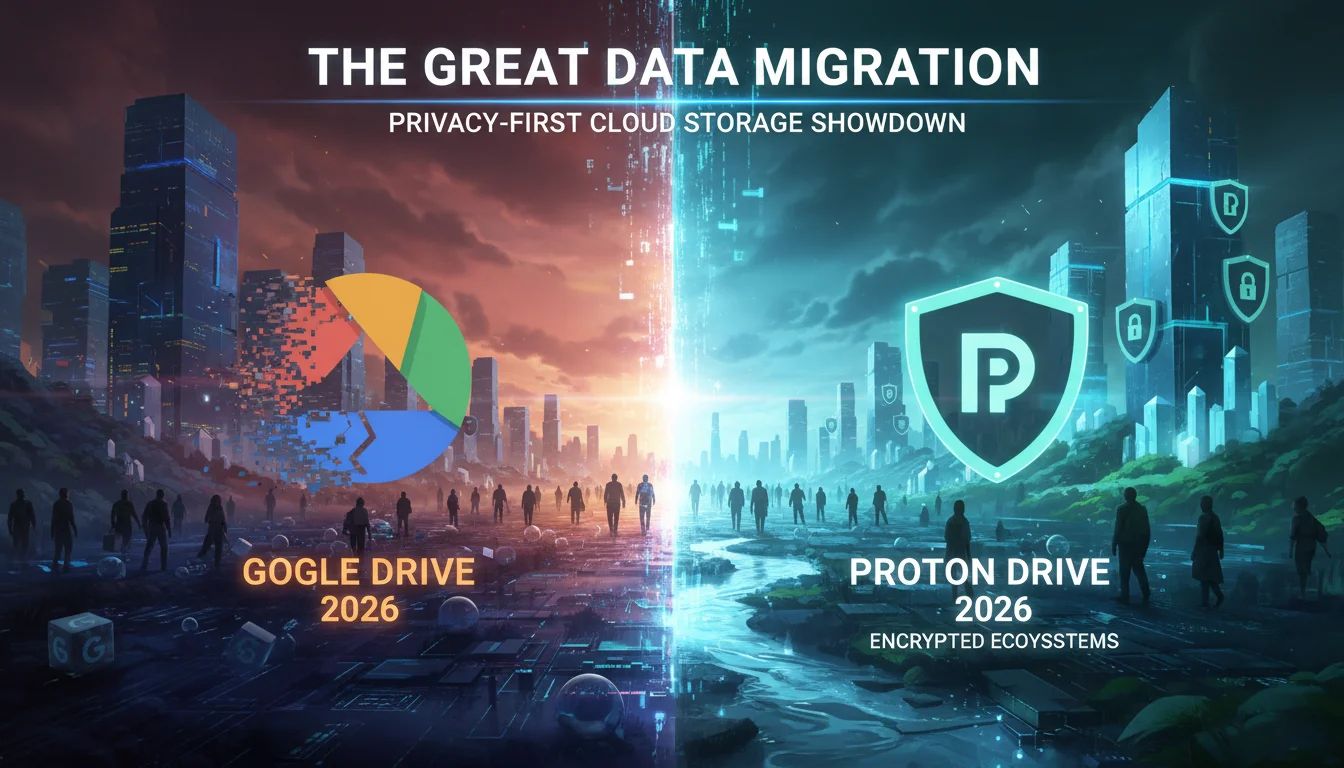

The year 2026 marks a pivotal turning point in the digital history of personal data. The conversation surrounding cloud storage has shifted from “Which service offers the most gigabytes for free?” to “Which service owns my intellectual property?”
With Big Tech’s aggressive integration of Generative AI into every facet of their ecosystems, terms of service have evolved. Google Drive, powered by an increasingly autonomous Gemini, offers unparalleled convenience at the cost of deep data inspection. Conversely, Proton Drive has emerged as the sanctuary for the privacy-conscious, riding a wave of migration fueled by users rejecting non-consensual AI training on their personal files.
In this comprehensive comparison, we utilize a semantic SEO framework to dissect Proton Drive vs Google Drive in 2026. We will analyze security architectures, collaboration features, AI implications, and cost-to-value ratios to help you decide if it’s time to make the switch.
The 2026 Landscape: The Great Privacy Migration
Why are we seeing search trends for “Proton Drive alternative” and “Delete Google account” spike in 2026? The catalyst is the AI Data Scrape Mandate. Major tech conglomerates have updated policies allowing their AI models to train on user-hosted documents, photos, and code to improve “user experience.”
For creative professionals, lawyers, developers, and privacy advocates, this is a dealbreaker. The choice is no longer about storage; it is about data sovereignty.
Google Drive in 2026: Convenience at a Cost
Google Drive remains the market leader in terms of market share and raw utility. Its integration with the wider Google Workspace (Docs, Sheets, Slides, Gmail) is seamless. However, the architecture is fundamentally built on data access.
The Gemini Integration
In 2026, Google Drive is less of a hard drive and more of an active assistant. Features include:
- Auto-Summarization: Gemini can read your PDFs and suggest edits in real-time.
- Smart Search: You can ask, “Find the receipt from March 2024,” and it parses images to find it.
- Content Generation: It drafts documents based on the context of your other stored files.
The Privacy Trade-off
To provide these features, Google must hold the encryption keys. This is Server-Side Encryption (SSE). While your data is encrypted at rest, Google can decrypt it to index content, train models (depending on your settings), and hand data over to authorities with a simple subpoena.
Proton Drive in 2026: The Swiss Fort
Proton Drive, developed by the scientists behind Proton Mail and CERN alumni, operates on a Zero-Knowledge Architecture. Located in Switzerland, it benefits from some of the world’s strictest privacy laws (FADP), which are arguably stronger than the EU’s GDPR.
End-to-End Encryption (E2EE)
Unlike Google, Proton uses rigorous end-to-end encryption. This means:
- Client-Side Encryption: Files are encrypted on your device before they reach Proton’s servers.
- No Access: Proton employees cannot see your files, even if they wanted to.
- No AI Training: Since they cannot read your data, they cannot train AI on it.
Feature Maturity in 2026
Critics used to call Proton “bare-bones,” but 2026 has changed that narrative. Proton has introduced:
- Proton Docs: A privacy-first collaborative editor that rivals Google Docs in basic functionality, offering real-time collaboration with E2EE.
- Photo Backup: Automatic, encrypted photo syncing for Android and iOS.
- Desktop Clients: Robust synchronization for Windows, macOS, and Linux.
Head-to-Head Comparison: Features and Performance
1. Security and Privacy
Winner: Proton Drive
There is no contest here. Google Drive manages keys; Proton gives them to you. Google scans files for hash matches (CSAM) and policy violations. Proton cannot see your files. If you are storing sensitive financial documents, private journals, or proprietary code, Proton is the objective winner.
2. Collaboration and Productivity
Winner: Google Drive
Despite Proton’s strides with Proton Docs, Google Workspace remains the gold standard for enterprise collaboration. The sheer number of plugins, add-ons, and real-time formatting capabilities in Google Sheets and Slides surpasses Proton’s current offering. If your workflow relies on complex macros or third-party API integrations, Google retains the edge.
3. AI Capabilities
Winner: Tie (Depends on Intent)
If you want an AI to write your emails and organize your life, Google wins. If you want to ensure an AI never learns from your life, Proton wins. The “feature” of AI is a “bug” for the privacy-conscious audience of 2026.
4. Speed and Syncing
Winner: Google Drive
Due to the overhead of encrypting and decrypting large files locally on the client side, Proton Drive can be slightly slower than Google Drive when handling massive video files. Google’s global content delivery network (CDN) infrastructure is also larger, resulting in faster sync speeds in remote regions.
Pricing Comparison 2026
Pricing structures have shifted as storage becomes cheaper but “privacy” becomes a premium commodity.
- Google One (2TB): Roughly $9.99/month. Includes Gemini Advanced access in higher tiers. You pay with money and data.
- Proton Unlimited (500GB): Roughly $12.99/month (bundled with Mail, VPN, Pass). While the storage-to-dollar ratio is lower, the value proposition includes the entire privacy suite.
- Proton Drive Plus (200GB): Roughly $4.99/month. A competitive entry point for those needing secure backup without the full ecosystem.
The Verdict: Who Should Switch?
Stick with Google Drive if:
- You rely heavily on Google Sheets formulas and heavy collaboration with non-tech-savvy users.
- You require AI assistance to manage your workflow.
- You prioritize raw speed and free storage (15GB free tier).
Switch to Proton Drive if:
- You are concerned about AI training on your personal photos and documents.
- You work in regulated industries (Journalism, Law, Healthcare) requiring strict confidentiality.
- You want to de-google your life and support an open-source, community-funded ecosystem.
Frequently Asked Questions (FAQ)
Can Proton Drive open Google Docs files?
Directly, no. You must export Google Docs as .docx or .pdf files before uploading them to Proton Drive. However, Proton Docs can now edit .docx files natively within the encrypted browser environment.
Is Proton Drive slower than Google Drive?
Yes, marginally. The encryption process happens on your device, which utilizes your CPU. On modern devices (2024 and later), this difference is negligible for documents but noticeable for large 4K video uploads.
Does Proton Drive have an AI assistant?
Proton has explicitly stated they will not implement generative AI that scans user content. They focus on “privacy-preserving AI” running locally on-device for things like search indexing, ensuring no data leaves your machine.
How hard is the migration process?
In 2026, Proton introduced the “Easy Switch” tool for Drive, allowing users to sign in to their Google account and have Proton automatically import files, encrypting them on the fly. It simplifies what used to be a manual download-upload nightmare.
Conclusion
The battle of Proton Drive vs Google Drive in 2026 is a clash of philosophies. Google represents the pinnacle of data-driven convenience, where your information is the fuel for the next generation of AI. Proton represents the digital fortress, where your data remains exclusively yours, protected by mathematics and Swiss law.
As AI scraping becomes the norm for Big Tech, the migration to Proton is not just a trend; it is a movement toward digital self-defense. If you value privacy over predictive text, the choice is clear.