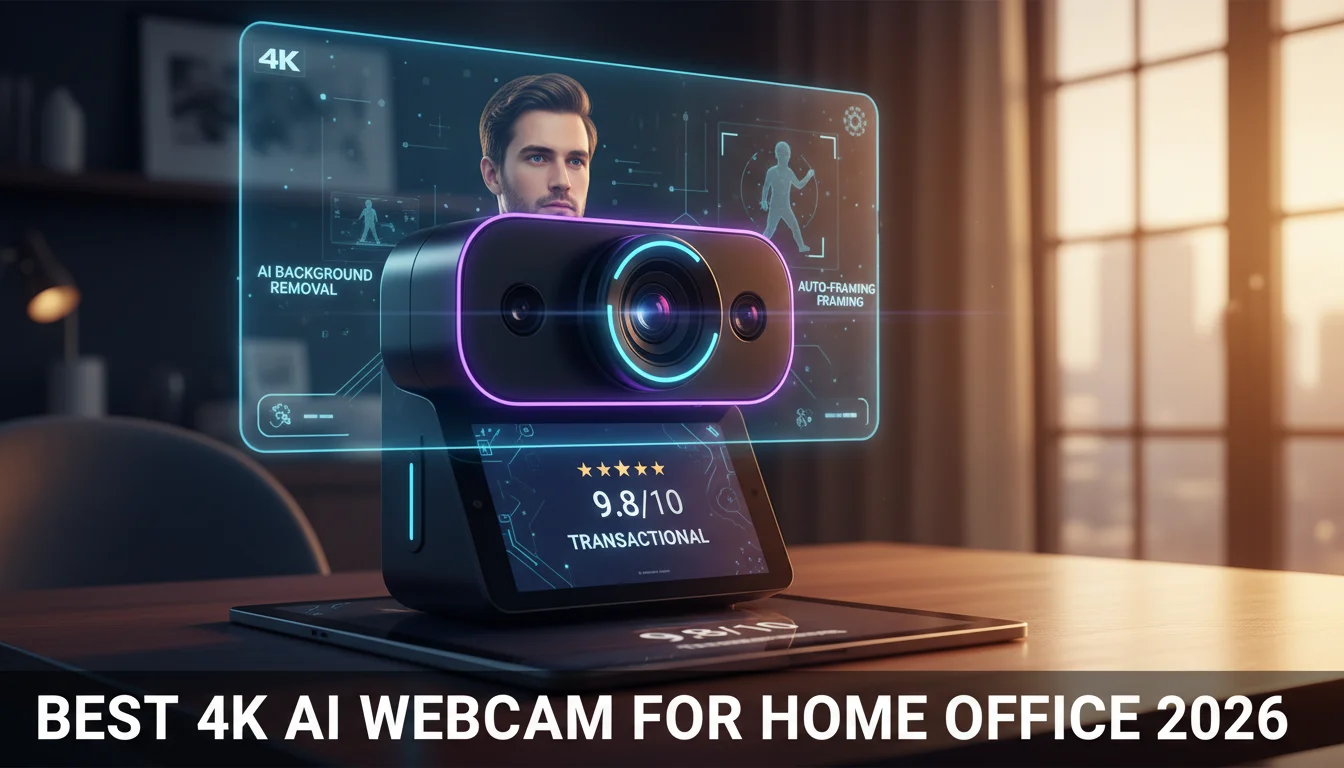

The era of grainy, washed-out video calls is officially behind us. As we settle into 2026, the standard for home office equipment has shifted dramatically, prioritizing both high-end visuals and overall workplace efficiency. It is no longer enough to simply have a 4K resolution; the focus has moved to hardware-native intelligence and cinematic optics.
For years, we relied on resource-heavy desktop software to blur our messy backgrounds or keep us in frame. In 2026, the best webcams do this work onboard. The latest trend isn’t just about pixels—it’s about native AI auto-framing that doesn’t lag your PC, and large sensors that provide real optical bokeh without the fake, artifact-heavy software outlines.
Whether you are an executive presenting to the board, a consultant closing deals, or a content creator learning how to screen record on Mac for high-quality tutorials, your webcam is your digital handshake. This guide breaks down the top contenders for the title of “Best 4K AI Webcam for Home Office 2026,” targeting the specific needs of modern professionals.
The 2026 Shift: Hardware AI vs. Software Tricks
Before diving into the reviews, it is crucial to understand the two main technologies driving the market this year:
- Native AI Tracking: Cameras like the OBSBOT Tiny 2 and Insta360 Link 2 use built-in gimbals and Neural Processing Units (NPUs) to physically follow you around the room. This processing happens inside the camera, saving your computer’s CPU for other tasks—a vital consideration if you are already managing hardware constraints like a PC RAM shortage.
- Optical Bokeh (The “Real” Blur): New entrants like the YoloLiv YoloCam S3 and Razer Kiyo Pro Ultra boast massive 1/1.2″ or 1/1.3″ sensors. These sensors are so large they create a natural background blur (depth of field) purely through optics, eliminating the need for “fake” AI background removal that often cuts off your ears or hair.
Top Picks for Best 4K AI Webcam 2026
1. Insta360 Link 2: The Best All-Rounder
Best For: Professionals who move while presenting (whiteboards, demos).
The Insta360 Link 2 continues to dominate the market by refining what its predecessor started. It features a 2-axis gimbal that is significantly smoother than previous generations. What sets it apart in 2026 is its improved AI Noise-Canceling and gesture control.
Key Features:
- Native Auto-Framing: The gimbal physically moves to keep you centered, which looks far more natural than digital cropping.
- Whiteboard Mode: AI automatically identifies and squares off your whiteboard, making it perfect for remote teaching or brainstorming.
- Smart Audio: Beamforming mics with AI noise reduction effectively isolate your voice from household chaos.
2. OBSBOT Tiny 2: The AI Tracking King
Best For: Executives and speakers who need precise, hands-free control.
If your priority is effortless tracking, the OBSBOT Tiny 2 is unmatched. Its “Deep Neural Learning Network” is incredibly sticky, meaning it won’t lose you even if you move quickly or turn your back. Unlike software-based solutions, this tracking is handled entirely on the device’s chip.
Why it wins:
- Voice Control: You can literally tell the camera to “Track Me” or “Zoom In” without touching a button.
- Privacy Mode: Simply tilt the camera down, and it automatically cuts the video and audio feed—a hardware-level privacy guarantee.
- Zone Tracking: New for 2026, you can set specific “zones” so the camera ignores movement in the background (like a passing family member).
3. YoloLiv YoloCam S3: The Cinematic Choice (Optical Bokeh)
Best For: Users who want the “DSLR look” without the complex setup.
The YoloCam S3 is a game-changer because it challenges the need for AI background blur entirely. With its massive sensor and wide f/1.8 aperture, it creates genuine optical bokeh. Your background is naturally soft and out of focus, just like on a professional mirrorless camera.
Pros:
- No Artifacts: No weird jagged edges around your hair because the blur is optical, not digital.
- Low Light Performance: The large sensor drinks in light, making you look clear even in a dimly lit home office.
- Zero CPU Load: Since the blur is physical, your computer doesn’t have to process a thing.
4. Logitech MX Brio: The Reliable Workhorse
Best For: Corporate users deeply integrated into the Logitech ecosystem.
While it lacks the physical gimbal of the Insta360 or OBSBOT, the Logitech MX Brio remains a top contender due to its reliability and software ecosystem. In 2026, updates to the Logi Options+ software have unlocked sharper 4K HDR and improved “Show Mode” (tilting the camera down to show your desk).
It bridges the gap by using advanced software-based AI for light correction (RightLight 5), ensuring you look balanced even with a bright window behind you.
Technical Deep Dive: Why Sensor Size Matters More Than AI
One of the most overlooked specs in 2026 is sensor size. Most standard webcams use tiny 1/4″ sensors, which require aggressive AI processing to remove noise and blur backgrounds. This results in the “plastic skin” look.
High-end models like the Razer Kiyo Pro Ultra and YoloCam S3 use 1/1.2″ sensors—nearly four times larger. This physics-based advantage means:
- Natural Depth of Field: The background blurs naturally.
- Less Noise: Pixels are larger and capture more light.
- Higher Dynamic Range: Bright highlights and dark shadows are preserved without washing out the image.
Pro Tip: If you have a powerful workstation (like a Copilot+ PC with an NPU), software AI blur is fine. But for most laptops, opting for a large-sensor webcam is the better performance choice.
FAQ: Choosing Your 2026 Webcam
Do I need a 4K webcam for Zoom/Teams?
Technically, Zoom and Teams often compress video to 1080p. However, a 4K sensor allows you to crop and zoom (lossless digital zoom) without losing quality. It also provides a sharper downsampled 1080p image than a native 1080p camera.
What is “Native” AI?
Native AI means the processing happens inside the webcam’s own processor (ISP/NPU). Non-native AI relies on your computer’s software (like NVIDIA Broadcast or Windows Studio Effects), which can slow down your PC during heavy tasks.
Is optical bokeh better than AI blur?
Yes. Optical bokeh looks organic and professional. AI blur can still struggle with complex outlines (like curly hair or headsets), creating a distraction. Optical bokeh is always 100% accurate because it is based on physics, not algorithms.
Conclusion
For the best 4K AI webcam for home office 2026, the choice comes down to your workflow. If you move around and present, get the Insta360 Link 2 or OBSBOT Tiny 2 for their superior native tracking. If you sit at a desk and want that rich, professional “podcast look,” skip the AI blur and go for the optical superiority of the YoloCam S3.
Invest in hardware that does the heavy lifting, and stop letting software slow you down.