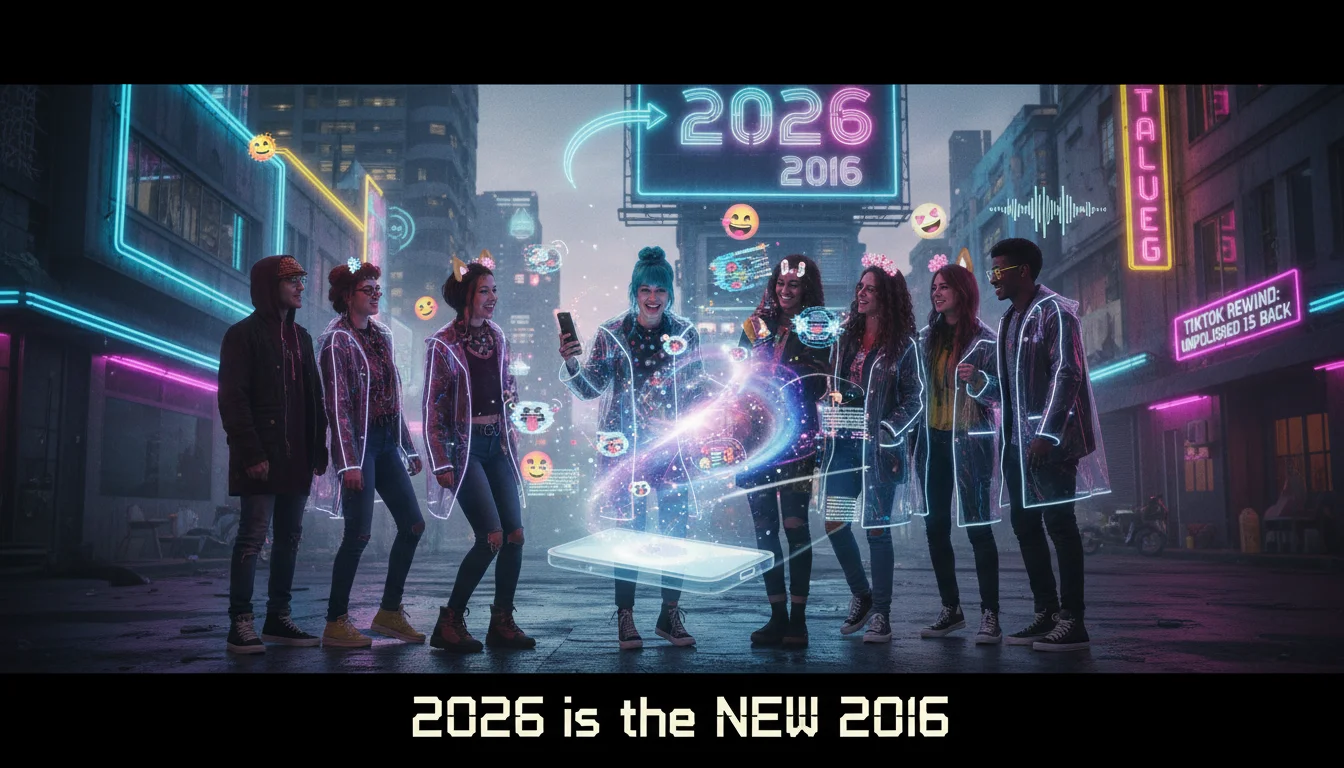

In the cyclic nature of digital culture, a decade is a lifetime. Yet, as we settle into 2026, a peculiar phenomenon has gripped the social media landscape. It is not a push toward the futuristic metaverse or hyper-realistic AI integration, but rather a sharp, collective U-turn into the past. The trending sentiment “2026 is the new 2016” has exploded across TikTok and Instagram, signaling a massive cultural shift away from the hyper-curated, algorithmic perfection of the early 2020s toward the chaotic, unpolished, and raw energy of the mid-2010s.
As a tech industry observer and content strategist, I have analyzed this “vibe shift.” It is not merely about using old Snapchat filters or listening to The Chainsmokers; it is a user-revolt against social media fatigue. This article utilizes semantic analysis to deconstruct why the “King Kylie” era is back, the psychology of digital nostalgia, and what this means for the future of content consumption.
The Anatomy of the Trend: What Does ‘2026 is the New 2016’ Mean?
To understand the trend, we must first define the entity that is 2016 internet culture. In the lexicon of Gen Z and Zillennials, 2016 represents the peak of the “King Kylie” era—a time characterized by heavy makeup, the dog filter on Snapchat, bomber jackets, and a social media environment that felt significantly less commercialized than today. It was the era just before the Cambridge Analytica scandal and the rise of hyper-aggressive algorithmic feeds.
The 2026 revival manifests in several key aesthetic and behavioral shifts:
- Visual Aesthetics: A move away from the “Clean Girl” aesthetic (minimalist, beige, polished) to “Indie Sleaze” and 2016-core (heavy contour, chokers, high-contrast filters).
- Platform Behavior: A rejection of 4K, cinematic Reels in favor of shaky, front-camera videos that mimic the casual nature of old Snapchat Stories.
- Audio Signatures: The resurgence of 2016 trap-pop, EDM, and mumble rap on viral charts.
The Psychology of Digital Nostalgia: Escaping the ‘AI’ Fatigue
Why are we looking back? The driver of this trend is Cognitive Escapism. By 2026, the average user is inundated with AI-generated content, deepfakes, and influencers who look indistinguishable from avatars. The digital space has become too perfect.
The Rejection of Hyper-Curation
From 2020 to 2025, social media was dominated by aspiration. Feeds were curated magazines. However, this created a high barrier to entry and psychological burnout. The return to 2016 is a return to accessible creation. In 2016, you didn’t need a lighting rig or a videographer to go viral; you needed a funny caption and a messy bun. Reviving this era allows users to lower the stakes of posting.
The ‘Simpler Times’ Fallacy
Semantically, 2016 is associated with a perceived innocence before the global geopolitical shifts of the late 2010s. While 2016 was politically turbulent, in the memory of the current 25-year-old cohort, it represents their teenage years—a time of lower responsibility. This is a classic nostalgia loop, which typically occurs every 20 years, but due to the acceleration of digital culture and the emergence of a nostalgic remix marketing strategy among Gen Z, it has compressed into a 10-year cycle.
The ‘King Kylie’ Aesthetic vs. The Metaverse
The central figure of this trend is the 2016 iteration of Kylie Jenner, often referred to as “King Kylie.” In terms of Semantic SEO entities, King Kylie represents the archetype of the Influencer 1.0.
Current data suggests a spike in search terms related to:
- “Anastasia Beverly Hills Dipbrow”
- “Snapchat Dog Filter”
- “Bomber Jackets”
- “Messy Bun Tutorials”
This is a direct counter-culture movement to the “Metaverse” push by big tech. While tech giants are trying to push users into VR headsets and sterile 3D environments, users are rebelling by embracing the gritty, pixelated reality of a smartphone camera from a decade ago.
Impact on Content Strategy and SEO for 2026
For brands and creators, understanding this shift and monitoring new AI visibility metrics is crucial for relevance. The high-gloss production that dominated 2024 and 2025 is now seen as “cringe” or inauthentic.
1. Lo-Fi is High Authority
Paradoxically, lower production value now signals higher trustworthiness (E-E-A-T). Users trust a video that looks like it was filmed in a messy bedroom more than a studio-lit testimonial. Brands should pivot their content strategy to include User Generated Content (UGC) styles that mimic the 2016 vlog style.
2. The Return of Chronological Storytelling
The 2016 era was defined by Snapchat Stories—linear, chronological dumps of a day. We are seeing a move away from the isolated, high-performance viral clip toward “Photo Dumps” and long-form “Storytimes” that build a narrative connection rather than just seeking a dopamine hit.
Technological Enablers: How Apps are Adapting
Social platforms are quickly pivoting to accommodate this, integrating important tools and software features that allow for more raw, unfiltered sharing. TikTok and Instagram have recently adjusted algorithms to favor “original audio” and “photo modes” that emulate the old Instagram interface. We are also seeing the rise of “retro” camera apps that deliberately lower image quality to mimic the iPhone 6s camera sensor, adding grain and saturation that modern computational photography tries to remove.
Frequently Asked Questions (FAQ)
What is the ‘2026 is the new 2016’ trend?
This is a viral social media movement where users are adopting the fashion, music, and unpolished posting style of 2016. It is a reaction against the over-curated and AI-heavy internet of the 2020s.
Why is the King Kylie era trending again?
The ‘King Kylie’ era (referring to Kylie Jenner circa 2015-2016) symbolizes the peak of the influencer boom. Gen Z views this era as a time of peak internet culture that was fun, experimental, and less corporate than today’s landscape.
How does this trend impact marketing strategies?
Marketers need to loosen their grip on brand guidelines. ‘Ugly’ or ‘messy’ content is performing better because it feels authentic. Brands should leverage nostalgia marketing and lo-fi aesthetics to connect with younger audiences.
Is 2016 aesthetic making a comeback in fashion?
Yes. We are seeing a resurgence of chokers, bomber jackets, heavy contour makeup, and grid-pattern apparel, replacing the ‘Clean Girl’ minimalism that dominated the early 2020s.
Conclusion: Embracing the Chaos
The assertion that “2026 is the new 2016” is more than a fleeting hashtag; it is a symptom of a digital society seeking to ground itself. After years of pandemic lockdowns, remote work, and the encroaching uncanny valley of AI, the messy, loud, and vibrant energy of 2016 feels like a breath of fresh air. For content creators and tech strategists, the lesson is clear: Stop polishing the humanity out of your content. Perfection is out; personality is in.