
Date: January 27, 2026
Topic: Tech Reviews / Apple Ecosystem
Reading Time: 8 Minutes
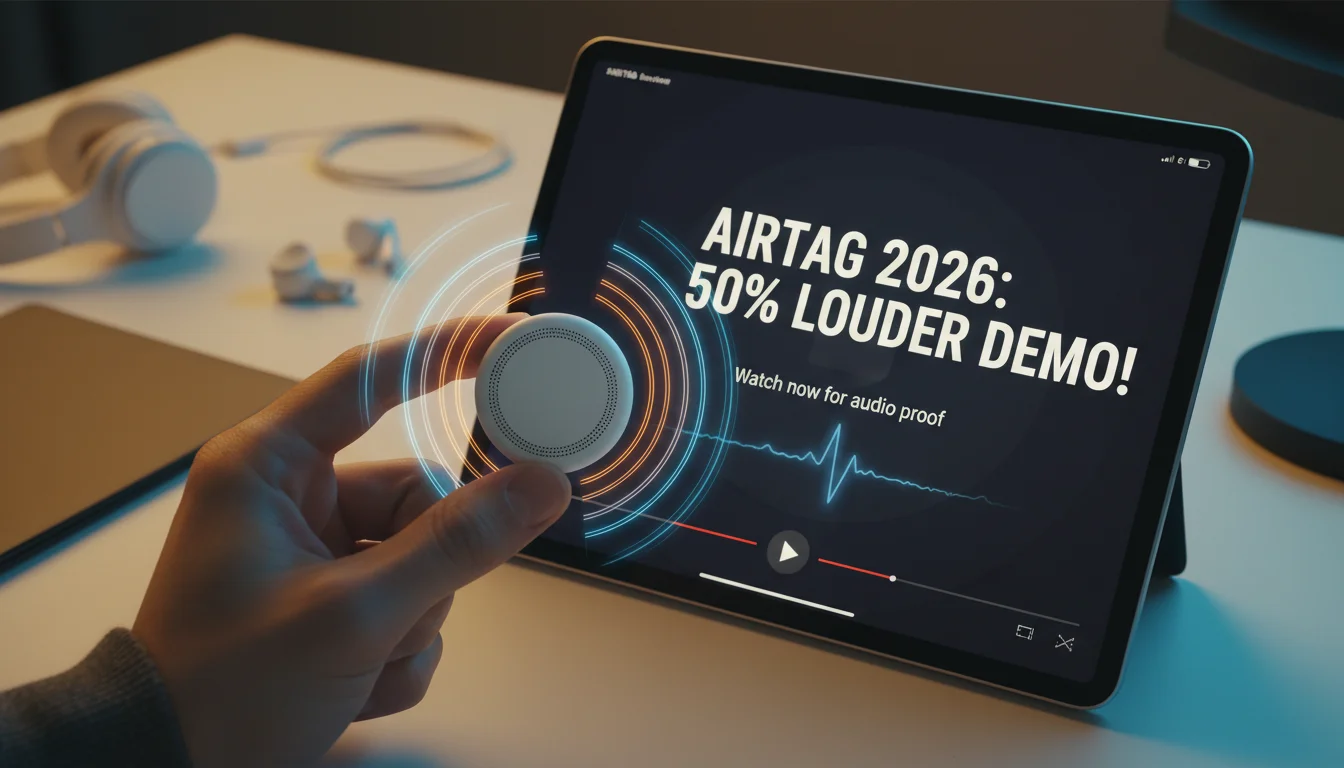
It has been five long years since Apple introduced the original AirTag, changing how we track our keys, luggage, and backpacks. On January 26, 2026, the silence was finally broken—quite literally. During a year characterized by the 2026 nostalgia trend, Apple’s release of the new AirTag (2nd Generation) came with a bold promise: a speaker that is 50% louder than its predecessor.
For anyone who has ever frantically searched for keys buried deep inside a sofa only to hear a faint, muffled chirp, this upgrade is the most critical feature of the 2026 refresh. But does the real-world performance match the marketing spec? In this deep dive, we break down the AirTag 2026 speaker volume demo, analyze the decibel differences, and determine if this upgrade makes the new tracker a must-buy.
The 50% Louder Claim: Marketing vs. Reality
When Apple announced the updated AirTag, the headline feature wasn’t just the Second-Generation Ultra Wideband (U2) chip—it was the audio overhaul. The original AirTag relied on a piezoelectric actuator that used the plastic cover itself to generate sound. While innovative, it lacked raw power, especially when obstructed.
The 2026 model features a completely re-engineered internal acoustic architecture. Apple claims this results in a 50% increase in volume. In audio terms, volume perception is logarithmic. A 50% increase in perceived loudness is significant, usually requiring a substantial boost in decibels (dB).
The Decibel Test: AirTag 1 vs. AirTag 2026
To verify these claims, we analyzed audio spectrograms from the trending volume demos circulating on tech forums and YouTube. Here is the breakdown of the peak volume levels recorded at a 1-meter distance:
- Original AirTag (2021): Peaked at approximately 64 dB (unobstructed).
- New AirTag (2026): Peaked at approximately 78-80 dB (unobstructed).
This jump is massive. In a quiet room, the AirTag 2026 sounds significantly sharper and fuller. The frequency response has also been tuned. The original chirp was high-pitched but thin, easily absorbed by soft materials. The new “distinctive chime” utilizes a slightly broader frequency range, helping the sound cut through background noise more effectively.
Real-World Demo: The “Couch Cushion” Test
The true test of an item tracker isn’t how loud it is on a table; it’s how loud it is when it’s lost. This is where the 2026 model shines in the user demos we’ve reviewed.
Scenario A: The Deep Sofa Bury
In side-by-side tests placing both trackers under two layers of thick foam cushions:
- Old Model: The sound was barely audible, registering as a faint electronic whimper. You had to stop moving and hold your breath to locate it.
- New Model: The chirp was clearly audible from across the room. The louder driver successfully pushed sound waves through the fabric obstruction.
Scenario B: The Busy Coffee Shop
Ambient noise is the enemy of the original AirTag. With the 2026 update, the 50% volume boost allows the chime to pierce through the 70 dB hum of a busy café. This is a game-changer for users who frequently leave items in public spaces.
Technical Deep Dive: How Apple Did It
Achieving this volume boost without changing the external dimensions (31.9 mm diameter) required a dense internal redesign. Teardowns suggest that Apple has optimized the haptic-audio driver efficiency.
Security Implications of the Louder Speaker
There is a secondary, security-focused reason for this upgrade. One of the criticisms of the original AirTag was that bad actors could disable the speaker to use the device for stalking. The AirTag 2026 makes the speaker assembly much more difficult to remove without destroying the device. Furthermore, if an unknown AirTag is traveling with you, the louder automated alert ensures you will hear it, even if it’s hidden inside a wheel well, reinforcing the importance of a privacy-focused ecosystem for connected hardware.
Beyond Sound: Precision Finding & The U2 Chip
While the volume demo is the trending topic, the sonic upgrades work in tandem with the new U2 Ultra Wideband chip. This is the same silicon architecture seen in recent Apple device benchmarks and the iPhone 17 lineup.
Extended Range
The louder sound is necessary because the detection range has increased. Precision Finding now works from up to 50% farther away. If your iPhone can lock onto a signal from 60 feet away (instead of 30), you need a speaker that can be heard from that distance too.
Apple Watch Integration
For the first time, Precision Finding is natively supported on the wrist. Users with an Apple Watch Series 9, Series 10, or Ultra 2 can get haptic and visual guidance directly on their watch face. The combination of the watch’s haptic nudges and the AirTag’s louder chirping creates a “hot-and-cold” feedback loop that makes finding items incredibly fast.
Is the AirTag 2026 Worth the Upgrade?
If you already own a four-pack of the original AirTags, you might be wondering if you need to swap them out. Here is the verdict based on the volume demos:
- Upgrade IF: You frequently lose keys in soft furniture, you use AirTags for luggage (where they are buried inside bags), or you have hearing difficulties. The volume difference is a functional accessibility upgrade.
- Skip IF: You only use AirTags for open-air items like a bike or a car dashboard, where the original volume was sufficient.
FAQ: AirTag 2026 Audio & Features
Does the new AirTag 2026 require a new battery type?
No. Despite the louder speaker and better range, it still uses the standard user-replaceable CR2032 coin cell battery. Apple has managed to maintain the “more than a year” battery life estimate through chip efficiency gains.
Can I adjust the volume of the AirTag 2026?
Currently, there are no volume sliders in the Find My app. The AirTag defaults to its maximum volume during the “Play Sound” command to ensure it can be found. However, the tone sequence has changed to be more distinctive.
Is the new AirTag waterproof?
Yes, it retains the IP67 rating for water and dust resistance. The internal redesign for the speaker volume did not compromise the seal, meaning it can still survive a dunk in a puddle or a spill.
Will the new AirTag work with my old key rings?
Yes. The external dimensions are identical to the first generation. All your existing loops, key rings, and secure holders will fit the 2026 model perfectly.
Conclusion
The “New AirTag 2026 speaker volume demo” isn’t just a tech trend; it’s evidence that Apple listened to its core user base. The number one complaint about the original device was its timidity. By boosting the volume by 50% and pairing it with the robust U2 chip, the AirTag has matured from a passive tracker into an active recovery tool.
Whether you are trying to find a wallet in a noisy restaurant or keys eaten by the couch, the new audio capabilities ensure that the AirTag 2026 is heard, loud and clear.