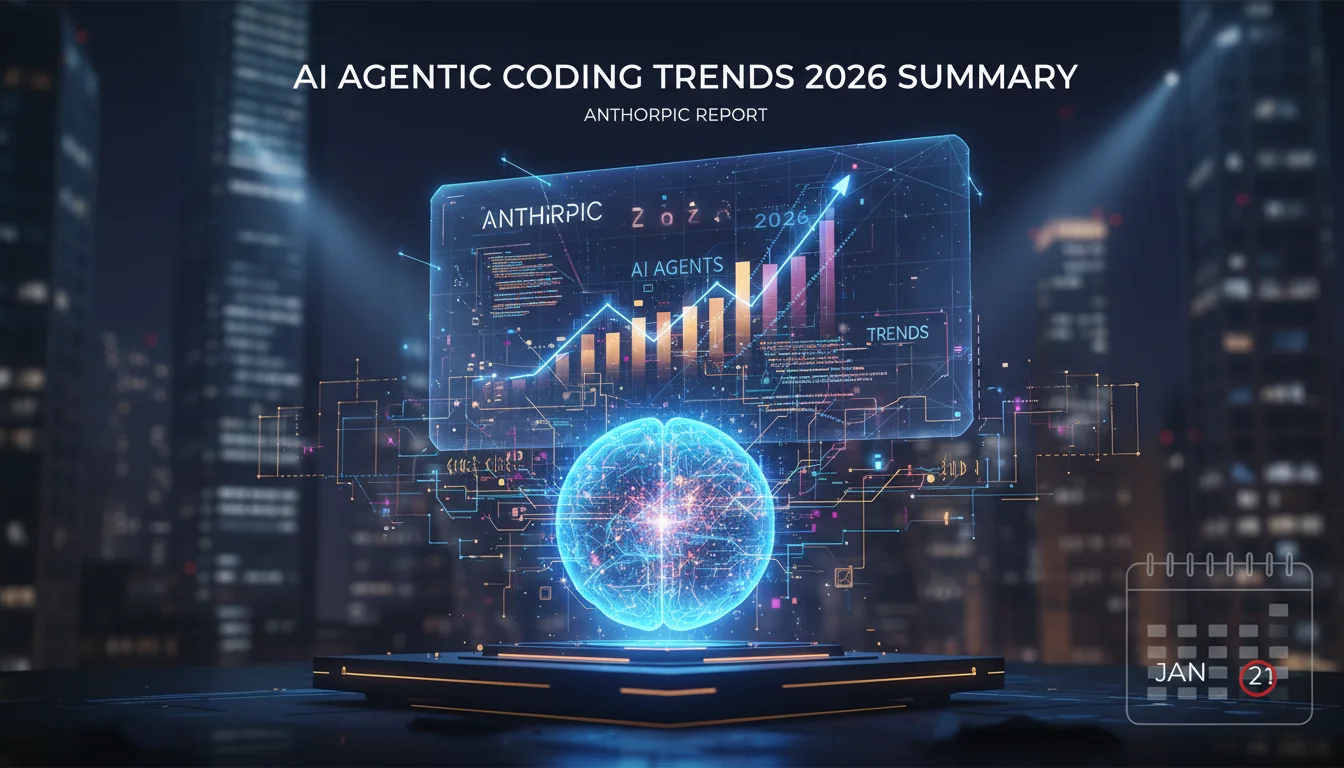

Anthropic released its landmark 2026 Agentic Coding Trends Report, a document that has already sent shockwaves through the tech industry. With Claude Code recently hitting a $1 billion annualized run rate faster than any previous AI tool, the report confirms what many engineering leaders have suspected: we have officially left the era of “AI Chat” and entered the era of Agentic Orchestration.
For CTOs, developers, and product managers, this isn’t just another forecast—it is a blueprint of the immediate future. Many organizations are now looking for a comprehensive agentic AI frameworks business guide to help them navigate this shift. The data is staggering: organizations like TELUS are reporting 500,000+ hours saved, while Rakuten achieved 99.9% accuracy on massive codebase migrations in mere hours. But beyond the numbers, the report highlights a fundamental restructuring of the developer’s role.
Below is a comprehensive, SEO-optimized summary of the 8 key trends and critical insights from Anthropic’s massive 2026 report.
The Core Shift: From Code Writer to System Orchestrator
If there is one headline from the report, it is this: The “Junior Developer” AI is dead; the “AI Colleague” has arrived.
Anthropic’s data reveals a fascinating paradox. Developers are now using AI in 60% of their daily workflows, yet they fully delegate ( unsupervised) only 0-20% of tasks. Why? Because the stakes have risen. The AI is no longer just writing snippets; it is architecting entire modules. This has forced the human role to evolve from “writer” to “reviewer and validator.”
The report defines this as the Orchestration Shift. Engineers are spending less time on syntax and more time coordinating teams of specialized agents—one for testing, one for security, and one for implementation—working in parallel context windows.
The 8 Agentic Coding Trends (2026 Summary)
Anthropic categorized their findings into three buckets: Foundation, Capability, and Impact. Here are the standout trends defining 2026.
1. Multi-Agent Systems are the New Standard
Single-prompt coding is obsolete for enterprise tasks. The report notes that 57% of organizations now deploy multi-step agent workflows. Instead of asking one bot to “fix the bug,” systems are designed where Agent A identifies the issue, Agent B writes the patch, and Agent C runs the regression tests. This “agent chaining” is responsible for the dramatic drop in error rates seen in late 2025.
2. The “Papercut” Revolution
One of the most surprising findings is the rise of fixing “papercuts”—minor, quality-of-life bugs that engineering teams historically deprioritized. Because agentic cost is so low, companies are now clearing years of technical debt and minor UI glitches that human devs never had time for. This has led to a measurable increase in overall software quality and user satisfaction scores.
3. Democratization via “Cowork” Agents
With the launch of tools like Cowork, Anthropic notes a surge in non-technical teams building their own software solutions. Marketing and Legal departments are now using natural language agents to build internal tools and automate workflows without filing tickets with IT. This trend is dissolving the traditional bottleneck between “Business” and “Engineering.”
4. The Rise of Self-Healing Code
Agents aren’t just writing code; they are maintaining it. The report highlights autonomous debugging loops where agents monitor production logs, identify anomalies, and propose (or strictly sandbox-test) fixes without human intervention. Rakuten’s case study—99.9% accuracy on a 12.5 million line codebase modification—is the prime example of this capability at scale.
5. Hybrid Build-and-Buy Architectures
Enterprises are not choosing between building custom agents or buying off-the-shelf solutions; they are doing both. 47% of respondents utilize a hybrid approach, integrating specialized proprietary agents with general-purpose tools like Claude Code. This landscape is increasingly defined by the competition between Agentforce vs Microsoft Agent 365 implementation strategies, which offer different paths for enterprise integration.
Barriers to Entry: The “Integration Wall”
Despite the optimism, the report identifies clear hurdles. It’s not about model intelligence anymore; it’s about system integration.
- 46% of leaders cite integration with legacy systems as their primary blocker.
- 40% identify security and compliance as the top risk.
The winners in 2026 are not the companies with the smartest models, but those who have solved the “plumbing” problem—securely connecting AI agents to production databases and CI/CD pipelines while adhering to the latest AI agent interoperability protocol (AIIP) standard.
Real-World Impact: The ROI of Agents
The financial impact detailed in the report is undeniable. The AI agents market is projected to skyrocket to $52.62 billion by 2030, driven by these immediate gains:
- TELUS: Saved 500,000 engineering hours and accelerated shipping times by 30%.
- Zapier: Achieved 97% internal adoption of AI agents, radically flattening their operational costs.
- GitHub/Microsoft: Integration of Claude Sonnet 4.5 and Opus 4.5 models has reportedly led to a “zero percent” code editing error rate on internal benchmarks.
FAQ: Understanding the 2026 Agentic Shift
What is the difference between an AI assistant and an AI agent?
An assistant (like the chatbots of 2024) waits for a user to give a command and responds with text. An agent has agency: it can plan a series of actions, use tools (like a terminal or browser), execute code, analyze the results, and iterate until the task is complete.
Will AI agents replace software developers in 2026?
No, but they are changing the role. The report emphasizes that while 60% of work involves AI, human oversight is critical for high-stakes decisions. The role is shifting from “manual coder” to “systems architect” and “agent supervisor.”
Which industries are adopting agentic coding fastest?
According to the report, the software development vertical leads, but significant growth is occurring in Financial Services (like CRED in India) and Telecommunications (TELUS), where scale and reliability are paramount.
Conclusion: Adapt or Decay
Anthropic’s January 21 report draws a line in the sand. The experimental phase of AI coding is over. We are now in the deployment phase. Organizations that treat AI as a mere autocomplete tool are already falling behind those deploying autonomous agentic squads.
As 2026 unfolds, the metric for success isn’t lines of code written—it’s agents orchestrated. For developers and tech leaders, the message is clear: embrace the orchestration role, or risk becoming obsolete.