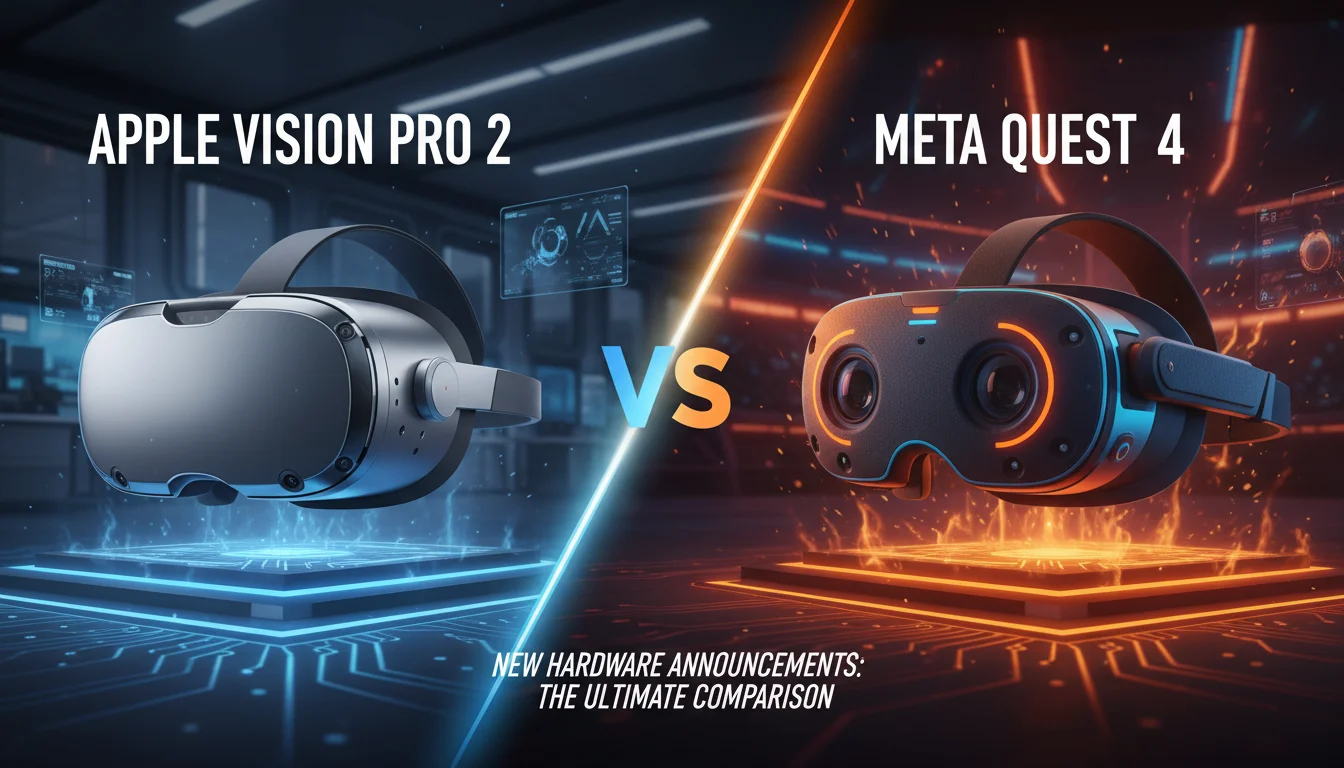

Two years ago, the tech world was split into two camps: the high-fidelity ecosystem of Apple and the accessible, gamer-centric world of Meta. Fast forward to January 2026, and the landscape has shifted dramatically. With fresh hardware announcements shaking up the Consumer Electronics Show (CES) earlier this month and rumors solidifying into specs, we are witnessing the second round of the heavyweights: the Apple Vision Pro 2 and the Meta Quest 4.
As a senior tech analyst who has spent hundreds of hours inside the original Vision Pro and the Quest 3, I’ve dissected the leaks, official teasers, and early developer kits to bring you this definitive comparison. Is Apple’s M5-powered marvel worth the luxury tax? or has Meta finally cracked the code for high-end immersion at a mass-market price?
The Core Philosophy: Spatial Computer vs. The Ultimate Console
Before diving into pixel counts, it is crucial to understand the diverging paths these companies are taking in 2026.
Apple remains steadfast in its mission to replace your laptop. The Vision Pro 2 isn’t just a headset; it is a Spatial Computer. With the integration of the new M5 silicon, Apple is pushing visionOS 3 as a legitimate workspace replacement, focusing on seamless integration with the Mac ecosystem, high-fidelity media consumption, and isolation-free productivity.
Meta, on the other hand, has doubled down on Social Presence and Gaming. The Quest 4 aims to be the device you wear to connect, play, and sweat. By refining Horizon OS and opening it up to third-party hardware makers (like ASUS and Lenovo), Meta is building the “Android of XR.” The Quest 4 is designed to be frictionless—lighter, cheaper, and ready for multiplayer chaos and online gaming.
1. Design and Comfort: The Weight Loss Journey
The biggest complaint about the Gen 1 devices? Weight. Wearing a computer on your face wasn’t comfortable for more than an hour. Both companies have aggressively addressed this in 2026.
Apple Vision Pro 2: Refining the Aluminum Curve
Apple has reportedly shaved off nearly 150 grams compared to its predecessor. By switching to a new titanium-magnesium alloy for the frame and redesigning the light seal, the Vision Pro 2 feels significantly less front-heavy. The rumored “AirStrap” inclusion—a dual-loop band included in the box this time—solves the pressure distribution issues that plagued the 2024 launch.
Meta Quest 4: The Slimmest Profile Yet
Meta has pushed the limits of pancake lens optics. The Quest 4 is shockingly thin, resembling a pair of oversized ski goggles rather than a shoebox. By moving the battery to the rear of the strap (a standard feature now, finally), they have achieved a near-perfect 50/50 weight balance. It is a device you can easily forget you are wearing during a 2-hour session of Supernatural or Beat Saber.
2. Display & Visuals: Micro-OLED vs. Mini-LED
This is where the price gap makes itself known.
- Apple Vision Pro 2: Features the next-gen Sony Micro-OLED panels. We are looking at a staggering 4.5K resolution per eye with brightness peaking at 6,000 nits. This eliminates motion blur and makes text look as crisp as it does on a MacBook Pro Retina display. The “Screen Door Effect” is scientifically non-existent here.
- Meta Quest 4: Meta has opted for advanced Mini-LED displays with local dimming. While it doesn’t match the absolute perfect blacks of Apple’s OLED, it offers vibrant colors and excellent contrast for a fraction of the cost. Resolution sits at a respectable 3K per eye—a massive jump from the Quest 3, making it viable for virtual desktop work, though videophiles will still prefer the Apple polish.
3. Performance: M5 vs. Snapdragon XR2+ Gen 3
The processing battle is akin to comparing a workstation PC to a high-end gaming console.
The Apple Advantage
The M5 chip is a monster. Built on the 2nm process, it handles real-time 3D rendering, 12 cameras, and the new Apple Intelligence onboard AI models without breaking a sweat. Multitasking in visionOS 3 is fluid; you can have Safari, Final Cut Pro, and a 3D model open simultaneously in your physical space with zero jitter.
The Meta Efficiency
The Snapdragon XR2+ Gen 3 is a marvel of mobile engineering. It is optimized specifically for XR workloads, prioritizing thermal management and battery life. While it can’t match the raw compute power of the M5, it doesn’t need to. Meta’s dynamic foveated rendering (eye-tracking is now standard on Quest 4) ensures that resources are only spent where you are looking, punching way above its weight class in gaming performance.
4. Passthrough and Mixed Reality
In 2024, Apple’s passthrough was magic, and Meta’s was “good enough.” In 2026, the gap has narrowed.
The Vision Pro 2 still holds the crown for “Reality Fidelity.” The photon-to-photon latency is now under 10ms, virtually indistinguishable from real life. You can read a phone screen, thread a needle, or catch a ball while wearing it.
The Quest 4, however, has fixed the warping issues. The depth sensors are now much higher resolution, allowing for accurate room mapping (scene mesh) that happens instantly. Walking around your house with the headset on feels natural, even if the dynamic range isn’t quite as wide as Apple’s.
5. Controllers and Input: Eyes vs. Tactile
Here lies the fundamental user experience difference.
- Apple: Still bet the farm on eye-tracking and hand gestures. It is elegant for media and browsing but still lacks the tactile feedback gamers crave. This sophisticated sensor array highlights the expanding role of biometrics in personalizing and securing spatial computing environments. The rumors of an “Apple Pencil for Vision” have surfaced, potentially aiding creatives.
- Meta: The Quest 4 ships with the new Touch Plus Pro controllers—haptic-rich wands that offer incredible precision. However, Meta’s hand tracking is now good enough that many UI interactions are controller-free. They are also pushing the neural wristband as an accessory for discrete, twitch-free input.
6. Price and Verdict
We cannot ignore the elephant in the room: the cost of entry.
- Apple Vision Pro 2: $3,499 (Starting)
- Meta Quest 4: $599 (128GB Model)
The Bottom Line:
If you are a creative professional, a developer, or an Apple ecosystem deep-diver who wants the absolute best display technology money can buy, the Vision Pro 2 is your new office. It is the future of computing, refined.
If you are a gamer, a fitness enthusiast, or someone curious about the Metaverse who wants 90% of the features for 15% of the price, the Meta Quest 4 is the undisputed champion of value. Meta has successfully democratized mixed reality, making the Quest 4 the device that will likely sit under millions of Christmas trees in 2026.
Frequently Asked Questions (FAQ)
Will my Quest 3 games work on Quest 4?
Yes, Meta has confirmed full backward compatibility. In fact, many older titles will receive an “XR3 Boost” patch to run at higher resolutions and frame rates automatically.
Does the Apple Vision Pro 2 finally support multiple Mac monitors?
Yes! With visionOS 3 and the M5 chip, you can now virtualize up to three distinct 4K displays from your MacBook, creating an ultrawide workspace without the physical clutter.
Is the Quest 4 comfortable for glasses wearers?
The Quest 4 features a new adjustable lens depth system that accommodates most frames. However, both Apple and Meta heavily recommend custom prescription inserts (like those from Zenni or ZEISS) for the best field of view.
Can I play SteamVR games on these headsets?
The Meta Quest 4 supports SteamVR wirelessly via Steam Link or Air Link flawlessly. The Apple Vision Pro 2 can access SteamVR via third-party ALVR apps, but it is not natively supported and requires a bit of tinkering.
Conclusion
The hardware war of 2026 has given us two incredible devices that serve two very different masters. Apple is perfecting the solitary, high-end computing experience, while Meta is building a bustling, social, and gamified layer on top of reality. Your choice ultimately depends not just on your budget, but on what you want to do in mixed reality: work in silence, or play with the world.