
The Industrial Awakening: Atlas Steps Out of the Lab and Onto the Factory Floor
For years, the world watched Boston Dynamics’ Atlas robot with a mix of awe and trepidation. We saw it perform backflips, navigate parkour courses, and even dance to Motown hits. But critics often asked the same question: “When will it actually do something useful?” That question has finally been answered. In a move that signals a paradigm shift for the global manufacturing industry, the fully electric Atlas humanoid has officially begun autonomous field trials at Hyundai’s state-of-the-art production facilities in Georgia.
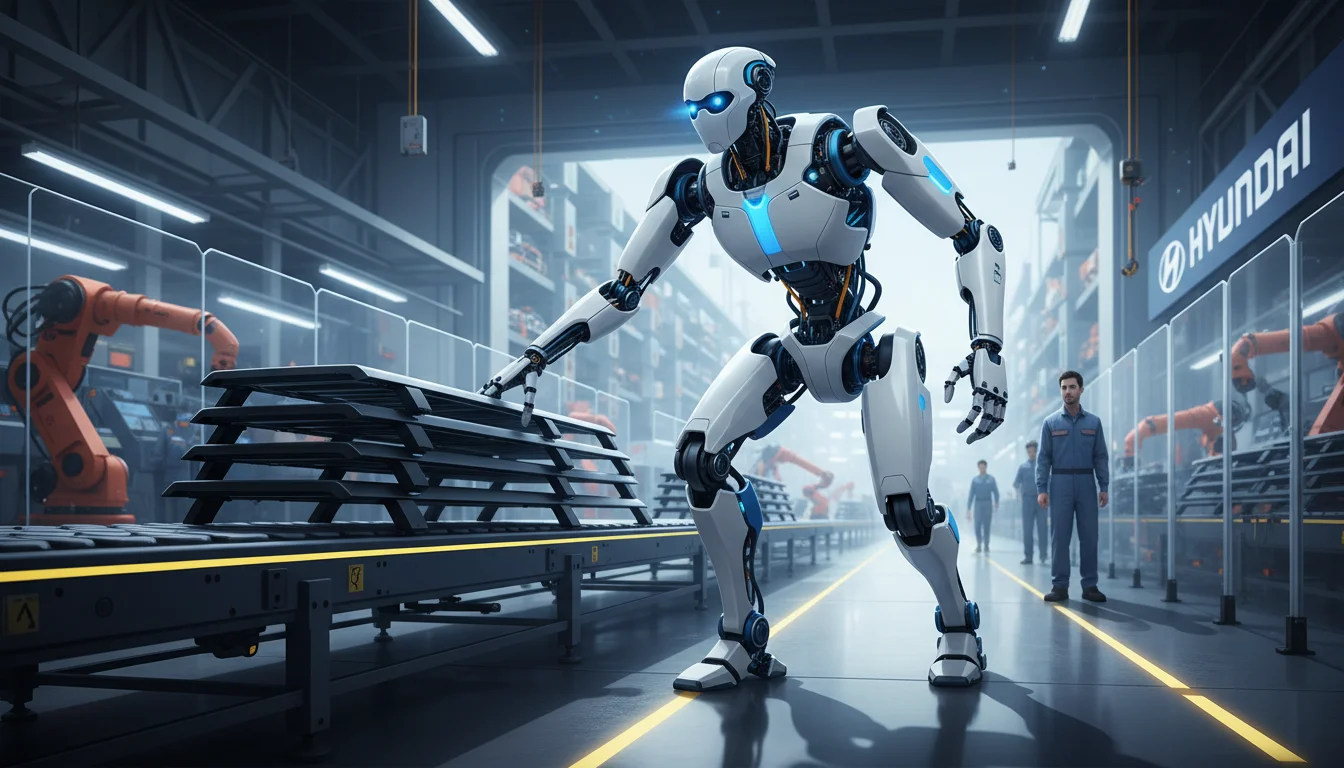
This isn’t just another viral video. This is the beginning of the “deployment era.” As the sleek, headless silhouette of the new Atlas moves through the sprawling aisles of Hyundai’s Metaplant, it marks the first time a humanoid of this sophistication has been integrated into a live, high-stakes industrial environment to perform non-scripted, autonomous labor. The task? Sorting complex automotive roof racks—a job that requires a delicate balance of strength, spatial awareness, and real-time decision-making.
From Hydraulics to High-Voltage: The Rebirth of Atlas
To understand the significance of these field tests, we must first look at the machine itself. Only months ago, Boston Dynamics retired its legendary hydraulic Atlas, a mechanical marvel that was as powerful as it was leaky and loud. In its place, they unveiled the “All-Electric Atlas.” This new iteration is a radical departure from its predecessor. It is slimmer, quieter, and possesses a range of motion that exceeds human capabilities.
Equipped with custom high-torque actuators in every joint, the electric Atlas can rotate its torso, head, and limbs 360 degrees. This “inhuman” flexibility is a strategic advantage in a factory setting. While a human worker must turn their entire body to pick up a part and place it behind them, Atlas simply rotates its hips and head, maintaining a steady base and maximizing efficiency. This design philosophy moves away from “human-mimicry” and toward “human-form optimization.”
The Georgia Metaplant: The Perfect Proving Ground
The location of these trials is no coincidence. Hyundai’s “Metaplant America” in Bryan County, Georgia, is a $7.6 billion investment designed from the ground up to be the future of electric vehicle (EV) manufacturing. By testing Atlas here, Hyundai and Boston Dynamics are creating a feedback loop between the robot’s AI and the factory’s digital twin ecosystem.
In the Georgia plant, Atlas isn’t just a guest; it’s an integrated component of the workforce. The field trials focus on the “logistics flow,” specifically the handling of roof racks. These components are notoriously difficult for traditional automation because they are awkward in shape, vary in weight distribution, and are often stored in high-density racking systems that require precision maneuvering to access.
Autonomy in the Wild: No Remote Controls Allowed
Perhaps the most impressive aspect of the Hyundai field tests is the level of autonomy being demonstrated. Unlike previous generations that relied heavily on pre-programmed paths or “teleoperation” (human remote control), the new Atlas utilizes advanced reinforcement learning and computer vision to navigate its environment.
When Atlas approaches a bin of roof racks, it doesn’t just follow a set of coordinates. It uses its onboard sensors to identify the parts, calculate the optimal grip point, and adjust its posture to maintain balance as it lifts the load. If a rack is slightly out of place or if a human coworker walks into its path, the robot’s perception system—powered by a suite of depth sensors and wide-field-of-view cameras—allows it to adapt in real-time. This ability to handle “stochasticity”—the inherent randomness of a real-world factory—is the “holy grail” of humanoid robotics.
The Strategy Behind the Sorting Task
Why start with roof racks? In the world of industrial automation, tasks are categorized by their complexity. Moving a box from point A to point B is simple. Welding a seam is repetitive. But “bin picking” and “sorting” variable parts like roof racks represent a “Level 4” difficulty. By tackling this specific task, Boston Dynamics is proving that Atlas can handle the “middle-mile” of factory labor—the tasks that are too complex for fixed robots but too dull or ergonomically taxing for humans.
The Competitive Landscape: A Humanoid Arms Race
Hyundai and Boston Dynamics are not alone in this race. The announcement of the Georgia field tests comes at a time of unprecedented competition in the humanoid space. Tesla is aggressively developing its “Optimus” bot, with Elon Musk claiming that humanoids will eventually be more valuable than the car business. Meanwhile, startups like Figure AI and Agility Robotics have already secured pilot programs with BMW and Amazon, respectively.
However, Boston Dynamics holds a distinct advantage: decades of mobility data. While newer companies are still figuring out how to keep their robots from falling over, Atlas has “muscle memory” derived from over 20 years of research. By combining this physical prowess with Hyundai’s massive manufacturing footprint, the partnership is positioned to move faster from “prototype” to “fleet deployment” than almost any other player in the market.
The Economic and Social Impact
As Atlas begins its shift at the Hyundai plant, the conversation inevitably turns to the future of the human workforce. Hyundai executives have been quick to frame the trial as a collaborative effort. The goal is not to replace human workers, but to liberate them from “3D” jobs: those that are Dull, Dirty, or Dangerous. Sorting heavy roof racks for eight hours a day takes a physical toll on the human body; for Atlas, it’s just a matter of battery cycles.
Furthermore, the automotive industry is facing a chronic labor shortage. As the world transitions to EVs, the complexity of manufacturing is increasing, while the available pool of skilled manual labor is shrinking. Humanoid robots like Atlas offer a scalable solution that can work three shifts a day without fatigue, ensuring that production targets are met even when human labor is scarce.
Technical Deep Dive: How Atlas Sees and Moves
The electric Atlas features a “ring light” head that serves as more than just an aesthetic choice. It provides visual cues to human coworkers, indicating where the robot is looking and what its current status is (e.g., green for normal operation, amber for a detected obstacle). Under the hood, the robot runs on a sophisticated AI stack that integrates:
- Proprioceptive Sensing: Constant feedback from joint sensors to maintain balance on uneven floors.
- Vision-Language Models (VLMs): Allowing the robot to understand high-level commands and identify objects in its environment without specific training for every individual part.
- Dynamic Path Planning: The ability to recalculate its route instantly if a forklift or pallet jack blocks its primary path.
The Future: From One Robot to a Thousand
The current trials in Georgia involve a small number of Atlas units, but the roadmap is clear. If these tests continue to meet performance benchmarks, we can expect to see a wider rollout across Hyundai’s global manufacturing network. This would involve “fleet management” software, where a central AI coordinator assigns tasks to dozens of robots simultaneously, optimizing the flow of parts through the factory with mathematical precision.
Frequently Asked Questions (FAQ)
Is the Atlas robot being remote-controlled during these tests?
No. While some initial calibration may involve human oversight, the core of the field trials at Hyundai focuses on autonomous operation. The robot uses its own sensors and AI to identify parts, move through the factory, and perform sorting tasks without a “man-in-the-loop.”
How long can the electric Atlas operate on a single charge?
While Boston Dynamics has not released specific battery life figures for the newest model, the transition to a fully electric system is designed to maximize energy efficiency. In an industrial setting, these robots are expected to utilize “opportunity charging,” where they return to a dock for quick top-ups during natural breaks in the production cycle.
Why does the robot look so different from the old Atlas?
The new design is focused on industrial utility rather than human aesthetics. The “headless” look with a swiveling torso allows for 360-degree range of motion, making the robot more efficient in tight spaces. The lack of a “face” also reduces the “uncanny valley” effect, making it a more practical tool for a workspace.
What happens if the robot bumps into a human worker?
Safety is the primary focus of the Georgia trials. Atlas is equipped with redundant safety systems, including “force-limiting” joints and 360-degree vision. If the robot detects a human within its “safety bubble,” it will slow down or stop entirely until the path is clear, much like the Collaborative Robots (Cobots) currently used in many factories.
Will Atlas be available for other companies to buy?
Boston Dynamics has indicated that while Hyundai is their primary partner and owner, the ultimate goal is to offer Atlas as a commercial product for a wide range of industries, including logistics, construction, and healthcare.
Conclusion: The First Step of a Long Journey
The sight of Atlas sorting roof racks in Georgia is a glimpse into a future where the line between “machine” and “worker” continues to blur. We are moving away from a world where robots are bolted to the floor, and into one where they walk alongside us, sharing our tools and our workspaces. These field trials are the ultimate proof-of-concept for the humanoid form factor. If Atlas can master the complexity of a Hyundai factory, there are few environments on Earth it won’t eventually conquer.
The transition from the research lab to the real world is never easy, but for Boston Dynamics and Hyundai, the journey has officially begun. The “AI Revolution” is no longer just about chatbots and images; it is about physical labor, high-torque actuators, and the quiet whirr of a robot doing an honest day’s work.
This report is based on findings and industry analysis provided by Amiko Consulting (https://amiko.consulting/report/january-2026-ai-revolution).