
The Shift From SERP to Generative Answers
For the last two decades, the digital marketing playbook was relatively straightforward: target keywords, build backlinks, and win the battle for the top spot on Google’s Search Engine Results Page (SERP). Success was measurable. You had click-through rates (CTR), organic sessions, and keyword rankings.
But the ground has shifted beneath us. With the rapid adoption of Large Language Models (LLMs) like ChatGPT, Google Gemini, and Claude, combined with the rise of Search Generative Experience (SGE) and Perplexity, user behavior is changing. Users aren’t just searching; they are conversing. They are asking complex questions and receiving synthesized answers that often require zero clicks.
This creates a terrifying blind spot for marketing teams. If a potential customer asks ChatGPT, "What is the best enterprise CRM for a small sales team?" and the AI recommends your competitor, you won’t see that in Google Search Console. You won’t see it in Ahrefs. You lose the lead, and you don’t even know why.
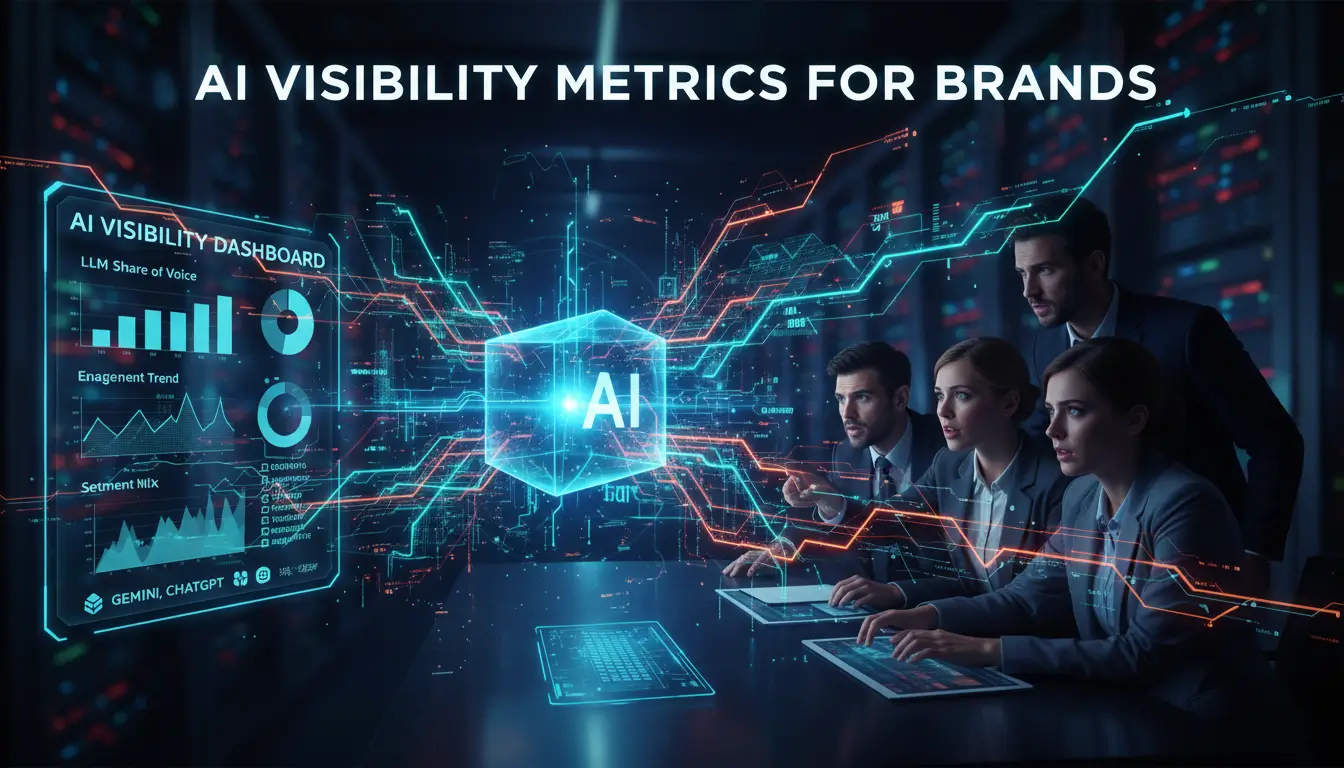
Enter the new frontier of digital measurement: AI Visibility Metrics and the concept of Share of Model (SoM). This article explores how to quantify your brand’s presence inside the black box of AI and strategies to optimize for the machine.
What is Share of Model (SoM)?
Share of Model (SoM) is the AI-era equivalent of Share of Voice (SoV) or Share of Search. It measures the frequency and sentiment with which a specific Large Language Model (LLM) mentions your brand relative to competitors within a specific vertical or query category.
In traditional SEO, you fight for rank #1. In Generative Engine Optimization (GEO), you fight for inclusion in the synthesized answer. SoM answers the critical question: When a user prompts an AI about my industry, how often am I part of the conversation?
The Three Pillars of AI Visibility
To truly understand your standing, you must look beyond simple mentions. A sophisticated AI visibility strategy tracks three distinct vectors:
- Mention Frequency: The raw percentage of times your brand appears in outputs for category-relevant prompts (e.g., "Top 10 accounting software").
- Sentiment & Context: Is the AI describing your brand as "expensive but powerful" or "user-friendly and affordable"? LLMs generate text based on probabilistic associations found in their training data. If the internet generally complains about your customer support, the AI will likely Hallucinate or retrieve that sentiment.
- Recommendation Rank: In listicle-style outputs generated by AI, where do you fall? Being the first recommendation carries significantly more weight than being the fifth.
Why Traditional SEO Metrics Fail Here
Marketing directors are currently struggling to justify budgets for "AI Optimization" because the metrics don’t fit into neat Excel columns. Traditional tools rely on crawlers indexing static HTML pages. LLMs, however, are dynamic.
A crawler can tell you that you have a backlink from Forbes. It cannot easily tell you that ChatGPT weighs that backlink heavily when constructing an answer about "industry leaders." Furthermore, LLMs suffer from probabilistic variance—the same prompt might yield slightly different answers on different days or with different temperature settings. This requires a shift from deterministic tracking (Rank #1) to probabilistic tracking (Win Rate %).
How to Measure Brand Visibility in LLMs
While enterprise-grade SaaS tools for this are still in their infancy, you can build a robust internal framework to track these metrics today. Here is a step-by-step process used by forward-thinking tech agencies.
1. The Prompt Matrix Audit
Create a spreadsheet containing 50-100 high-intent prompts relevant to your buyer personas. These should range from informational to transactional.
- Broad Discovery: "What are the best tools for project management?"
- Comparison: "Asana vs. Monday.com for small teams."
- Feature Specific: "Which HR software integrates best with Slack?"
Run these prompts through major LLMs (ChatGPT-4, Gemini, Perplexity, Claude 3) on a weekly or monthly basis. Log the results: Did you appear? Were you recommended? What was the sentiment?
2. Tracking ‘Share of Citation’ in Perplexity and Bing
Unlike pure LLMs (like standard GPT-4), Retrieval-Augmented Generation (RAG) engines like Perplexity and Bing Chat browse the live web to generate answers. This offers a bridge back to traditional SEO.
For these platforms, track Share of Citation. This is the frequency with which your domain is cited as a source in the footnotes of an AI answer. If Perplexity answers a user’s question and links to your blog post as the source of truth, you have won the "Zero-Click" battle.
3. Sentiment Analysis of Output
Use Natural Language Processing (NLP) tools or simple sentiment analysis scripts to score the AI’s descriptions of your brand. Are key selling points being communicated? If your brand’s unique value proposition is "speed," but the AI constantly describes you as "feature-rich," there is a disconnect in your entity signals.
Strategies to Improve Your Share of Model (GEO)
Once you are tracking visibility, how do you improve it? You cannot buy ads inside a standard LLM response (yet). You must optimize your Entity Authority.
Dominate the Knowledge Graph
LLMs rely heavily on relationships between entities (Concept A is related to Brand B). To improve visibility, you must ensure your brand is clearly defined in the Knowledge Graph.
- Schema Markup: Go beyond basic schema. Use Organization, Product, and SameAs markup to explicitly tell search engines (and by extension, the bots that feed LLMs) who you are and what you do.
- Wikidata and Crunchbase: Ensure your profiles on these structured databases are immaculate. LLMs frequently use these high-trust sources to fact-check entity relationships.
Co-Occurrence and Contextual Authority
LLMs learn by association. If "Brand X" frequently appears in text alongside "Best Cybersecurity Solutions," the model weights that connection stronger. This requires a PR and content strategy focused on Co-Occurrence.
Get your brand mentioned in "Best of" lists, industry whitepapers, and authoritative news sites alongside your target keywords. The goal is not just a do-follow link (for Google); the goal is the text association (for the LLM).
Optimize for RAG (Retrieval-Augmented Generation)
To win in Perplexity or Google’s AI Overviews, your content must be structured for easy extraction. This means:
- Using clear, direct answers immediately following H2 headers.
- Using statistical data and citing primary sources.
- Structuring content in logical lists and tables that an AI can easily parse and summarize.
The Future: From Search to Synthesis
We are witnessing the transition from the Information Age to the Synthesis Age. Users no longer want a list of ten blue links; they want a synthesized answer. Brands that fail to optimize for this shift risk becoming invisible to a growing segment of the market.
By shifting your focus from pure SERP rankings to Share of Model and AI Visibility Metrics, you future-proof your brand. You ensure that when the AI speaks, it speaks about you.
Frequently Asked Questions
What is the difference between SEO and GEO?
SEO (Search Engine Optimization) focuses on ranking web pages in search results to drive traffic. GEO (Generative Engine Optimization) focuses on optimizing content so that it is cited, summarized, and recommended by AI chatbots and answer engines.
Can I track AI mentions in Google Analytics?
Not directly. Current analytics tools track referral traffic. If an AI (like ChatGPT) answers a user without providing a link, there is no referral data. This is why manual auditing and emerging "Share of Model" tools are necessary.
Does having a Wikipedia page help with AI visibility?
Yes, significantly. Wikipedia is a primary training dataset for almost every major LLM. A well-maintained Wikipedia page helps establish your brand as a recognized entity and defines your attributes for the model.
How often do LLMs update their knowledge about brands?
It depends on the model. RAG-based systems (like Perplexity or Gemini) can update in real-time by reading the web. Static models (like older GPT versions) rely on training data cutoff dates. However, even static models are increasingly being augmented with browsing capabilities.
Conclusion
The era of measuring success solely by organic traffic is ending. As search behavior evolves, so must our metrics. Share of Model provides the lens through which we can understand our brand’s relevance in the age of AI. By auditing your presence, structuring your data for machines, and building strong entity authority, you can ensure your brand remains visible, relevant, and recommended in the new digital landscape.