
It has been five long years since Apple first introduced the AirTag in 2021, changing how we keep track of our keys, luggage, and backpacks. On January 26, 2026, Apple finally unveiled the new AirTag (2nd Generation), arriving shortly after the Lego Smart Brick release at CES 2026. While the design looks nearly identical to its predecessor, the internal specs tell a different story.
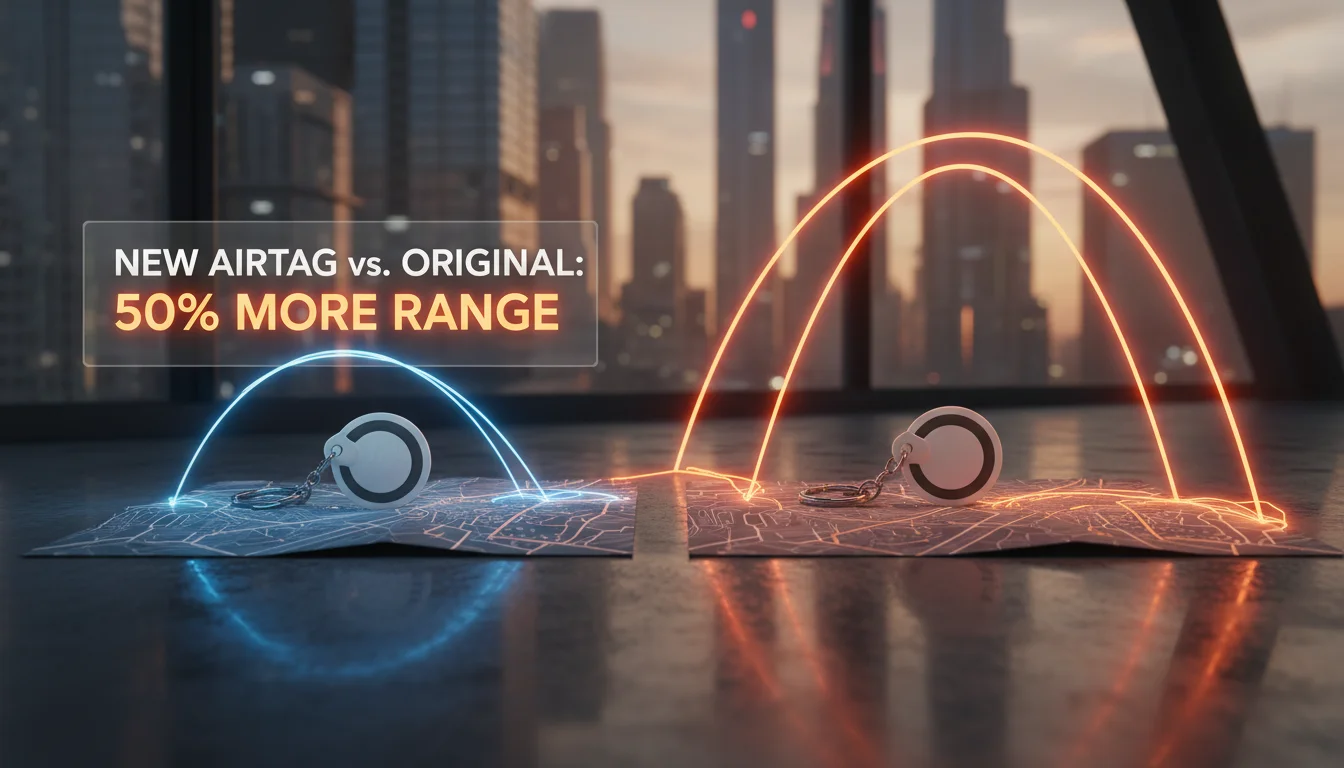
The headline feature? A 50% increase in Precision Finding range.
For users who have struggled to connect to their tracker from the next room or deep inside a parking garage, this range boost is the most critical upgrade. But does the new U2 chip actually deliver on this promise in the real world? In this detailed comparison of the New AirTag vs Original AirTag, we break down the technology, the range differences, and whether you need to replace your existing fleet of trackers.
The Core Upgrade: The U2 Chip Explained
To understand the range improvement, we have to look under the hood. The original AirTag was powered by the U1 Ultra Wideband chip. At the time, it was revolutionary, allowing for “Precision Finding”—that directional arrow that guides you to your lost item with centimeter-level accuracy.
The new AirTag utilizes Apple’s Second-Generation Ultra Wideband (U2) chip. This is the same silicon found in the iPhone 15 Pro and later, as well as the Apple Watch Ultra 2 and Series 9. For those setting up these newer devices, it is also a good time to review how to change password on iPhone to ensure your security settings are up to date.
Technical Breakdown: U1 vs. U2
- Original AirTag (U1): optimized for close-range directional tracking (typically 10-15 meters in open space).
- New AirTag (U2): optimized for extended range, capable of locking onto a signal from 1.5x farther away.
This isn’t just a minor tweak; it fundamentally changes the “handshake” distance between your iPhone and the AirTag. Where the original model required you to be fairly close to initiate Precision Finding, the new model allows you to pick up the trail from much further away, reducing the amount of aimless wandering required to get a signal.
Real-World Range Test: What 50% More Actually Looks Like
Apple’s marketing claims a 50% increase, but how does that translate to daily usage? We analyzed the performance differences in common scenarios.
Scenario 1: The “Big House” Test
With the original AirTag, leaving your keys in a bedroom upstairs often meant your iPhone in the kitchen couldn’t establish a Precision Finding connection. You would see the map location, but the “Find” arrow button would remain greyed out until you walked to the bottom of the stairs.
With the New AirTag: The improved Bluetooth 5.3+ architecture and U2 chip allow the signal to penetrate walls and floors more effectively. Users report locking onto the Precision Finding signal from across the house, eliminating the need to walk room-to-room searching for a connection.
Scenario 2: The Parking Lot Search
One of the most frustrating limitations of the Gen 1 AirTag was the “Searching for Signal…” screen when walking through a parking lot. You often had to be within 30-40 feet of your car to get a lock.
With the New AirTag: The 50% range boost extends this radius significantly. While it doesn’t turn the AirTag into a GPS tracker (it still relies on the Find My network for long distances), the local finding experience is much snappier. You can detect your car or bike from further down the aisle.
Beyond Range: The 50% Louder Speaker
Range is useless if you can’t find the item once you get close. A common complaint with the original AirTag was that the speaker was too quiet, especially if the tag was buried inside a leather bag or trapped under a sofa cushion.
Apple has addressed this directly. The new AirTag features a redesigned audio driver that is 50% louder. This hardware focus on reliability is a welcome change, similar to the importance of knowing how to reset AirPods to default when your audio devices need a fresh start.
This creates a “double threat” upgrade:
- The Range gets you to the general area faster.
- The Sound helps you pinpoint the item instantly, even if it’s muffled by fabric or buried in luggage.
New Feature: Precision Finding on Apple Watch
Because the new AirTag uses the U2 chip, it unlocks a feature previously unavailable to the original model: Precision Finding on the Apple Watch.
If you own an Apple Watch Series 9, Ultra 2, or newer, you can now get the directional arrows and haptic feedback directly on your wrist. The original AirTag (U1) cannot support this feature on the watch due to chip architecture differences. For users who prefer to leave their phone in their pocket, this ecosystem integration is a massive selling point.
Comparison Table: AirTag (Gen 1) vs. New AirTag (Gen 2)
| Feature | Original AirTag (2021) | New AirTag (2026) |
|---|---|---|
| Chip | U1 Ultra Wideband | U2 Ultra Wideband |
| Precision Range | Standard (~10-15m) | Extended (~20-25m) |
| Speaker Volume | Standard | 50% Louder |
| Bluetooth | Bluetooth 5.0 | Upgraded Bluetooth |
| Water Resistance | IP67 | IP67 |
| Battery | CR2032 (Replaceable) | CR2032 (Replaceable) |
| Price | $29 | $29 |
Is the Upgrade Worth It?
Since the price remains at $29, the new AirTag is the obvious choice for new buyers. But should you replace your old ones?
Upgrade if:
- You frequently lose keys in a large home: The extra range will save you time.
- You have hearing difficulties: The louder speaker is a significant accessibility upgrade.
- You own a newer Apple Watch: The wrist-based Precision Finding is incredibly convenient.
Stick with Gen 1 if:
- Your current AirTags work fine: The core functionality of the “Find My” network (relying on other people’s iPhones to spot your lost item) is identical between both models.
- You use them for close-range items: If you only track a wallet that is usually within 5 feet of you, the extended range offers diminishing returns.
FAQ: Common Questions About the New AirTag
Does the New AirTag have better battery life?
Apple states the battery life is still “more than a year,” similar to the original. It continues to use the standard, user-replaceable CR2032 coin cell battery.
Do old AirTag accessories fit the New AirTag?
Yes. The physical dimensions remain largely unchanged. Your existing keychains, loops, and mounts will fit the new model perfectly.
Can I use the New AirTag with an older iPhone?
You can use basic tracking features with older iPhones, but to utilize the extended Precision Finding range, you need an iPhone equipped with the U2 chip (iPhone 15 series and later).
Is the New AirTag waterproof?
It retains the IP67 rating, meaning it can withstand immersion in water up to one meter for 30 minutes. It is water-resistant, but not waterproof.
Conclusion
The New AirTag vs Original AirTag comparison ultimately comes down to refinement rather than reinvention. Apple didn’t change the shape or the battery, but they fixed the two biggest user complaints: range and volume.
The 50% increase in range provided by the U2 chip transforms the experience from “wandering around hoping for a signal” to “locking onto your item immediately.” For a $29 accessory, this tech refresh cements the AirTag’s position as the undisputed king of Bluetooth trackers in 2026.