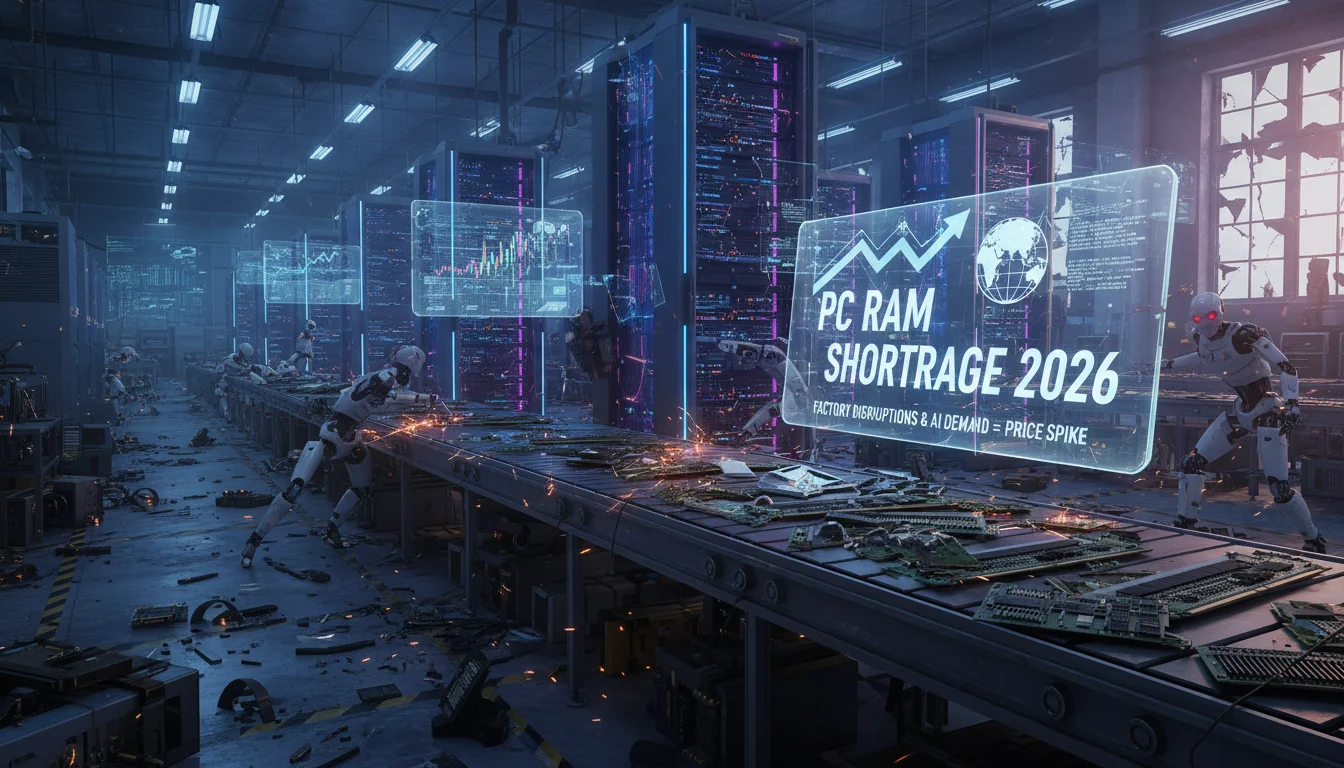

By early 2026, PC builders and tech enthusiasts were expecting a year of hardware stabilization. Instead, the market has been hit with a severe case of sticker shock. The cost of system memory—specifically high-performance DDR5 and the nascent DDR6 modules—has surged dramatically, with stock levels dwindling across major retailers. This isn’t just a minor fluctuation; it is a full-blown supply chain crunch.
If you have tried to price out a gaming rig or a workstation upgrade recently, you have likely noticed that RAM kits are trading at premiums not seen since the shortages of the early 2020s. But unlike previous crises driven by crypto mining or global lockdowns, the PC RAM shortage of 2026 is driven by a unique convergence of two massive factors: an insatiable hunger for Artificial Intelligence infrastructure and critical manufacturing disruptions in Asia.
In this deep dive, we will analyze the root causes of the 2026 memory crisis, utilizing a semantic analysis of the supply chain to understand why consumer PC memory is becoming a luxury item once again.
The Perfect Storm: Why is RAM So Expensive in 2026?
The current shortage is a classic case of supply elasticity failing to meet a bifurcated demand. While consumer demand for PCs has remained relatively stable, the composition of semiconductor manufacturing has shifted radically. The shortage is not because manufacturers cannot make chips; it is because they are prioritizing a different kind of chip.
To understand the 2026 shortage, we must look at the reallocation of silicon wafers. The three major players—Samsung, SK Hynix, and Micron—have pivoted their production lines aggressively. This pivot has created a vacuum in the standard DRAM market (the type used in your laptop and desktop), leading to the volatility we see today.
Cause #1: The AI Cannibalization Effect
The single biggest driver of the 2026 RAM shortage is the explosion of generative AI and Large Language Models (LLMs). AI accelerators, such as those from NVIDIA and AMD, do not use standard off-the-shelf RAM. They rely on High Bandwidth Memory (HBM), specifically the latest HBM3e and HBM4 iterations.
HBM vs. DDR: The Wafer War
Manufacturing HBM is significantly more complex and resource-intensive than producing standard DDR5 consumer memory. An HBM stack requires a larger die area and more intricate packaging technologies (like TSV – Through Silicon Via).
- Profit Margins: HBM commands significantly higher profit margins for manufacturers compared to consumer DDR5.
- Capacity Drain: To meet the demand for AI servers, manufacturers have converted production lines that previously churned out consumer DRAM into HBM lines.
- Yield Impact: HBM production has lower yield rates initially. This means more silicon wafers are consumed to produce usable chips, leaving fewer wafers available for the consumer market.
In essence, the data center industry is buying up the manufacturing capacity that used to serve the consumer PC market. This “AI Cannibalization” has effectively squeezed the supply of standard consumer memory modules, driving up spot prices on the global exchange.
Cause #2: Factory Disruptions in Asia
While the AI shift was a predictable long-term trend, the sudden spike in Q1 2026 prices was exacerbated by acute localized issues in the primary manufacturing hubs of Taiwan and South Korea.
The Vulnerability of the Supply Chain
The semiconductor supply chain remains heavily centralized. In late 2025 and early 2026, a series of disruptions hit key fabrication plants (fabs). Reports indicate that minor seismic activity in the region triggered automatic shutdown protocols in several high-precision fabs. While physical damage was minimal, the recalibration of lithography machines and the scrapping of wafers in process caused a supply gap of several weeks.
Furthermore, raw material constraints have re-emerged. The specialized chemicals required for the advanced nodes used in high-speed DDR5 (6000MT/s+) and early DDR6 production faced logistical bottlenecks due to regional geopolitical tensions affecting shipping lanes in the South China Sea. These disruptions delayed shipments to module integrators (brands like Corsair, G.Skill, and Kingston), creating immediate scarcity at the retail level.
The Transition Struggle: DDR5 Maturity vs. DDR6 Introduction
2026 is also a transitional year for memory standards, which historically leads to supply friction. The industry is currently trying to push the boundaries of DDR5 speeds while simultaneously tooling up for DDR6.
Yield Rate Challenges
As manufacturers push DDR5 to extreme speeds (8000MT/s and beyond) to keep up with new CPU architectures, yield rates drop. Making a stable, high-speed bin is difficult. Simultaneously, early pilot production of DDR6 is eating into R&D and production resources. This split focus means the “sweet spot” memory—affordable, mid-range DDR5—is being produced in lower quantities than the market actually needs.
Impact on Consumer PC Builds and Upgrades
What does this mean for the average consumer or IT manager in 2026? The impact is felt primarily in the “Mid-Range Squeeze.”
- Budget Builds: Entry-level builders are forced to settle for slower, higher-latency RAM or stick with older DDR4 platforms, which are becoming obsolete.
- High-End Gaming: Enthusiasts are paying 30-40% more for the same 32GB or 64GB kits compared to 2025 prices.
- Laptop Market: OEM laptop prices are creeping up as manufacturers pass the increased Bill of Materials (BOM) cost to consumers.
2026 Market Outlook: When Will Prices Stabilize?
Forecasting the memory market is notoriously difficult due to the “hog cycle” nature of DRAM production. However, industry analysts suggest that relief may not arrive until Q4 2026.
Samsung and Micron have announced plans to bring new fabrication capacity online specifically for HBM, which should theoretically free up existing lines to return to consumer DDR production. However, these facilities take time to ramp up. Until the AI server demand plateaus—or production capacity expands significantly—consumer RAM prices are likely to remain elevated.
Frequently Asked Questions (FAQ)
Why did RAM prices jump suddenly in 2026?
The jump is primarily caused by major manufacturers (Samsung, SK Hynix, Micron) shifting production focus to HBM (High Bandwidth Memory) for AI servers, reducing the supply of consumer DDR5 chips. This was compounded by minor factory disruptions in Asia affecting output.
Is 2026 a bad time to build a PC?
It is a challenging time due to memory and potentially GPU pricing. However, storage (SSD) and CPU prices remain relatively competitive. If you build now, consider buying a standard 16GB or 32GB kit and waiting to upgrade to high-capacity, high-speed kits later when prices normalize.
Will DDR4 prices also rise?
Yes, but to a lesser extent. As DDR5 becomes too expensive, some builders fall back to DDR4 platforms, slightly increasing demand for older tech. However, since DDR4 production is mature and fully amortized, price spikes are less volatile than the cutting-edge DDR5/DDR6 market.
When will the shortage end?
Most analysts predict a stabilization in late 2026 as new fabrication plants come online to handle the specific demand for AI memory, allowing older lines to revert to producing consumer RAM.
Conclusion
The PC RAM shortage of 2026 serves as a stark reminder of how interconnected the modern technology landscape is. The insatiable demand for Artificial Intelligence is not just changing software; it is fundamentally reshaping the hardware supply chain, often at the expense of the consumer PC market. Combined with the fragility of Asian manufacturing logistics, we are currently in a seller’s market.
For consumers, the best strategy in 2026 is patience and pragmatism. Beyond hardware, this is also a critical year for software transitions, so ensure you follow our how to move passwords to passkeys in 2026 guide to keep your new builds secure. The shortage will eventually ease, but for now, the AI revolution is exacting a toll on our wallets.