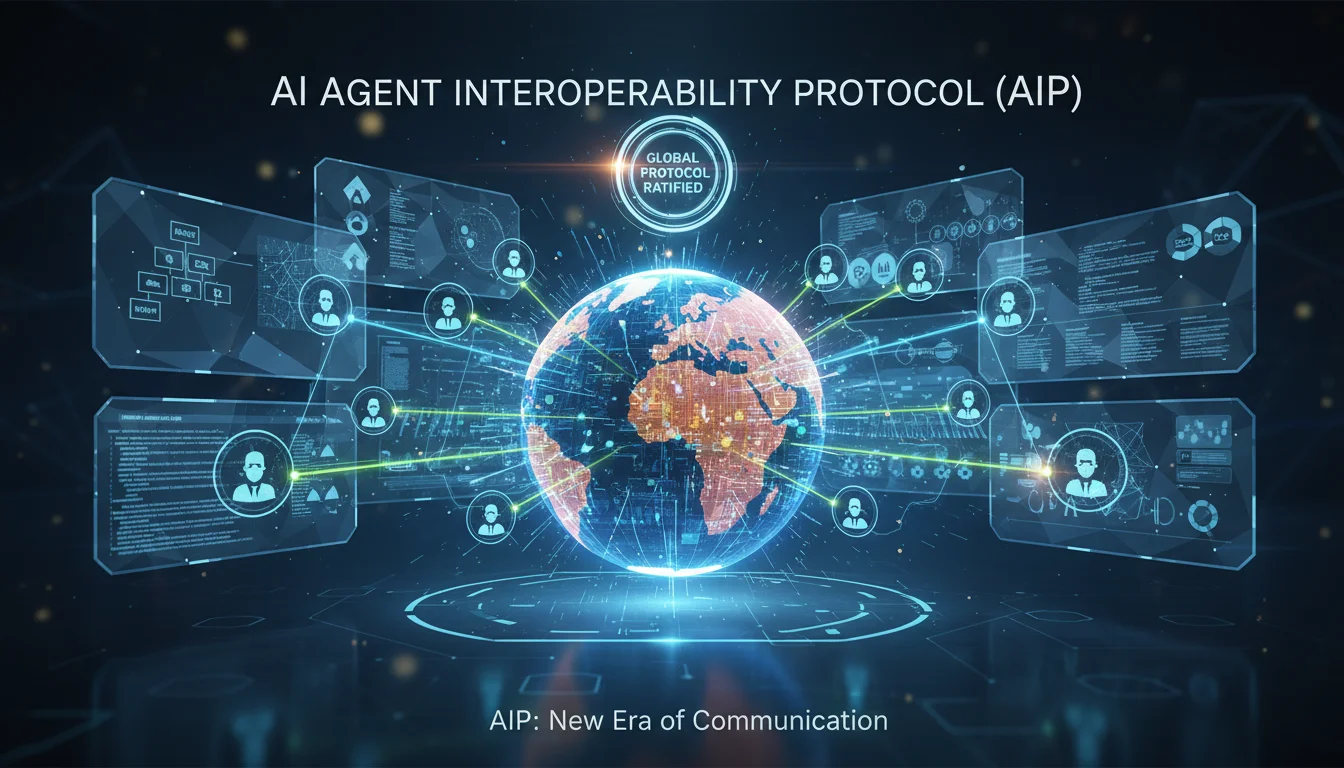

For the past decade, the artificial intelligence landscape has resembled the early days of computing: powerful, promising, but deeply fragmented. We have lived in an era of digital walled gardens, where your project management AI cannot speak to your calendar AI, and your smart home assistant is baffled by data stored in your CRM. That era ended this week.
With the historic ratification of the AI Agent Interoperability Protocol (AIIP) by a consortium of major tech firms, we have effectively established the TCP/IP of the agentic age. This new global standard is not just a technical update; it is a fundamental restructuring of how artificial intelligence operates on the web. It promises a future where autonomous agents can collaborate, negotiate, and execute complex workflows across different platforms without human intervention.
In this comprehensive analysis, we will deconstruct the AIIP, exploring its technical architecture, its semantic implications for the web, and why this protocol represents the biggest shift in software architecture since the advent of the RESTful API.
What is the AI Agent Interoperability Protocol (AIIP)?
The AI Agent Interoperability Protocol (AIIP) is a standardized communication framework designed to allow distinct AI agents—regardless of their underlying Large Language Model (LLM) or parent company—to exchange information, request services, and verify outcomes trustlessly.
Before AIIP, integrating two AI services required custom API connectors, rigid webhooks, and manual maintenance. If one model changed its output schema, the connection broke. AIIP solves this by introducing a universal semantic layer. Instead of rigid code-based instructions, AIIP allows agents to communicate using standardized intent definitions and context-aware negotiation.
The End of Walled Gardens
The ratification of AIIP signals a move away from vertical integration toward a horizontal, collaborative Agentic Web. Previously, tech giants incentivized locking users into a single ecosystem. However, the complexity of modern workflows made this untenable. No single company can build the best AI for coding, writing, logistics, and legal analysis simultaneously. AIIP acknowledges that the future is multi-agent, necessitating a clear Agentforce vs Microsoft Agent 365 implementation roadmap for many organizations.
The Core Architecture of AIIP
To understand the significance of this protocol, we must look under the hood. AIIP is built upon three foundational pillars that ensure security, scalability, and semantic clarity.
1. The Semantic Handshake (SHS)
At the beginning of any interaction, two agents engage in a Semantic Handshake. Unlike a standard server handshake that checks for connection status, the SHS verifies capability and context.
- Identity Verification: Using decentralized identifiers (DIDs), agents cryptographically prove their identity and ownership.
- Ontology Alignment: The agents exchange “knowledge maps” to ensure they define terms similarly. For instance, ensuring that when Agent A says “urgent,” Agent B understands the specific time parameters associated with that priority level.
2. Intent-to-Action Translation Layer
This is the engine of AIIP. It utilizes a shared library of Standardized Intent Tokens (SITs). If a travel agent AI needs to book a flight via a finance agent AI, it doesn’t just send a text string. It sends a structured SIT containing the objective, constraints (budget, time), and fallback parameters. This ensures that even if the receiving agent operates on a different logic model, the intent is preserved perfectly.
3. The Trust and Permission Protocol (TPP)
Security is the primary concern in an autonomous web. AIIP incorporates a granular permission system. Agents do not have blanket access to each other. Instead, they operate on Just-In-Time (JIT) Permissions. Access to data is granted only for the duration of the specific task and is revoked immediately upon completion. This stateless security model minimizes the attack surface for malicious actors.
Why AIIP Matters: The SEO and Business Impact
From a semantic SEO perspective, the introduction of AIIP creates a new entity layer on the internet. We are moving from optimizing content for search engines to optimizing services for agents (Agent Engine Optimization, or AEO), as part of comprehensive search everywhere optimization strategies.
The Rise of Agent-Readable Endpoints
Businesses will soon need to expose “AIIP-compliant endpoints.” If your e-commerce store or SaaS platform cannot be navigated by an AI agent using the standard protocol, you will effectively be invisible to the new economy. Just as mobile-responsiveness became a ranking factor, AIIP-compliance will likely become a trust signal for search visibility and one of the new AI visibility metrics brands must monitor.
Reducing Operational Friction
For enterprises, AIIP reduces the “integration tax.” Companies spend billions annually maintaining brittle connections between software suites. With AIIP, an Enterprise Resource Planning (ERP) agent can dynamically connect with a Logistics agent from a third-party vendor without a single line of custom code, provided both adhere to the protocol.
Real-World Use Cases: AIIP in Action
The ratification of these standards unlocks workflows that were previously theoretical.
Personalized Cross-Platform Assistants
Imagine asking your mobile assistant to “Plan a dinner party.” Under AIIP, your assistant acts as a general contractor. It dispatches a sub-agent to your calendar app to find a date, another sub-agent to a recipe app to curate a menu based on guest dietary restrictions (fetched from their public agent profiles), and a third agent to a grocery delivery service to order the ingredients. All these platforms communicate via AIIP, handling payments and scheduling autonomously.
Autonomous Supply Chain Correction
In a manufacturing setting, a localized weather agent predicts a storm that will delay a shipment. It broadcasts an AIIP alert. The factory’s inventory agent receives this, processes the implication, and immediately negotiates with a backup supplier’s sales agent to secure necessary parts, preventing a production halt.
Challenges and Implementation Hurdles
While the standard is ratified, adoption will take time. Several challenges remain:
- Latency: The Semantic Handshake and verification steps add milliseconds to interactions. For high-frequency trading or real-time gaming, AIIP may initially be too slow.
- Hallucination Risks: If an agent hallucinates an intent, the receiving agent must have robust error-checking mechanisms to reject illogical requests. The AIIP standard includes validation loops, but they are not foolproof.
- Privacy Compliance: With agents exchanging user data, adherence to GDPR and CCPA is complex. AIIP includes metadata tags for data residency, ensuring data doesn’t leave legal jurisdictions, but enforcement relies on the integrity of the agent developers.
Future Outlook: The Global AI Mesh
The ratification of the AI Agent Interoperability Protocol is not just a technical milestone; it is the starting gun for the Global AI Mesh. We are transitioning from a web of documents to a web of acts. In this new paradigm, the value of software lies not in how well it keeps users inside, but how well it communicates outside.
For developers, the mandate is clear: start building AIIP-compliant interfaces today. For businesses, the strategy must shift toward interoperability. The walls are coming down, and the agents are ready to talk.
Frequently Asked Questions (FAQ)
What is the difference between an API and AIIP?
An API (Application Programming Interface) is a rigid set of rules for how software components interact, typically requiring custom coding for each integration. AIIP (AI Agent Interoperability Protocol) is a universal language that allows AI agents to negotiate and understand each other dynamically without pre-written custom integrations.
Will AIIP replace current LLMs like GPT-4 or Gemini?
No, AIIP is not a model; it is a communication protocol. Think of GPT-4 as a person and AIIP as the language (English, Spanish, etc.) they use to speak to others. AIIP allows GPT-4 to collaborate with Claude or Llama seamlessly.
Is AIIP secure?
Security is a core component of the ratified standard. AIIP uses decentralized identifiers (DIDs) and Just-In-Time (JIT) permissions to ensure that agents only access the data they are explicitly authorized to use for a specific task.
How can businesses prepare for AIIP?
Businesses should begin auditing their data structures and APIs to ensure they can be exposed to AI agents. Adopting schema markups and structuring data for machine readability is the first step toward AIIP readiness.
Conclusion
The ratification of the AI Agent Interoperability Protocol marks the maturity of the Artificial Intelligence industry. By establishing a common tongue for our digital assistants, we are unlocking exponential utility. The siloed internet is fading, replaced by a collaborative ecosystem where software works together to serve human intent. As we move forward, the question is no longer which AI model is the smartest, but which ecosystem is the most connected.