
For the past few years, the pinnacle of meeting productivity was an automated summary. We celebrated tools that could listen to a Zoom call, transcribe the audio, and spit out a bulleted list of key takeaways. But as we settle into 2026, the tech landscape has shifted dramatically. Passive transcription is now a commodity; the new frontier is action.
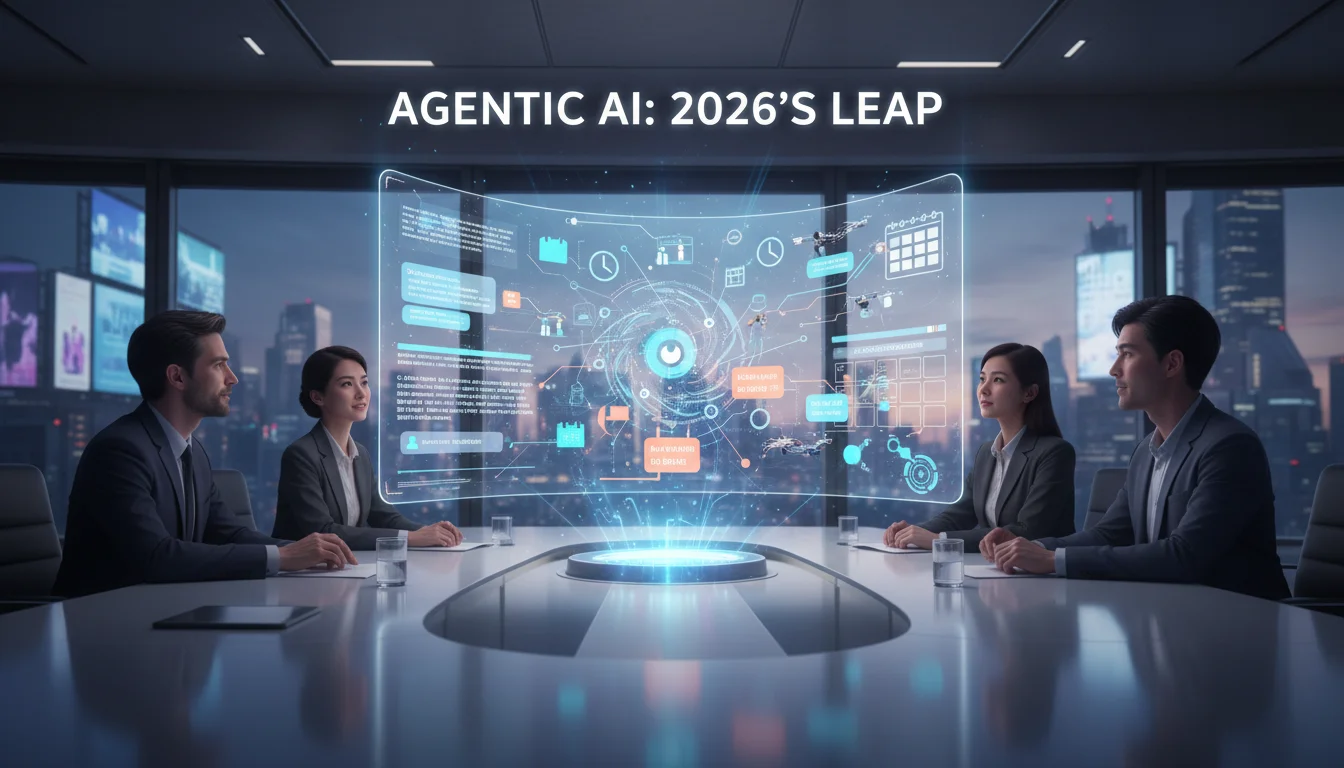
Enter Agentic AI meeting assistants. These are not passive observers that merely record history; they are active participants capable of shaping the future. They don’t just write down that you promised to send a contract—they draft the email, attach the document, and queue it for your approval before the meeting even ends.
In this comprehensive guide, we will dismantle the mechanics of this shift, explore why “Large Action Models” (LAMs) are replacing standard LLMs in the enterprise, and how you can leverage agentic workflows to reclaim hours of lost productivity every week.
What Are Agentic AI Meeting Assistants?
To understand Agentic AI, we must first distinguish it from the Generative AI of 2024. While GenAI focused on creating content (text, images, summaries), Agentic AI focuses on executing goals. An Agentic AI meeting assistant is a software entity integrated into your communication platforms (Teams, Slack, Zoom) that possesses the autonomy to perform multi-step tasks based on verbal triggers and contextual understanding.
According to the Koray Semantic Framework, we define this entity by its capabilities:
- Perception: Understanding voice, text, and screen context in real-time.
- Reasoning: Determining which tools are required to fulfill a request.
- Action: Using APIs to manipulate external software (CRMs, Project Boards, Calendars).
From Passive Listeners to Active Doers
The fundamental difference lies in the loop. Traditional AI tools operated on an open loop: Input (Audio) → Output (Text). The human had to take that text and act on it. Agentic AI closes the loop: Input (Audio) → Reasoning → Action → Output (Task Completion).
For example, if a project manager says, “Let’s move the deadline to next Friday and assign the UI review to Sarah,” a standard transcriber notes it down. An agentic assistant actively accesses Jira, updates the due date, and sends a Slack notification to Sarah.
The Technical Breakthrough: Large Action Models (LAMs)
Why is this happening now, in 2026? The shift is driven by the maturation of Large Action Models (LAMs) and improved function calling capabilities in foundational models. Unlike standard LLMs designed for conversation, LAMs are fine-tuned to understand software interfaces and API structures, often adhering to the latest ai agent interoperability protocol (AIIP) standard. They bridge the gap between natural language intention and machine-executable code.
This evolution enables meeting assistants to:
- Parse Ambiguity: Distinguish between a hypothetical idea (“We should maybe email them”) and a direct command (“Email them now”).
- Authenticate Securely: Manage OAuth tokens to interact with third-party apps like Salesforce or HubSpot securely.
- Error Correction: If an API call fails (e.g., a calendar slot is double-booked), the agent can self-correct and suggest an alternative immediately.
Core Capabilities of 2026 Agentic Assistants
If you are evaluating the market for an AI meeting participant, look for these specific agentic behaviors that separate high-utility tools from glorified tape recorders.
1. Real-Time Bi-Directional CRM Sync
Sales teams are the primary beneficiaries of this trend. An agentic assistant doesn’t just dump a call summary into the “Notes” field of a CRM. It parses fields. It identifies the budget, the decision-maker, and the timeline, and populates specific fields in Salesforce or HubSpot. If a client mentions a new competitor, the agent updates the competitive intelligence field automatically.
2. Autonomous Project Management
Modern agents integrate deeply with Asana, Trello, Linear, and Monday.com. When a blocker is identified in a daily standup, the agent can create a ticket, tag the relevant engineer, and link the transcript snippet for context—all without a human touching a keyboard.
3. Smart Scheduling and Calendar Negotiation
“Let’s circle back next Tuesday.” In the past, this triggered a painful email thread. Agentic assistants now check the calendars of all participants (internal and external via public booking links), find the optimal slot, and send the invite before the current call concludes.
The Strategic Value: ROI of Agentic Workflows
Adopting agentic AI is not just about convenience; it is a play for organizational velocity. By reducing the latency between decision and action, companies can accelerate execution cycles.
Consider the “Post-Meeting Slump.” Usually, after a one-hour meeting, there is a 15-minute period of organizing notes and assigning tasks. Across an organization of 1,000 employees, this equates to hundreds of hours of administrative debt daily. Agentic AI eliminates this debt instantly.
Challenges: Security and The “Human-in-the-Loop”
With great power comes great responsibility. Giving an AI write access to your database or email is risky. The industry standard for 2026 is the “Human-in-the-Loop” (HITL) approval mode, which is frequently managed using AI observability tools in production to ensure system reliability.
In this mode, the agent prepares the action—drafts the email, stages the Jira ticket, cues the calendar invite—but requires a single click confirmation from the meeting host. This ensures that hallucinations (which, while reduced, still exist) do not result in erroneous data corruption or embarrassing client communications.
Frequently Asked Questions (FAQ)
How is Agentic AI different from tools like Otter.ai or Fireflies?
While legacy versions of Otter and Fireflies focused on transcription, their 2026 iterations are becoming agentic. However, true agentic AI is defined by “tool use”—the ability to manipulate external software via APIs, rather than just generating text summaries.
Is my data safe if the AI can access my other apps?
Enterprise-grade agentic assistants use “scoped permissions.” They only access the specific data needed for the task (e.g., calendar read/write) and do not train their public models on your proprietary data. For many European organizations, these tools are often hosted within a sovereign cloud vs public cloud framework to maintain strict data residency compliance. Always look for SOC 2 Type II compliance.
Can agentic assistants understand technical jargon?
Yes. Most modern agents allow you to upload a “knowledge base” or glossary. Furthermore, RAG (Retrieval-Augmented Generation) allows the agent to pull context from your internal wikis to understand project-specific acronyms.
Will this replace executive assistants?
Not entirely. It replaces the administrative drudgery (scheduling, note-taking, data entry). This frees up human executive assistants to focus on high-level strategy, relationship management, and complex problem-solving that requires emotional intelligence.
Conclusion: The Era of the Autopilot Meeting
The transition from passive transcription to active participation marks a pivotal moment in the history of work. Agentic AI meeting assistants are not just tools; they are teammates. They ensure that nothing slips through the cracks, that decisions turn into actions immediately, and that human creativity is spent on solving problems rather than managing the administrative wake of meetings.
As we move deeper into 2026, the question is no longer “Did you take notes?” but rather “Did your agent execute the next steps?” Embracing this technology is the key to staying competitive in a high-velocity business environment.