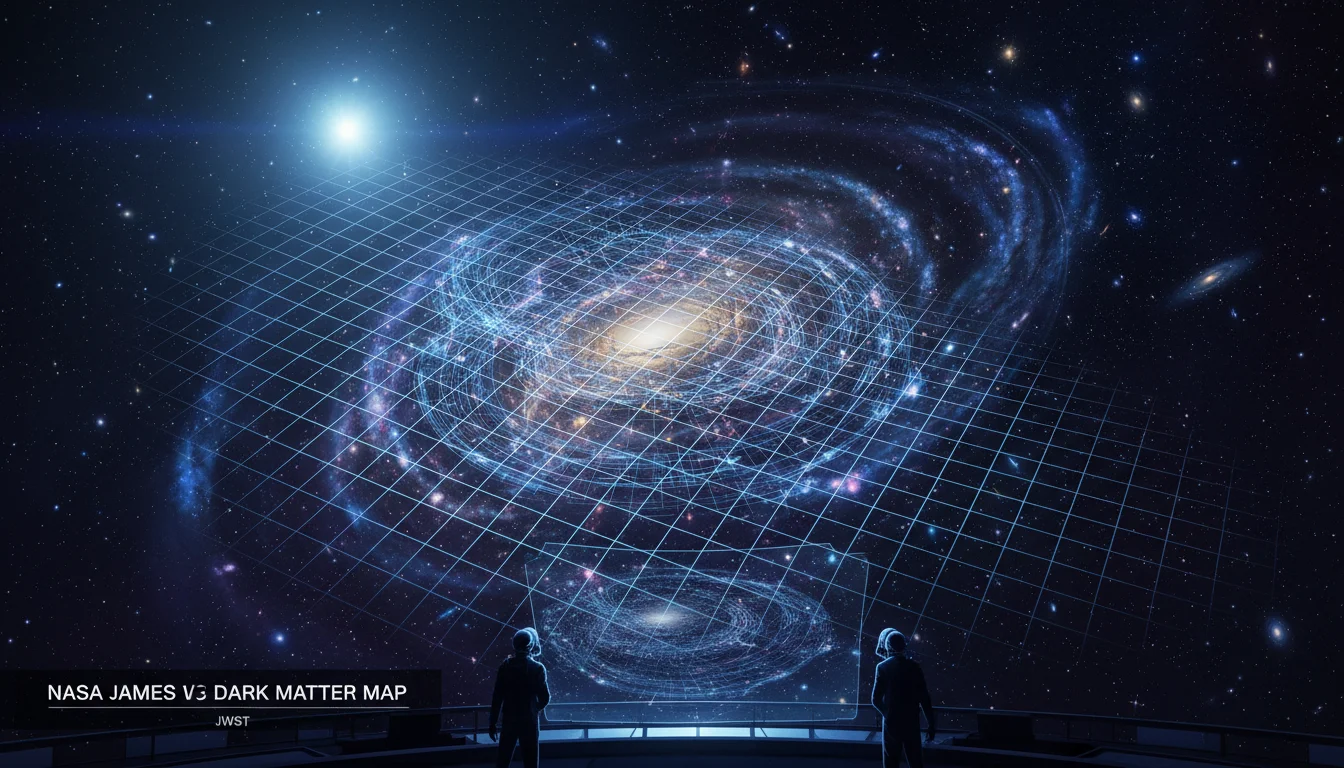

For decades, astronomers have stared into the void, knowing that the visible universe—every star, planet, and glowing nebula—is merely the tip of a cosmic iceberg. The vast majority of matter out there is invisible, a ghostly substance known as dark matter that exerts a powerful gravitational pull but refuses to interact with light. Now, the James Webb Space Telescope (JWST) has fundamentally changed how we view this hidden realm.
In a groundbreaking release published in Nature Astronomy in January 2026, an international team of astronomers unveiled the most detailed map of dark matter ever created. By utilizing the extreme sensitivity of JWST’s Near-Infrared Camera (NIRCam), researchers have produced a map twice as sharp as previous attempts by the Hubble Space Telescope, revealing the intricate “invisible scaffolding” that dictates the structure of our universe.
This massive leap forward comes from the COSMOS-Web survey, a treasury program that has turned JWST’s golden eye toward a specific patch of sky to trace the distortions of light caused by unseen mass. For tech enthusiasts and space watchers alike, this isn’t just a pretty picture; it represents a leap in observational power comparable to new AI visibility metrics, providing the strongest confirmation yet of our standard model of cosmology, validating theories about how the universe grew from a smooth soup of particles into the complex web of galaxies we see today.
The New Dark Matter Map: A Sharpness Revolution
The newly released map covers a contiguous area of the sky known as the COSMOS field, located in the constellation Sextans. While this region spans only about 0.54 square degrees—roughly 2.5 times the size of the full moon—it is packed with deep cosmic history. The map was constructed using weak gravitational lensing data from approximately 250,000 to 800,000 background galaxies, capturing light that has traveled for billions of years.
Lead author Diana Scognamiglio of NASA’s Jet Propulsion Laboratory (JPL) described the breakthrough: “Previously, we were looking at a blurry picture of dark matter. Now we’re seeing the invisible scaffolding of the universe in stunning detail, thanks to Webb’s incredible resolution.”
The difference in clarity is stark. Where previous maps showed blobby, indistinct regions of mass, the JWST map resolves tight clumps and thin filaments. It reveals how dark matter forms a vast network—the cosmic web—with dense knots acting as anchors for galaxy clusters and long, tendril-like filaments stretching between them.
How JWST “Sees” the Invisible: Weak Gravitational Lensing
If dark matter is invisible, how did JWST map it? The answer lies in a phenomenon predicted by Albert Einstein called gravitational lensing. Massive objects warp the fabric of space-time around them. When light from a distant background galaxy passes near a massive foreground object (like a clump of dark matter), its path is bent, acting like a lens.
Strong vs. Weak Lensing
- Strong Lensing: Occurs when the alignment is perfect, creating giant arcs or Einstein rings. This is visually spectacular but rare.
- Weak Lensing: The technique used for this map. It involves measuring minute, statistical distortions in the shapes of thousands of background galaxies. Their light is slightly sheared or stretched by the gravity of the dark matter sitting between them and the telescope.
Because JWST is sensitive to infrared light, it can peer through cosmic dust and detect extremely faint, distant galaxies that ground-based telescopes or even Hubble cannot see. This allows astronomers to gather a much higher density of background sources—essentially providing more “pixels” for their dark matter image. The result is a high-resolution contour map of invisible mass.
The COSMOS-Web Survey: A Deep Dive into Sextans
The data driving this discovery comes from COSMOS-Web, the largest observational program in JWST’s first cycle of operations. Over the course of 255 observational hours, the telescope mosaicked a wide field of the sky, collecting data that will fuel astrophysical research for decades. This volume of data highlights the growing need for high-performance processing, similar to the hardware found in the best budget AI workstations, to handle such complex image reconstructions.
The COSMOS field was chosen because it is relatively empty of bright foreground stars from our own Milky Way, offering a clear window into the deep universe. By combining JWST’s Near-Infrared Camera (NIRCam) data with its Mid-Infrared Instrument (MIRI), researchers could measure distances (redshifts) with unprecedented precision, ensuring that the lensing distortions were mapped to the correct 3D structures.
Validating the Lambda-CDM Model
The map strongly supports the standard model of cosmology, known as Lambda-CDM (Cold Dark Matter). This model predicts that dark matter collapsed first after the Big Bang, creating gravitational wells that pulled in normal matter (gas and dust) to form stars and galaxies. The JWST map shows exactly this: galaxies are not randomly scattered but are strung along the dark matter filaments like pearls on a necklace.
Comparison: James Webb vs. Hubble Space Telescope
While the Hubble Space Telescope was the pioneer of dark matter mapping (famously creating the first map of the COSMOS field in 2007), JWST has taken the technology to the next level. The comparison highlights the technological leap occurred over the last two decades:
- Resolution: The JWST map is approximately twice as sharp as the 2007 Hubble map.
- Galaxy Count: JWST detected nearly three times as many galaxies in the same field due to its larger mirror and infrared sensitivity.
- Depth: JWST can see older, redder galaxies that were invisible to Hubble, allowing the map to trace dark matter structures further back in time.
Why This Map Matters for the Future of Tech and Science
This map is more than just a scientific curiosity; it is a technological triumph that sets the stage for future missions. It serves as a “ground truth” for upcoming wide-field surveys like the European Space Agency’s Euclid mission and NASA’s Nancy Grace Roman Space Telescope. These efforts in large-scale cosmic modeling parallel terrestrial advancements like Nvidia’s Earth-2, which uses open-source nowcasting to simulate complex systems here on our own planet.
Furthermore, understanding the precise distribution of dark matter helps physicists constrain its properties. Is it “cold” (slow-moving) or “warm”? Does it interact with itself? The sharpness of the clumps in the JWST map provides tight constraints on these theoretical questions, potentially guiding particle physicists toward the correct candidate for the dark matter particle.
Frequently Asked Questions (FAQ)
Can the James Webb Telescope see dark matter directly?
No, dark matter does not emit, absorb, or reflect light. JWST detects it indirectly by observing how its gravity distorts the light from galaxies located behind it, a process called gravitational lensing.
What is the Cosmic Web?
The cosmic web is the large-scale structure of the universe, consisting of vast filaments of dark matter and gas that connect galaxy clusters. Between these filaments are massive voids containing very few galaxies.
Why is the COSMOS-Web survey important?
COSMOS-Web is one of the largest and most ambitious programs for the Webb telescope. It surveys a large enough area to minimize “cosmic variance” (random statistical fluctuations), providing a representative sample of how the universe evolved over the last 13 billion years.
Did JWST find any “dark galaxies”?
While the primary goal was mapping mass, the survey also identified thousands of faint galaxies previously unseen. Some research suggests the possibility of “dark galaxies”—clumps of dark matter with very few stars—though confirming them requires further spectroscopic analysis.
Conclusion
The release of the new dark matter map by the James Webb Space Telescope marks a pivotal moment in astronomy. We have moved from inferring the existence of the universe’s invisible skeleton to mapping its bones with surgical precision. As the COSMOS-Web survey continues to yield data, we can expect even more revelations about the hidden physics that govern our reality.
For the first time, humanity is not just looking at the stars; we are seeing the invisible forces that hold them in place. The era of precision cosmology is here, and the view is spectacular.